Have you ever wondered whether to write CatchUp, catch up, or catch-up? These forms look almost identical, but the spacing and hyphen can change how the expression functions in a sentence.
Understanding CatchUp vs Catch Up helps you write more clearly in emails, school assignments, social media posts, and professional documents.
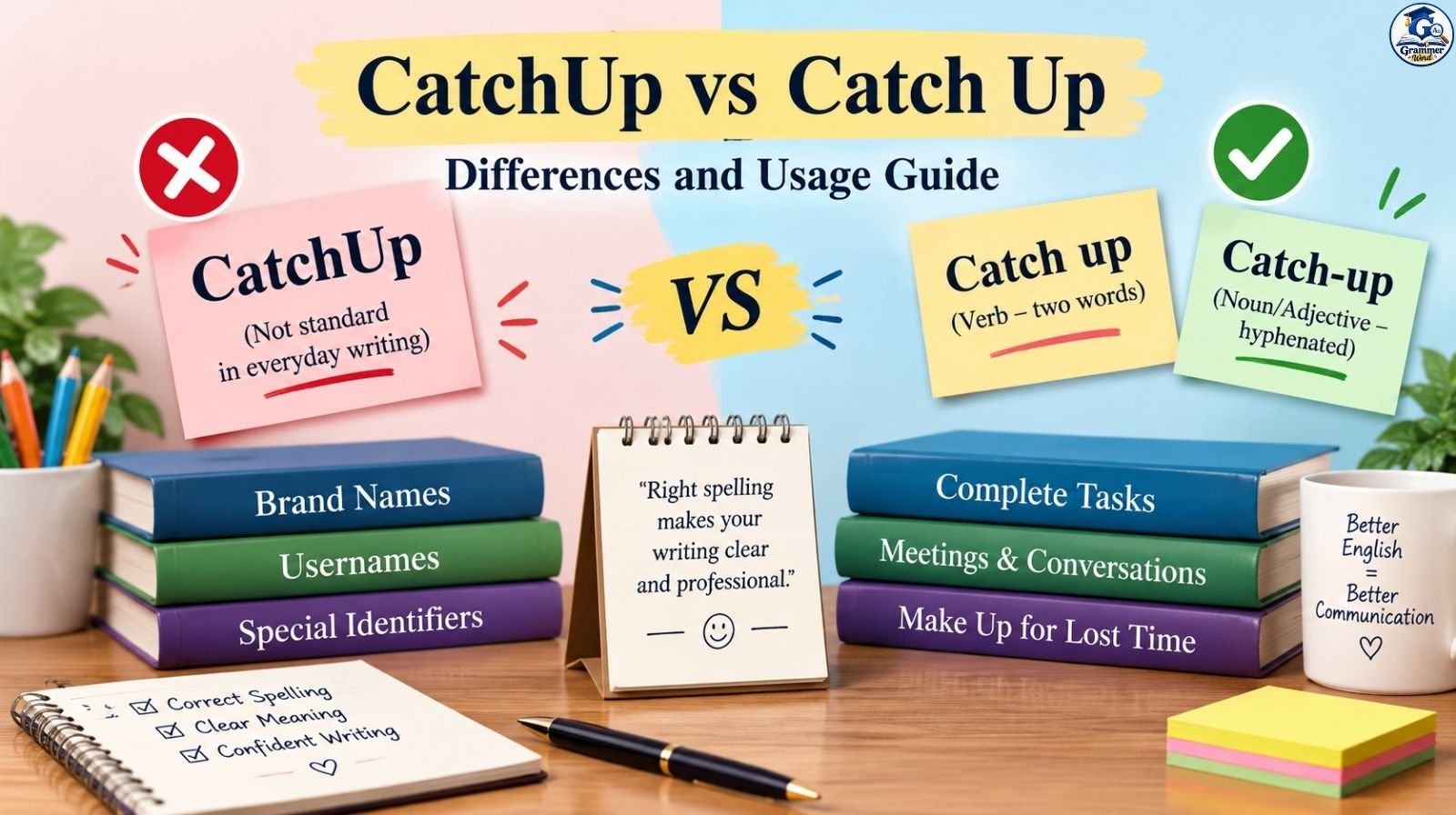
The good news is that the rule is simple: “catch up” is the standard form of the verb, “catch-up” is commonly used as a noun or adjective, and “CatchUp” is generally not standard in ordinary English writing.
In this guide, you’ll learn the meaning of each form, discover real-world examples, compare their grammatical uses, and find out how to avoid common spelling mistakes.
Read More: Loose or Lose? The Common Mistake Explained Clearly
What Is the Difference Between CatchUp and Catch Up?
The main difference is grammatical function. In standard English, catch up is a phrasal verb, while catch-up is a hyphenated form commonly used as a noun or adjective. CatchUp, written as one word with an internal capital letter, is generally reserved for product names, usernames, or other special naming conventions.
Catch Up: The Standard Phrasal Verb
The expression catch up means to reach someone who is ahead, make progress after falling behind, complete delayed work, or exchange news with someone.
Examples:
- I need to catch up on my homework.
- Let’s catch up over coffee this weekend.
- She ran faster to catch up with her friends.
- He spent Sunday catching up on emails.
In these sentences, catch up describes an action, so it is written as two words.
Catch-Up: The Hyphenated Form
Catch-up is commonly used as a noun referring to a meeting or conversation to exchange news, or to the process of making up for lost time. It can also function as an adjective.
Examples:
- We had a quick catch-up after lunch.
- The students attended a catch-up class.
- I scheduled a catch-up meeting with my manager.
The hyphen helps show that the words work together as one grammatical unit.
CatchUp: Is It Correct?
In ordinary prose, CatchUp is not the standard spelling of the expression. It may appear in brand names, software features, usernames, or programming identifiers where capitalization and spacing follow a specific naming convention.
For example:
- Standard English: I need to catch up on my reading.
- Standard English: We arranged a catch-up meeting.
- Special name or identifier: CatchUp may be used as a product or feature name.
For everyday writing, choose catch up or catch-up according to the sentence.
Read More: Tomatoes or Tomatos: Which Spelling Is Correct?
When Should You Use Catch Up?
Use catch up when you want to describe an action. This is the most common form in everyday English, particularly when talking about unfinished tasks, conversations, progress, or reaching someone who is ahead.
1. Catch Up on Unfinished Work
When you have missed tasks or fallen behind, you can use catch up on to explain what you need to complete.
Examples:
- I need to catch up on my assignments before Friday.
- She stayed late to catch up on her emails.
- We spent the weekend catching up on household chores.
These examples show that the expression refers to completing something that was delayed.
2. Catch Up With Friends and Family
People also use catch up when they want to share news or learn what has happened in someone’s life.
Examples:
- I called my cousin to catch up with her.
- Let’s catch up this evening.
- It was great catching up with my old classmates.
This meaning is especially common in casual conversations, text messages, and invitations.
3. Catch Up With Someone Who Is Ahead
The expression can also describe reaching someone physically or becoming as advanced as another person.
Examples:
- Walk a little faster so you can catch up with us.
- The student worked hard to catch up with the rest of the class.
- The company is trying to catch up with its competitors.
The meaning depends on the context, but the spelling remains two separate words when used as a verb.
When Should You Use Catch-Up?
Use catch-up when the expression acts as a noun or adjective. Recognizing its grammatical role makes the spelling easier to remember.
1. Catch-Up as a Noun
A catch-up can be an informal meeting or conversation in which people exchange updates.
Examples:
- We had a friendly catch-up over lunch.
- Our weekly catch-up helps everyone share progress.
- I arranged a catch-up with my former teacher.
In each example, catch-up names an event or activity rather than describing the action of catching up.
2. Catch-Up as an Adjective
The hyphenated form can also describe something intended to help a person make up for missed work or progress.
Examples:
- The school organized catch-up lessons.
- Our team scheduled a catch-up session.
- Students received catch-up materials after the break.
Here, catch-up describes the type or purpose of the lessons, session, or materials.
Read More: Capital or Capitol: Which One Is Correct And When To Use It?
3. Catch Up vs Catch-Up: A Quick Comparison
| Feature | Catch up | Catch-up |
|---|---|---|
| Standard spelling | Two words | Hyphenated |
| Main grammatical role | Phrasal verb | Noun or adjective |
| Meaning | Complete delayed work, reach someone, or exchange news | A meeting, process, or something intended to make up for a delay |
| Example | I need to catch up on work. | We had a catch-up meeting. |
| Best use | Describing an action | Naming or describing an activity or thing |
Quick rule: If you’re describing an action, write catch up. If you’re naming a meeting or describing a session intended to make up for lost time, catch-up is often the correct choice.
Common Catch Up vs Catch-Up Mistakes
Even fluent English speakers sometimes confuse these forms because they sound the same when spoken. The best way to avoid mistakes is to check how the expression functions in the sentence.
1. Writing CatchUp as One Word
Incorrect in ordinary prose: I need to catchUp on my studies.
Correct: I need to catch up on my studies.
Unless you’re using a specific brand name or identifier, keep the verb as two words.
2. Using Catch-Up Instead of Catch Up
Incorrect: I need to catch-up on my reading.
Correct: I need to catch up on my reading.
The phrase describes an action, so the standard spelling is two words.
3. Forgetting the Hyphen in a Noun
Less standard in edited prose: We scheduled a catch up with the manager.
Preferred: We scheduled a catch-up with the manager.
The hyphenated form is widely used when the expression functions as a noun. However, house styles and informal writing practices may vary.
4. Confusing Catch Up With Catch-Up Meeting
Compare these sentences:
- Let’s catch up tomorrow.
- Let’s schedule a catch-up meeting tomorrow.
The first sentence describes an action. The second names a meeting. Understanding that difference will help you choose the right form naturally.
Read More: Women vs Woman: Which One Is Correct And When To Use It?
A Real-Life Example: Using Catch Up at Work
Imagine that Emma works as a marketing assistant at a small company. She takes three days off and returns to find dozens of unread emails, two unfinished reports, and a team meeting scheduled for the afternoon.
When she messages her manager, she writes, “I need to catch up on my emails and finish the reports before our meeting.” This is correct because catch up describes the action of completing delayed tasks.
Later, her manager invites her to a short conversation to discuss the team’s progress. Emma adds the event to her calendar as “Weekly Catch-Up.” In this case, catch-up is used as a noun because it names a meeting.
During the meeting, Emma says, “I’d also like to catch up with everyone on the new campaign.” Again, the two-word form is correct because she is describing an action: exchanging information with her colleagues.
This example illustrates why the distinction matters. The same expression can appear in several forms during a normal working day, but its grammatical function determines the spelling.
Emma doesn’t need to memorize separate meanings for every situation. She simply needs to recognize whether she’s describing an action or naming an event.
For professional emails, reports, calendar entries, and messages, this small spelling distinction helps keep writing clear and polished.
Catch Up Usage and Grammar: What the Evidence Shows
There is an important distinction between verified language guidance and statistical claims. Rather than inventing a 2025–2026 spelling survey or search-volume statistic, it’s more useful to consult established dictionaries for the actual usage rules.
What Established Dictionaries Say
Established English dictionaries recognize catch up as a phrasal verb and catch-up as a noun or adjective. Their definitions cover reaching someone, completing delayed work, and discussing recent news.
These references support three practical conclusions:
- Catch up is the appropriate spelling for the verb.
- Catch-up is an established spelling for the noun and adjective.
- CatchUp is not the usual form in standard English sentences.
How to Apply This Guidance in 2026
For schoolwork, websites, workplace communication, and published articles, use the grammatical role of the expression to guide your spelling. If you’re editing a document for a particular organization, follow its style guide consistently.
There is no need to claim that one form is more popular based on an unverified percentage. The established usage rules provide a clear and practical guide that readers can apply immediately.
Read More: Nosy or Nosey? The Correct Spelling Explained (With Examples)
Catch Up vs Catch-Up: Mini Quiz Questions
Test your grammar skills with these 15 short, fun questions about CatchUp vs Catch Up. Each question includes its answer so you can learn the correct usage easily!
Choose the correct answer for each question, then check your result.
1. Which spelling is correct for an action?
I need to ___ on my homework.
A) CatchUp B) Catch up C) Catch-up
Answer: B) Catch up Use two words when describing the action of completing unfinished work.
2. Fill in the blank
Let’s have a quick ___ after lunch.
A) catch up B) CatchUp C) catch-up
Answer: C) catch-up The hyphenated form can be used as a noun for a meeting or conversation.
3. Which sentence is correct?
A) I need to catch-up on my reading. B) I need to catch up on my reading. C) I need to catchUp on my reading.
Answer: B) I need to catch up on my reading. The verb is written as two words.
4. What does “catch up with a friend” mean?
A) To avoid a friend B) To exchange news with a friend C) To compete against a friend
Answer: B) To exchange news with a friend It often means talking about what has happened in your lives.
5. Choose the correct phrase
We scheduled a ___ meeting.
A) catch-up B) catchUp C) catch up
Answer: A) catch-up The hyphenated form works as an adjective describing the meeting.
6. Which form is generally nonstandard in ordinary English writing?
A) Catch up B) Catch-up C) CatchUp
Answer: C) CatchUp The one-word form is generally used only for special names or identifiers.
7. Complete the sentence
She stayed late to ___ on her emails.
A) catch-up B) catch up C) CatchUp
Answer: B) catch up Use the two-word phrasal verb for an action.
8. Which sentence uses “catch-up” as a noun?
A) We had a friendly catch-up. B) I will catch up tomorrow. C) They caught up with us.
Answer: A) We had a friendly catch-up. Here, catch-up names a conversation or meeting.
9. What is the past tense of “catch up”?
A) Catched up B) Catch-up C) Caught up
Answer: C) Caught up The past tense of catch is caught.
10. True or False: “I need to catch up on my studies” is correct.
A) True B) False
Answer: A) True Catch up on is the standard expression for completing delayed work.
11. Choose the best sentence for a calendar entry
A) Weekly catch-up B) Weekly catch up on C) Weekly CatchUp on
Answer: A) Weekly catch-up The hyphenated noun works well as a meeting title.
12. Fill in the blank
Walk faster so you can ___ with us.
A) catch-up B) catch up C) CatchUp
Answer: B) catch up The phrase describes reaching people who are ahead.
13. True or False: “Catch-up lessons” is a correct expression.
A) True B) False
Answer: A) True Catch-up describes lessons intended to help students make up for missed work.
14. Which sentence is best for a casual text message?
A) Hey, let’s catch up soon! B) Hey, let’s catch-up soon! C) Hey, let’s CatchUp soon!
Answer: A) Hey, let’s catch up soon! The phrase describes the action of talking and sharing news.
15. What’s the easiest rule to remember?
A) Always write CatchUp as one word. B) Use catch up for the verb and catch-up for the noun or adjective. C) Always use a hyphen.
Answer: B) Use catch up for the verb and catch-up for the noun or adjective. This simple rule helps you choose the right form in most everyday sentences.
Read More: Blond or Blonde: What’s The Difference And Which One Is Correct?
FAQs
Q1. Is CatchUp One Word or Two?
In standard English, the verb is written as two words: catch up. The one-word form CatchUp is generally limited to names, brands, and special identifiers.
Q2. Is Catch-Up Correct English?
Yes. Catch-up is a recognized hyphenated form used as a noun or adjective. For example, “We had a catch-up meeting after lunch.”
Q3. Should I Write Catch Up or Catch-Up in an Email?
Use catch up when describing an action, such as “I’d love to catch up with you.” Use catch-up when naming an event, such as “Let’s arrange a catch-up.”
Q4. Is It Catch Up Meeting or Catch-Up Meeting?
Catch-up meeting is the conventional choice in edited English because the hyphenated expression modifies the noun meeting.
Q5. What Does Catch Up Mean?
It can mean reaching someone who is ahead, making up for missed work, reaching the same level as someone else, or exchanging news.
Q6. What Is the Past Tense of Catch Up?
The past tense is caught up. For example, “I caught up on my work yesterday.” The verb catch changes to caught, while up remains unchanged.
Conclusion:
The difference between CatchUp vs Catch Up becomes easy once you understand how each form works. Write catch up as two words when describing an action, and use catch-up when it functions as a noun or adjective. Avoid CatchUp in ordinary sentences unless it is part of a specific name or identifier.
Remember these examples:
- Catch up: I need to catch up on my reading.
- Catch-up: We arranged a catch-up meeting.
- CatchUp: Use only where a particular name or identifier requires it.
With this simple rule, you can write more confidently in emails, articles, assignments, and everyday conversations.
Ready to improve your English? Save this guide for future reference and explore more word comparisons to make your writing clearer, more accurate, and easier to understand.
Discover More Article
- Dysregulated vs Disregulated: Correct Usage Explained
- Enrol vs Enroll: Which One Is Correct And How To Use Them?
- Elude vs Allude: Which One Is Correct And How Do You Use Them?
- Whoa vs Woah: Which One Is Correct? Meaning, Usage, And Examples
Keep learning with more easy grammar lessons on Grammer Word.com

Hi, I’m Noor Fatima, the person behind this website. I created this site to make English grammar and confusing words easier to understand. I love breaking down tricky words, meanings, spellings, and grammar rules into simple explanations. My goal is to help you learn English naturally, avoid common mistakes, and feel more confident every time you write or speak.