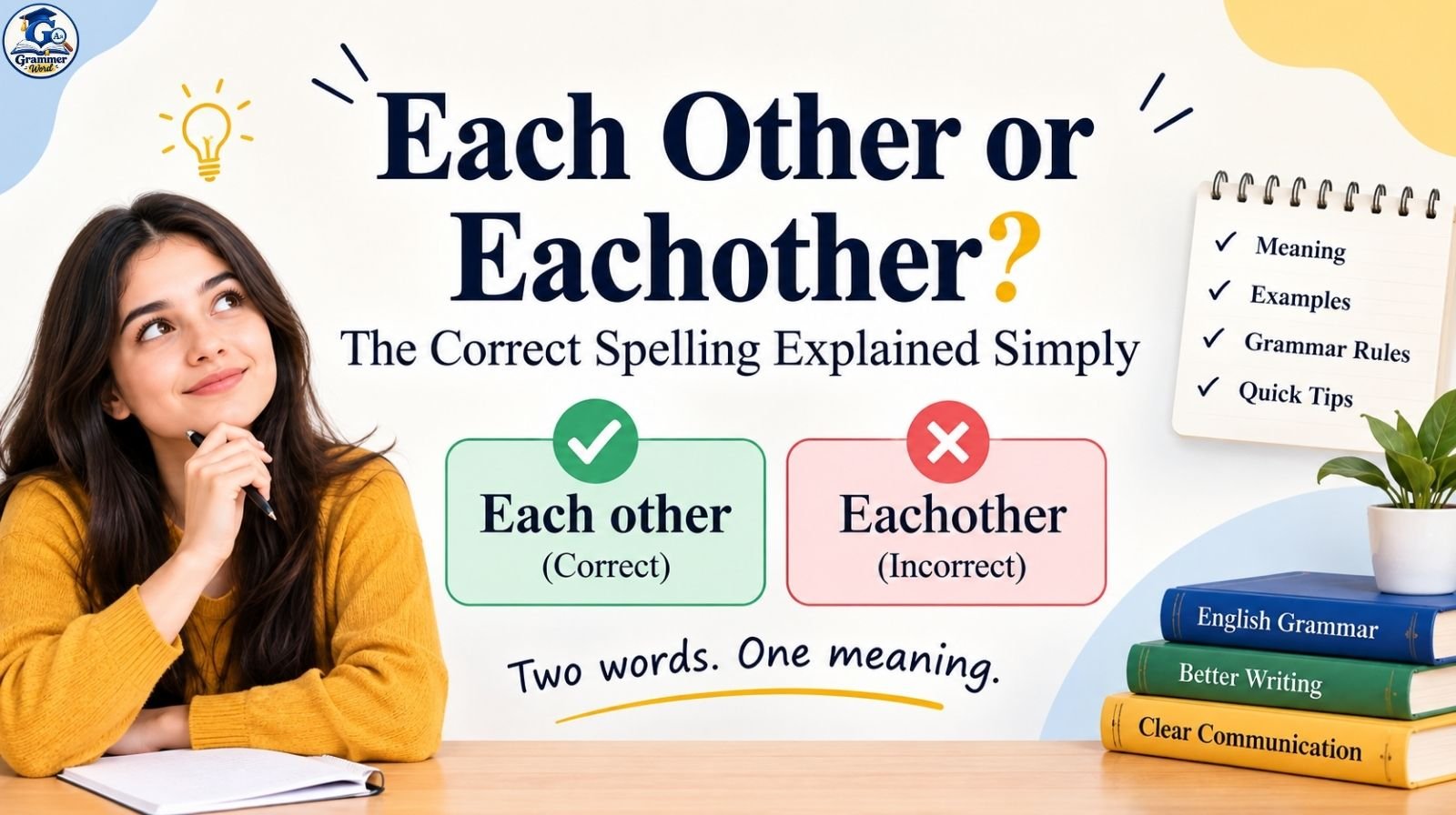
Have you ever typed “eachother” and wondered whether it should actually be “each other”? You are not alone. Because the phrase is pronounced naturally as one unit, it can be easy to forget the space.
The correct spelling in standard English is each other two separate words. Eachother written as one word is not the standard spelling.
In this guide, you’ll learn what each other means, why it is written as two words, how to use it correctly, and how it compares with one another.
Read More: Whoever or Whomever: A Complete Guide To Correct Usage
Each Other or Eachother: Which Spelling Is Correct?
The answer is simple: each other is correct, while eachother is not the standard English spelling.
The Correct Form: Each Other
Each other is a reciprocal pronoun used when people or things perform an action toward one another.
For example:
- They help each other.
- We respect each other.
- The two friends called each other every day.
- The students shared their notes with each other.
According to Cambridge Dictionary’s grammar guidance, each other is written as two separate words, with no hyphen. Cambridge specifically identifies eachother as an error.
The Incorrect Form: Eachother
Eachother is not the standard form used in modern English writing.
For example:
❌ They always help eachother.
✅ They always help each other.
The pronunciation may make the phrase sound like a single word, but spelling does not always follow pronunciation.
What Does Each Other Mean?
Each other means that two or more people or things perform an action toward the other members of the group.
In simple terms, it expresses a mutual or reciprocal action.
Each Other Meaning in Simple English
Consider this sentence:
Sarah and Tom helped each other.
This means:
- Sarah helped Tom.
- Tom helped Sarah.
The action goes in both directions.
Similarly:
The children were talking to each other.
This tells us that the children were talking to one another rather than simply talking to a third person.
Oxford’s dictionary defines each other as a pronoun used as the object of a verb or preposition when each member of a group does something to or for the other members.
Examples of Each Other
Here are some natural examples:
- My brother and I understand each other.
- The two teams congratulated each other.
- We should listen to each other.
- They looked at each other and laughed.
- The neighbors often help each other.
Notice that each other normally comes after a verb or preposition.
Read More: Possum or Opossum: What’s The Correct Spelling And Usage?
Why Is Each Other Written as Two Words?
The main reason is grammatical structure. Each and other are separate words that work together as a reciprocal pronoun.
Although English contains many words that have developed from combinations of words, each other has retained its two-word spelling in standard modern English.
Think of It as a Two-Word Phrase
A useful way to remember the spelling is:
each + other = each other
Do not combine them:
❌ eachother
✅ each other
Do not hyphenate them:
❌ each-other
✅ each other
Cambridge’s current grammar guidance explicitly gives each other as the standard written form and identifies eachother as incorrect.
An Easy Memory Trick
Think of the phrase as describing each person and the other person.
Each → the individual person
Other → the other person or people
Therefore:
each + other = each other
Keeping the space visible makes the correct spelling much easier to remember.
How to Use Each Other Correctly
Knowing the spelling is only half the job. You also need to understand where each other fits in a sentence.
Each Other After a Verb
One of the most common patterns is:
Subject + verb + each other
Examples:
- They trust each other.
- We support each other.
- The players encouraged each other.
- The sisters understand each other.
Here, the phrase receives the action of the verb.
Each Other After a Preposition
You can also use each other after a preposition.
Examples:
- They sat next to each other.
- We talked with each other.
- The children played with each other.
- The two companies compete with each other.
The phrase can therefore appear naturally in many everyday sentence patterns.
Read More: Dreamt or Dreamed: Which One Is Correct?
The Possessive Form: Each Other’s
When you want to show possession, use:
each other’s
Examples:
- They borrowed each other’s books.
- The sisters wore each other’s jackets.
- We read each other’s essays.
- The neighbors respect each other’s privacy.
Be careful not to write:
❌ each others
❌ eachothers
❌ each-other’s
The standard possessive form is:
✅ each other’s
Cambridge also lists each other’s as the possessive form.
Each Other vs One Another
A common question is whether each other and one another have different meanings.
In modern English, they are usually interchangeable.
Is One Another Different?
Compare these sentences:
The friends helped each other.
The friends helped one another.
Both sentences express essentially the same idea: the friends helped the other members of the group.
Cambridge states that there is very little difference between each other and one another, and that they can normally be used in the same places. It also notes that each other is more common.
Quick Comparison
| Form | Correct? | Meaning | Example |
|---|---|---|---|
| each other | ✅ Yes | Mutual action | They help each other. |
| eachother | ❌ No | Nonstandard spelling | They help eachoth er. |
| one another | ✅ Yes | Mutual action | They help one another. |
| each other’s | ✅ Yes | Possession | They borrowed each other’s books. |
| each others | ❌ No | Incorrect possessive form | They borrowed each others books. |
Some traditional grammar advice suggested using each other for two people and one another for three or more. However, modern English does not generally require that distinction. Collins likewise describes the two forms as interchangeable in common usage.
Common Mistakes With Each Other
Because the phrase is so common, several mistakes appear regularly in informal writing.
Mistake 1: Writing Eachother
❌ We should respect eachother.
✅ We should respect each other.
This is the most important spelling mistake to avoid.
Mistake 2: Adding a Hyphen
❌ They looked at each-other.
✅ They looked at each other.
There is normally no hyphen.
Mistake 3: Forgetting the Apostrophe
When possession is intended:
❌ They exchanged each others phone numbers.
✅ They exchanged each other’s phone numbers.
The apostrophe shows possession.
Mistake 4: Writing Each Others
Each other does not normally become each others simply because more than two people are involved.
❌ The students helped each others.
✅ The students helped each other.
Cambridge specifically notes that each other is not made plural as each others.
Read More: Laid Off or Layed Off: Which One Is Correct?
A Real-Life Example: Using Each Other at School
Imagine a group of four students working together on a class project. Maria researches the topic, James creates the presentation, Aisha checks the grammar, and Daniel prepares the final notes.
At first, they work separately. However, as the deadline gets closer, they begin reviewing one another’s work. Maria reads James’s slides and suggests a clearer explanation.
James checks Maria’s research and notices that one source needs a correction. Aisha helps Daniel organize his notes, while Daniel reviews Aisha’s grammar.
By the end of the project, the students have learned from each other.
If we wrote:
The students helped eachother with the project.
the meaning would still be understandable, but the spelling would be incorrect in standard English.
The correct sentence is:
The students helped each other with the project.
This example shows why the phrase matters in everyday writing. Each other communicates a reciprocal action: the students are not simply receiving help from one person; they are helping members of the same group.
The possessive form can also appear naturally:
The students reviewed each other’s work.
Here, each other’s means that every student reviewed the work belonging to another student.
2025–2026 Usage and Language Data
Current language references continue to treat each other as the standard two-word form.
What Recent Sources Show
A 2025 article from LanguageTool, revised in March 2026, discusses each other and one another and reports that each other occurs more frequently in both British and American English, with its analysis finding roughly 3–4 times as many occurrences as one another in the sources it examined.
This does not mean one another is incorrect. Instead, it indicates that each other is the more frequently encountered choice in the analyzed material.
A separate spelling-frequency resource analyzed in September 2026 lists eachother as a nonstandard alternative spelling associated with each other. However, its frequency ranking should not be interpreted as evidence that eachother is an accepted standard spelling.
The strongest practical evidence remains dictionary and grammar guidance: Cambridge explicitly instructs writers to spell the expression as two separate words.
Bottom line: In standard English writing in 2025–2026, use each other, not eachother.
Read More: Midday vs Mid Day: Which Spelling Is Correct In Modern English?
A Simple Checklist for Remembering the Correct Spelling
Before publishing, submitting, or sending your sentence, use this quick checklist:
- Is the phrase written as two words?
→ each other ✅ - Did you accidentally write “eachother”?
→ Add a space. - Did you add a hyphen?
→ Remove it. - Are you showing possession?
→ Use each other’s. - Are you comparing it with “one another”?
→ Both can normally express reciprocal action.
Quick Rule
Always remember: “Each other” is two words.
That single rule will prevent most spelling mistakes involving this phrase.
Mini Quiz: Eachother or Each Other
1. Which spelling is correct?
A) Eachother
B) Each other
C) Each-other
D) Eachothers
Answer: B) Each other
2. Fill in the blank:
They always help ___.
A) eachother
B) each-other
C) each other
D) each others
Answer: C) each other
3. Is “eachother” standard English spelling?
A) Yes
B) No
Answer: B) No
4. What does “each other” usually express?
A) A past action
B) A mutual action
C) A future action
D) A question
Answer: B) A mutual action
5. Which sentence is correct?
A) We respect eachother.
B) We respect each-other.
C) We respect each other.
D) We respect each others.
Answer: C) We respect each other.
6. Which one is the correct possessive form?
A) Each others
B) Eachother’s
C) Each-other’s
D) Each other’s
Answer: D) Each other’s
7. Complete the sentence:
The two friends understand ___.
A) each other
B) eachother
C) each others
D) each-other
Answer: A) each other
8. Which phrase is also commonly used with a similar meaning?
A) One another
B) One other
C) Another each
D) Other one
Answer: A) One another
9. Spot the mistake:
“They talked to eachother.”
A) talked
B) to
C) eachother
D) No mistake
Answer: C) eachother
10. Which sentence uses the possessive form correctly?
A) They borrowed each others books.
B) They borrowed eachother’s books.
C) They borrowed each other’s books.
D) They borrowed each-other books.
Answer: C) They borrowed each other’s books.
11. How many words are in the correct form “each other”?
A) One
B) Two
C) Three
D) Four
Answer: B) Two
12. Choose the correct sentence:
A) The students helped each other.
B) The students helped eachother.
C) The students helped each-others.
D) The students helped each others.
Answer: A) The students helped each other.
13. True or False: “Each-other” is the standard spelling.
A) True
B) False
Answer: B) False
14. Which sentence sounds correct in standard English?
A) They looked at eachother.
B) They looked at each other.
C) They looked at each-other.
D) They looked at each others.
Answer: B) They looked at each other.
15. Quick final one! What should you remember?
A) Write “eachother” as one word
B) Always hyphenate “each-other”
C) Write “each other” as two words
D) Write “each others”
Answer: C) Write “each other” as two words
Read More: Masonary vs Masonry: Which Spelling Is Correct And Why It Matters
FAQs
Q1. Is “eachother” one word?
No. Eachother is not the standard spelling in English. The correct form is each other, written as two separate words.
Q2. Is “each other” grammatically correct?
Yes. Each other is a standard reciprocal pronoun used to show that members of a group perform an action toward one another.
Q3. Is it “each other” or “eachother”?
The correct spelling is each other. For example:
We should help each other.
Not:
We should help eachother.
Q4. Is “each other” the same as “one another”?
In modern English, the two expressions are generally interchangeable. Each other is more common, but one another is also correct.
Q5. How do you write the possessive form?
The possessive form is each other’s.
Example:
They borrowed each other’s books.
Q6. Can “each other” refer to more than two people?
Yes. Modern standard English does not require each other to be limited to exactly two people. It can describe reciprocal actions involving groups as well.
Conclusion:
When choosing between each other or eachother, the answer is straightforward: each other is the correct standard spelling.
Use each other as two separate words when describing a mutual or reciprocal action:
They respect each other.
Use each other’s when showing possession:
They respect each other’s opinions.
And remember that one another is also a valid alternative in most situations.
The easiest rule to remember is simple: never combine “each” and “other” into “eachother.” Keeping that small space will help your writing stay clear, polished, and grammatically correct.
Discover More Article
- Flyer or Flier: Which One Is Correct? A Clear Guide For Writers
- Busses vs Buses: The Correct Spelling You Need To Know In 2026
- Jist or Gist: Which Spelling Is Correct And How To Use It Properly?
- Every Time or Everytime: Which One Is Correct?
Keep learning with more easy grammar lessons on Grammer Word.com

Hi, I’m Noor Fatima, the person behind this website. I created this site to make English grammar and confusing words easier to understand. I love breaking down tricky words, meanings, spellings, and grammar rules into simple explanations. My goal is to help you learn English naturally, avoid common mistakes, and feel more confident every time you write or speak.