Have you ever wondered whether you should write “apart” or “a part”? These expressions sound almost identical when spoken, but they have completely different meanings in written English.
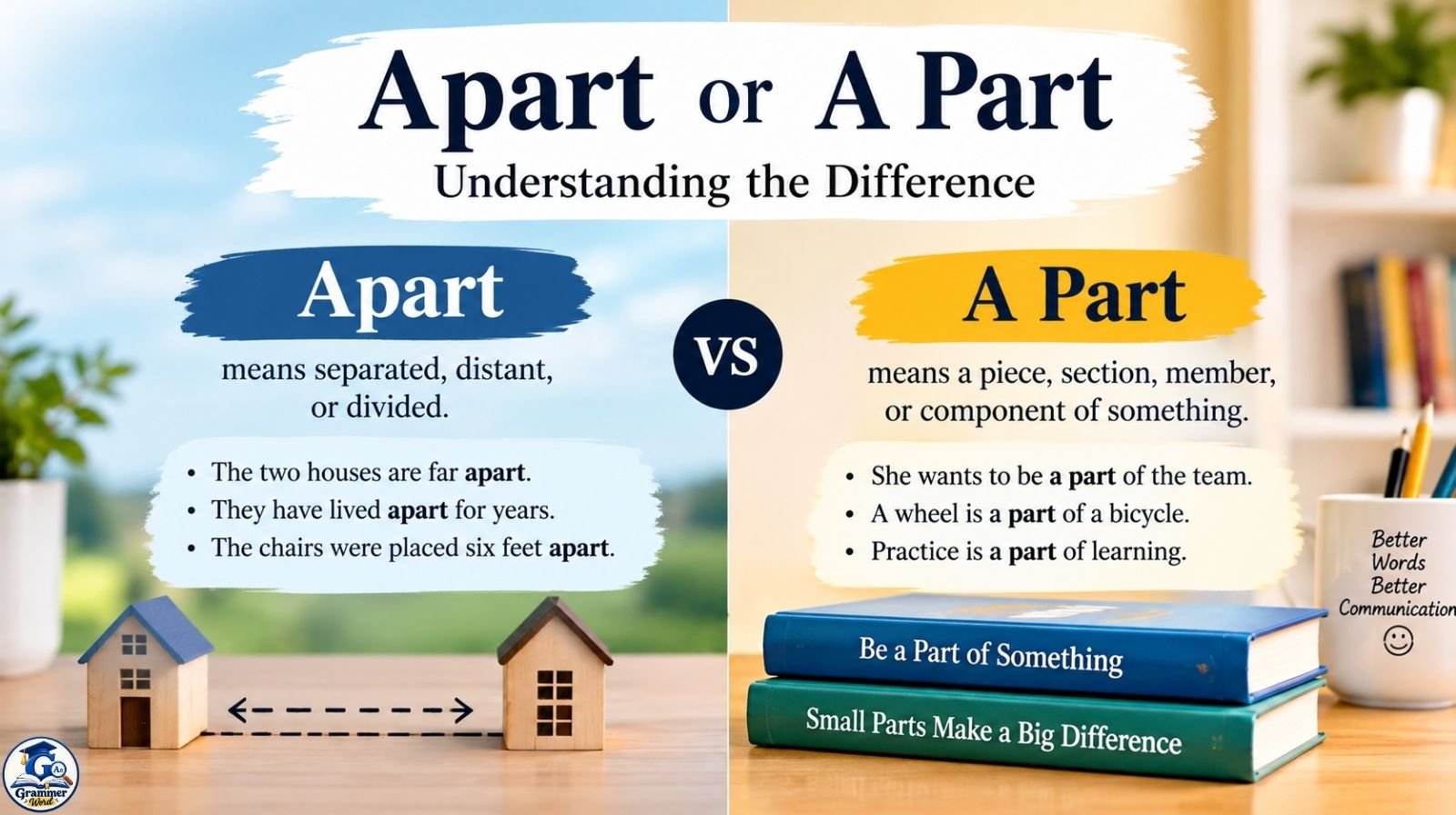
The easiest way to remember the difference is simple: apart usually describes separation, distance, or being divided, while a part refers to one piece, section, member, or component of something larger.
For example:
- The two houses are far apart.
- She wants to be a part of the team.
In this guide, you’ll learn exactly when to use apart or a part, how apart from differs from a part of, common mistakes to avoid, and practical examples that make the distinction easy to remember.
Read More: Whoever or Whomever: A Complete Guide To Correct Usage
Apart or A Part: What Is the Difference?
The main difference between apart and a part is their meaning and grammatical function.
Apart is normally used to describe separation or distance. A part is a noun phrase referring to a piece, portion, section, role, or member of a larger whole.
What Does “Apart” Mean?
Apart generally means separated, away from one another, or divided.
Examples:
- The children sat apart.
- The two buildings are several miles apart.
- They have lived apart for years.
- The old machine fell apart.
- The twins were born three years apart.
In each example, apart communicates some form of separation.
It can describe physical distance, time, relationships, or something being separated into pieces.
What Does “A Part” Mean?
A part means one piece, section, component, role, or member of something larger.
Examples:
- A wheel is a part of a bicycle.
- She wants to be a part of the project.
- He played a part in the school performance.
- A part of the building needs repair.
- Everyone wants to feel like a part of the community.
Here, the focus is not separation. Instead, something belongs to or contributes to a larger whole.
The Quickest Way to Remember
Think of the meanings this way:
| Word or phrase | Basic meaning | Example |
|---|---|---|
| apart | separated or distant | The friends live far apart. |
| a part | a piece or member of something | She is a part of the team. |
| apart from | separate from / except for | Apart from John, everyone agreed. |
| a part of | a piece or member of | John is a part of the team. |
A useful memory trick is:
Apart = away or separated.
A part = a piece or member.
Read More: Skillset or Skill Set: Which Term Is Correct In Modern English?
How to Use “Apart” Correctly
Understanding the common uses of apart makes it much easier to recognize when the one-word form is needed.
Apart Means “Separated”
Use apart when people or things are physically separated.
Examples:
- The chairs were placed six feet apart.
- The two villages are ten miles apart.
- Keep the chemicals apart.
- The children stood apart from the crowd.
Here, apart describes distance or separation.
Apart Can Describe Emotional Distance
Apart is not limited to physical space. It can also describe people becoming emotionally or socially distant.
Examples:
- The couple slowly grew apart.
- Moving to different countries drove the friends apart.
- They spent several months apart.
In these sentences, the separation may be emotional rather than physical.
Apart Can Mean “Into Pieces”
You can also use apart when something separates into pieces or is dismantled.
Examples:
- The mechanic took the engine apart.
- The old chair came apart during the move.
- The box fell apart after getting wet.
- We need to take the device apart to repair it.
This use still carries the central idea of separation.
How to Use “A Part” Correctly
Use a part when you’re talking about a piece, portion, component, role, or member of a larger whole.
A Part Means “A Piece”
Imagine a bicycle. The bicycle is the whole, while its wheels, brakes, chain, and pedals are individual components.
You could say:
- The chain is a part of the bicycle.
- One part of the bicycle is damaged.
- We need to replace a part of the machine.
The same idea works with less physical things:
- This chapter is a part of the book.
- Research is a part of the writing process.
- Practice is a part of learning English.
A Part Can Mean a Role
A part can also refer to someone’s role or involvement in an event, performance, or activity.
Examples:
- She played a part in the school play.
- Everyone had a part in the project’s success.
- He had a part in organizing the event.
- The actor was offered a part in the new film.
In these examples, a part means a role or contribution.
“Part Of” Does Not Always Need “A”
This is an important detail.
You can say:
- I am part of the team.
- I am a part of the team.
Both can be grammatical, although they can carry slightly different emphasis depending on context.
However, when you use part as a countable noun referring to one particular component, a part may be necessary:
- This is a part of the machine.
- She played a part in the production.
The key is to focus on the meaning rather than automatically adding or removing the space.
Read More: Dreamt or Dreamed: Which One Is Correct?
Apart From vs. A Part Of: The Common Confusion
One of the biggest problems with apart or a part appears when these words are followed by prepositions.
The phrases apart from and a part of are different expressions with different meanings.
What Does “Apart From” Mean?
Apart from commonly means separate from, except for, or besides, depending on context.
Examples:
- Apart from Sarah, everyone attended the meeting.
- Apart from the rain, the trip was enjoyable.
- The house stands apart from the other buildings.
Consider this sentence:
Apart from Tom, everyone passed the test.
Here, the meaning is “except for Tom.”
What Does “A Part Of” Mean?
A part of means something is included within a larger whole.
Examples:
- Sarah is a part of our team.
- This page is a part of the larger report.
- Exercise is a part of a healthy routine.
- The introduction is a part of the article.
Compare:
Sarah is a part of the team.
This means Sarah belongs to the team.
But:
Sarah is apart from the team.
This indicates separation from the team.
The tiny space between a and part therefore changes the meaning considerably.
Apart vs. A Part: Common Mistakes to Avoid
These words are easy to confuse because they sound similar in everyday speech. Writing makes the distinction especially important.
Mistake 1: Writing “Apart Of”
One of the most common errors is:
❌ She is apart of the group.
The correct sentence is:
✅ She is a part of the group.
Why? Because the intended meaning is that she belongs to the group.
Remember:
a part of = included in something
Mistake 2: Using “A Part” for Separation
Incorrect:
❌ The two buildings are five miles a part.
Correct:
✅ The two buildings are five miles apart.
Here, the sentence describes distance, so apart is required.
Mistake 3: Confusing “Apart From” With “A Part Of”
Incorrect:
❌ He felt a part from his family.
Correct:
✅ He felt apart from his family.
The sentence describes separation, so apart from is appropriate.
Compare it with:
✅ He wanted to be a part of his family.
This sentence describes belonging.
A Simple Three-Step Check
When you’re unsure, ask yourself:
- Does the sentence describe separation or distance?
Use apart. - Does it describe a piece, member, role, or component?
Use a part or part. - Does the expression mean “except for” or “separate from”?
Use apart from.
Apart or A Part: Comparison Table
The following table gives you a quick reference whenever you’re unsure which form to use.
| Feature | Apart | A Part |
|---|---|---|
| Spelling | One word | Two words |
| Main idea | Separation | Portion or inclusion |
| Common function | Adverb/adjective | Article + noun |
| Describes distance | Yes | No |
| Means a piece | No | Yes |
| Can describe a role | No | Yes |
| Common expression | apart from | a part of |
| Example | They live apart. | She is a part of the team. |
A Fast Replacement Test
Try replacing the expression with “separate” or “a piece.”
If separate makes sense, choose apart.
The houses are separate.
The houses are apart. ✅
If a piece or a member makes sense, choose a part.
She is a member of the team.
She is a part of the team. ✅
This simple test can help you choose the correct spelling quickly.
Read More: Girlie or Girly: Which Word Is Correct? Meaning, Usage, Differences, And Examples For 2026
Real-Life Example: Why One Space Can Change the Meaning
Consider a workplace situation.
A new employee named Daniel joins a marketing team. During a meeting, Daniel says, “I want to be a part of this project.” His meaning is clear: he wants to participate and contribute to the project.
Now imagine the manager says, “Daniel has been working apart from the marketing team.”
That sentence communicates almost the opposite idea. It suggests Daniel has been working separately from the team.
The difference is only one space, but the meaning changes substantially.
This distinction becomes especially important in professional emails, reports, applications, and online content. A sentence such as “I am apart of the team” may be understood by readers, but it is grammatically incorrect because apart does not mean “a member of.”
The correct sentence is:
I am a part of the team.
However, if the intended meaning is separation, apart is correct:
I work apart from the main team.
The example demonstrates an important principle of English writing: words that sound alike can have very different grammatical functions and meanings. When writing, always consider what you actually want to communicate rather than relying only on pronunciation.
2025–2026 Data: Why Small Writing Differences Still Matter

There is no authoritative 2025–2026 statistic specifically measuring how many people confuse apart with a part. That distinction is important: a reliable source should not be presented as having data that it does not actually collect.
However, recent communication data shows why accuracy in everyday digital writing remains relevant.
At the start of 2025, approximately 5.56 billion people worldwide were using the internet, representing about 67.9% of the global population, according to DataReportal’s Digital 2025 Global Overview Report.
That means written communication is taking place on an enormous digital scale across websites, email, social platforms, education, and workplaces.
Grammarly also reported research involving more than 450 professional workers in which access to its AI writing assistance was associated with a 20% reduction in errors, equivalent to roughly 30–70 fewer errors per user per day, depending on the tool being used.
These figures do not prove that “apart” and “a part” are major sources of errors. Instead, they provide broader context: as more communication happens digitally, small differences in spelling, grammar, and word choice can matter for clarity and professionalism.
For writers, students, editors, and content creators, learning small distinctions such as apart vs. a part is therefore a practical part of developing accurate written English.
Read More: Midday vs Mid Day: Which Spelling Is Correct In Modern English?
Mini Quiz: Apart or A Part
1. Which is correct?
The two houses are far ___.
Answer: apart ✅
2. Fill in the blank
She wants to be ___ of the team.
Answer: a part ✅
3. Choose the correct phrase
A) apart of the group
B) a part of the group
Answer: B) a part of the group ✅
4. Which word means “separated”?
A) A part
B) Apart
Answer: B) Apart ✅
5. Fill in the blank
Everyone attended ___ John.
Answer: apart from ✅
6. Which sentence is correct?
A) We live a part.
B) We live apart.
Answer: B) We live apart. ✅
7. Quick grammar check
“Maria is apart of our team.”
Correct or incorrect?
Answer: Incorrect ❌
Correct: “Maria is a part of our team.” ✅
8. Pick the right word
The two friends grew ___ after the argument.
Answer: apart ✅
9. What does “a part” usually mean?
A) Separated
B) A piece or member of something
Answer: B) A piece or member of something ✅
10. Complete the sentence
Practice is ___ of learning English.
Answer: a part ✅
11. Which one describes distance?
A) Apart
B) A part
Answer: A) Apart ✅
12. Choose the correct sentence
A) This wheel is apart of the bicycle.
B) This wheel is a part of the bicycle.
Answer: B) This wheel is a part of the bicycle. ✅
13. Fill in the blank
The chairs were placed six feet ___.
Answer: apart ✅
14. Which phrase means “except for”?
A) A part of
B) Apart from
Answer: B) Apart from ✅
15. Final Challenge! 🎯
Which sentence is correct?
A) I am apart of the project.
B) I am a part of the project.
Answer: B) I am a part of the project. 🎉
FAQs
Q1. Is “apart” one word or two?
Apart is one word. It usually means separated, distant, or divided.
Example:
The two friends live apart.
Q2. Is “a part” always two words?
Yes, when you’re using the phrase a part, it consists of the article a and the noun part.
Example:
She is a part of the organization.
However, part of can also be used without the article:
She is part of the organization.
Q3. Is it “apart of” or “a part of”?
The correct expression for belonging or inclusion is a part of or simply part of.
Correct:
He is a part of the team.
Also correct:
He is part of the team.
“Apart of” is generally incorrect when you mean membership or inclusion.
Q4. What is the difference between “apart from” and “a part of”?
Apart from indicates separation, exception, or sometimes addition depending on context.
Apart from John, everyone arrived.
A part of indicates a piece, component, or member of something.
John is a part of the team.
Q5. Which is correct: “We live apart” or “We live a part”?
The correct sentence is:
We live apart.
Here, apart describes separation.
Q6. Can “apart” refer to emotional separation?
Yes. Apart can describe emotional or relational distance.
For example:
After the argument, the friends grew apart.
More commonly, English speakers say:
After the argument, the friends grew apart.
Q7. Can “a part” mean a role?
Yes. A part can mean a role, contribution, or involvement.
For example:
She played a part in the school’s production.
Final Takeaway:
The difference between apart or a part becomes much easier once you focus on meaning.
Use apart when you mean separate, distant, divided, or away from something:
The two offices are far apart.
Use a part when you mean a piece, portion, component, role, or member of something larger:
She is a part of the team.
And remember the two especially useful expressions:
- apart from = separate from / except for
- a part of = a piece or member of something
The easiest memory trick is “apart = away” and “a part = a piece.” Once you connect each spelling with its core meaning, choosing the correct form becomes much more natural.
If you found this guide helpful, save it as a quick reference and share it with anyone who frequently mixes up apart and a part. Clear word choices make everyday writing easier to understand and more professional.
Discover More Article
- To Much or Too Much: Which One Is Correct?
- Per Say or Per Se: Which One Is Correct?
- Lets or Let’s: Which One Is Correct And When To Use It?
- Choose or Chose: Everything You Need To Know
Keep learning with more easy grammar lessons on Grammer Word.com

Hi, I’m Noor Fatima, the person behind this website. I created this site to make English grammar and confusing words easier to understand. I love breaking down tricky words, meanings, spellings, and grammar rules into simple explanations. My goal is to help you learn English naturally, avoid common mistakes, and feel more confident every time you write or speak.