If you have ever wondered whether ageing or aging is the correct spelling, you are not alone. Both forms appear regularly in English, but the difference is mainly connected to British and American English.
So, is ageing wrong? Is aging more modern? Or can you use either one?
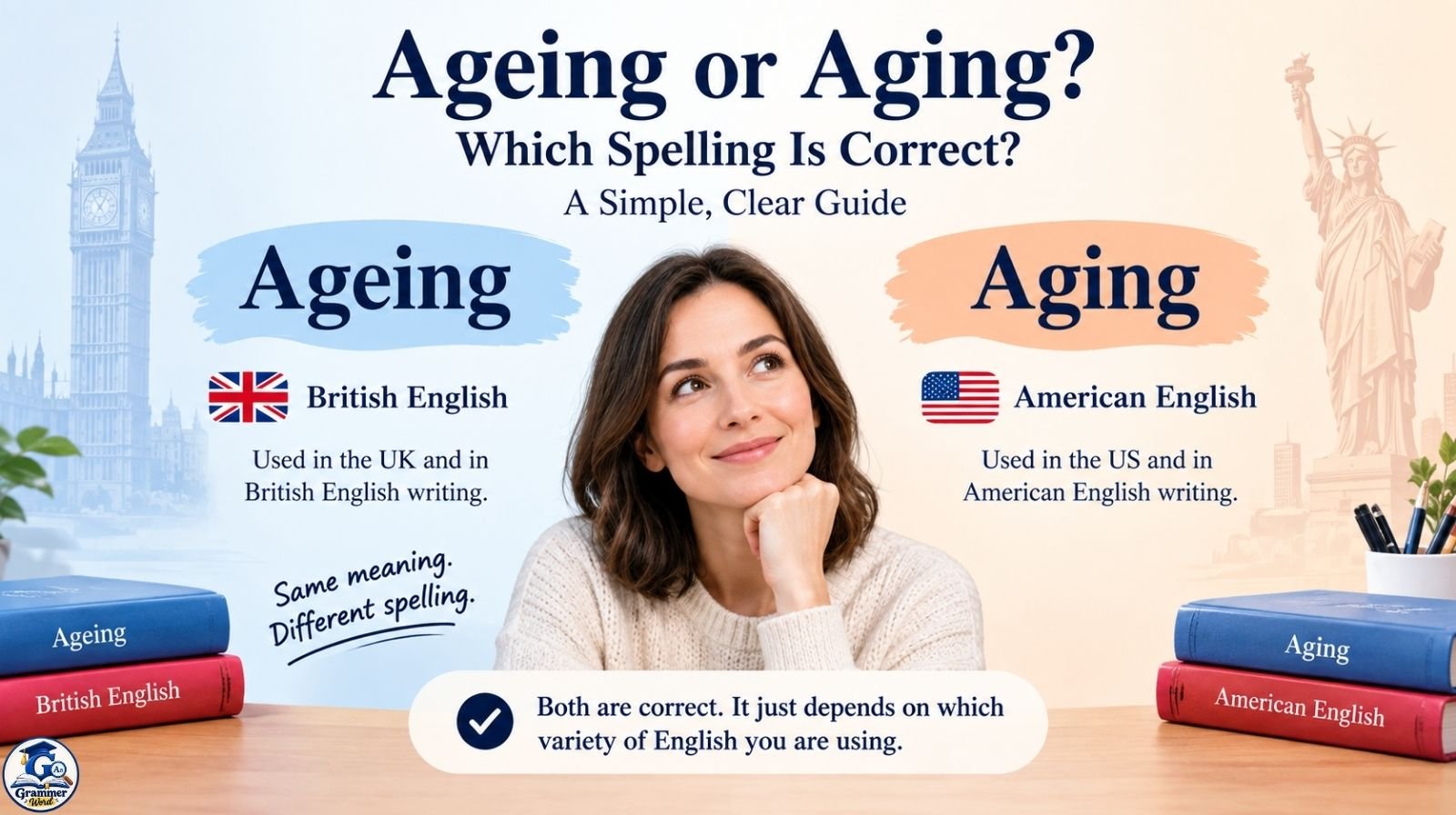
The simple answer is: both are correct. Ageing is the standard spelling in British English, while aging is the standard spelling in American English. The meaning is the same.
This guide explains the difference between ageing and aging, shows you when to use each spelling, and provides practical examples so you can choose the right form confidently.
Read More: Women vs Woman: Which One Is Correct And When To Use It?
Ageing or Aging: Which Spelling Is Correct?
The main difference between ageing and aging is regional spelling rather than meaning.
Ageing in British English
Ageing is the usual spelling in British English and is commonly used in the UK and in writing that follows British spelling conventions.
For example:
- The ageing population needs better healthcare services.
- Scientists are studying the ageing process.
- The company has an ageing workforce.
- Regular exercise may support healthy ageing.
Cambridge Dictionary identifies ageing as the UK spelling of aging.
Aging in American English
Aging is the standard American English spelling.
For example:
- The aging population is creating new social challenges.
- Researchers are studying the aging process.
- The company has an aging workforce.
- Healthy aging is an important public-health topic.
Cambridge Dictionary specifically identifies aging as the US spelling of ageing.
Quick Comparison
| Word | Standard usage | Example |
|---|---|---|
| Ageing | British English | The ageing population is growing. |
| Aging | American English | The aging population is growing. |
Bottom line: Neither spelling is incorrect. Choose the spelling that matches the variety of English you are using.
What Does Ageing or Aging Mean?
Ageing and aging describe the process of becoming older. The words can refer to people, animals, populations, materials, products, or other things that change over time.
Meaning When Talking About People
When referring to people, ageing/aging describes the natural process of getting older.
For example:
She is interested in the science of ageing.
In American English, you would normally write:
She is interested in the science of aging.
The meaning does not change.
Read More: Nosy or Nosey? The Correct Spelling Explained (With Examples)
Meaning in Science and Health
The word is also common in discussions about biology, medicine, and public health.
Examples include:
- healthy ageing
- healthy aging
- ageing research
- aging research
- age-related changes
- the ageing process
- the aging process
The World Health Organization uses ageing in its international materials, including its 2025 Ageing and health fact sheet.
Ageing or Aging as a General Concept
The word does not necessarily mean that someone is elderly. It can simply describe the process of becoming older.
For example:
Aging is a natural part of life.
Or in British English:
Ageing is a natural part of life.
Both sentences communicate the same idea.
Why Does British English Use “Ageing” While American English Uses “Aging”?
The difference comes from broader spelling conventions in British and American English.
The British “-ing” Pattern
British English often retains the e in words formed from certain verbs ending in -e when adding -ing.
Thus:
- age → ageing
- dye → dyeing
- singe → singeing
However, English spelling has many individual conventions, so it is better to learn common forms rather than assume every verb follows exactly the same pattern.
The American “Aging” Pattern
American English commonly uses aging, without the extra e.
For example:
- age → aging
- aging population
- aging process
- aging infrastructure
Cambridge lists aging as the US spelling and ageing as the UK spelling.
Read More: Traveled or Travelled: Which Spelling Is Correct In English?
Is One Spelling More Correct?
No.
It would be misleading to say that aging is more correct than ageing, or vice versa.
The better approach is to consider consistency. If your article, website, school assignment, or publication follows British English, use ageing. If it follows American English, use aging.
Ageing vs. Aging: Examples in Real Sentences
Seeing the two forms side by side makes the distinction much easier.
Examples With Ageing
British English:
- The country has an ageing population.
- Researchers are studying healthy ageing.
- The ageing process varies from person to person.
- The company is replacing its ageing equipment.
- She works in the field of ageing research.
Examples With Aging
American English:
- The country has an aging population.
- Researchers are studying healthy aging.
- The aging process varies from person to person.
- The company is replacing its aging equipment.
- She works in the field of aging research.
A Simple Rule to Remember
If your audience expects British English, choose:
ageing
If your audience expects American English, choose:
aging
The meaning remains unchanged.
A Real-Life Example: Choosing the Right Spelling for an Article
Imagine a writer in London is preparing an article about demographic changes. Throughout the article, the writer uses British spelling:
- organisation
- centre
- behaviour
- labour
- ageing
In this context, writing ageing population keeps the spelling consistent with the rest of the article.
Now imagine an American journalist writing about the same subject. The article uses:
- organization
- center
- behavior
- labor
- aging
In that context, aging population is the natural choice.
Why Consistency Matters
The important point is not that one writer has chosen a “better” spelling. Each writer is following a different English variety.
This is especially useful for:
- blog writers
- students
- editors
- businesses
- publishers
- international websites
- SEO content creators
For example, a website aimed primarily at readers in the UK may naturally prefer ageing. A US-focused website may use aging.
The key is to establish your preferred spelling convention and use it consistently throughout your content.
Read More: Lay or Lie? The Simple Grammar Rule Most People Get Wrong
Ageing or Aging: What Current Data Shows About the Topic
The spelling question is linguistic, but the subject itself is increasingly important worldwide.
Global Ageing and Aging Statistics
The World Health Organization reported in February 2025 that the number of people aged 60 and older worldwide was about 1.1 billion in 2023 and is projected to reach 1.4 billion by 2030. WHO also reports that global life expectancy at birth reached 73.3 years in 2024.
A WHO fact sheet published on October 1, 2025, states that by 2030, approximately one in six people worldwide will be aged 60 or older. It also projects that the population aged 60 and above will reach 2.1 billion by 2050.
More recent WHO information published in July 2026 reports that 1.1 billion people worldwide were aged 60 or older in 2023, with that figure projected to nearly double to 2.1 billion by 2050.
| Statistic | Recent WHO figure |
|---|---|
| People aged 60+ in 2023 | 1.1 billion |
| Global life expectancy at birth in 2024 | 73.3 years |
| Expected people aged 60+ by 2030 | 1.4 billion |
| Expected people aged 60+ by 2050 | 2.1 billion |
| Share aged 60+ by 2030 | About 1 in 6 people |
These statistics explain why terms such as ageing population, aging population, and healthy ageing/aging are increasingly common in journalism, research, healthcare, and public policy.
How to Choose Between Ageing and Aging
If you are unsure which form to use, follow this simple step-by-step guide.
Step 1: Identify Your English Variety
Ask yourself which spelling system your writing follows.
- British English → ageing
- American English → aging
Step 2: Check Your Existing Content
Look at other words in your document.
If you use:
- colour
- centre
- organisation
you are probably following British English, so ageing will usually fit.
If you use:
- color
- center
- organization
you are probably following American English, so aging will usually fit.
Read More: Further or Farther: Simple Rules And When To Use Each
Step 3: Consider Your Audience
For a UK audience, ageing is generally the natural choice.
For a US audience, aging is generally the natural choice.
For an international audience, either can work, provided your spelling system is consistent.
Step 4: Don’t Mix Forms Without a Reason
Avoid switching randomly between ageing and aging in the same piece of writing.
For example, this looks inconsistent:
The aging population is increasing, and researchers are studying healthy ageing.
A consistent version would be:
The aging population is increasing, and researchers are studying healthy aging.
Or:
The ageing population is increasing, and researchers are studying healthy ageing.
Mini Quiz: Ageing or Aging
1. Quick Pick: Which Is Correct in British English?
A) Aging
B) Ageing
C) Agein
D) Aginng
Answer: B) Ageing
2. American English Check
Which spelling is standard in American English?
A) Ageing
B) Ageingg
C) Aging
D) Agein
Answer: C) Aging
3. Same Meaning?
Do ageing and aging have the same basic meaning?
A) Yes
B) No
C) Only in formal writing
D) Only in science
Answer: A) Yes
4. Fill the Gap
“Scientists are studying healthy ______.”
A) aging
B) ageeing
C) agein
D) agging
Answer: A) aging (American English)
5. British Style Challenge
Which sentence follows British English spelling?
A) The aging population is growing.
B) The ageing population is growing.
C) The ageeing population is growing.
D) The agging population is growing.
Answer: B) The ageing population is growing.
6. US Style Challenge
Which sentence uses standard American English?
A) The ageing population is growing.
B) The ageeing population is growing.
C) The aging population is growing.
D) The agging population is growing.
Answer: C) The aging population is growing.
7. True or False?
“Ageing” is an incorrect spelling.
A) True
B) False
Answer: B) False
Read More: Quite or Quiet? Simple Guide To The Common English Confusion
8. Spot the Difference
What is the main difference between ageing and aging?
A) Meaning
B) Pronunciation
C) Regional spelling
D) Grammar
Answer: C) Regional spelling
9. Complete the Phrase
Which is standard in British English?
“Healthy ______”
A) ageing
B) agingg
C) agein
D) agging
Answer: A) ageing
10. Complete the Phrase
Which is standard in American English?
“Healthy ______”
A) ageeing
B) ageing
C) aging
D) agging
Answer: C) aging
11. Memory Trick
Which pairing is easiest to remember?
A) UK = aging, US = ageing
B) UK = ageing, US = aging
C) UK = agein, US = aging
D) UK = agging, US = ageing
Answer: B) UK = ageing, US = aging
12. Which One Sounds Right?
For a British English article, which phrase is appropriate?
A) An aging population
B) An ageing population
C) An ageeing population
D) An agging population
Answer: B) An ageing population
13. Which One Fits US English?
For an American English article, choose the correct phrase:
A) The ageing process
B) The ageeing process
C) The aging process
D) The agging process
Answer: C) The aging process
14. Consistency Check
If your article uses colour, centre, and organisation, which spelling fits best?
A) Aging
B) Ageing
C) Agein
D) Aginng
Answer: B) Ageing
15. Final Brain Teaser
Complete this simple rule:
British English → ______ | American English → ______
A) aging | ageing
B) ageing | aging
C) agein | ageing
D) ageing | agein
Answer: B) ageing | aging
FAQs
Q1. Is “ageing” grammatically correct?
Yes. Ageing is a standard spelling, particularly in British English. Aging is the standard American English spelling.
Q2. Is “aging” American or British English?
Aging is the standard American English spelling. British English generally uses ageing.
Q3. Is “ageing” more correct than “aging”?
No. Both are correct in their respective English varieties. The appropriate choice depends mainly on the spelling convention you are following.
Q4. Which spelling should I use in a UK article?
Use ageing if you are following standard British English.
For example:
The UK’s ageing population is changing the demand for healthcare.
Q5. Which spelling should I use in an American article?
Use aging if you are following standard American English.
For example:
The US aging population is creating new challenges for healthcare providers.
Q6. Do ageing and aging have different meanings?
No. In ordinary usage, they have the same meaning. The difference is primarily spelling by English variety. Cambridge Dictionary lists ageing as the UK spelling and aging as the US spelling.
Q7. How do I remember the difference?
Use this quick memory rule:
UK = ageing
US = aging
If you remember those two associations, you can usually choose the correct spelling immediately.
Conclusion:
So, ageing or aging: which spelling is correct? The answer is both.
Use ageing when following British English, and use aging when following American English. Neither form is inherently more correct. The most important thing is to match your spelling to your intended English variety and remain consistent throughout your writing.
Whether you are writing about the ageing population, the aging process, healthy ageing, or healthy aging, the meaning stays the same.
Quick reminder:
🇬🇧 British English → ageing
🇺🇸 American English → aging
Save this simple rule, and the next time you wonder whether to write ageing or aging, you will know exactly which form to choose.
Discover More Article
- Lay Down or Lie Down – What’s The Correct Usage?
- Carmel or Caramel: Which One Is Correct?
- Labelled or Labeled: Which Spelling Is Correct?
Keep learning with more easy grammar lessons on Grammer Word.com

Hi, I’m Noor Fatima, the person behind this website. I created this site to make English grammar and confusing words easier to understand. I love breaking down tricky words, meanings, spellings, and grammar rules into simple explanations. My goal is to help you learn English naturally, avoid common mistakes, and feel more confident every time you write or speak.