Have you ever wondered whether to write stationary or stationery when talking about pens, notebooks, or something that is not moving? These two words sound exactly alike, but their meanings and uses are completely different. Because they share the same pronunciation, many English learners and even experienced writers sometimes confuse them.
The difference between stationary vs stationery is actually quite simple once you understand what each word means. One describes something that remains still or does not move, while the other refers to writing materials such as paper, envelopes, pens, and notebooks.
Although they differ by only one letter, using the wrong spelling can change the meaning of your sentence entirely. For example, saying that a delivery truck is stationery instead of stationary would make your sentence incorrect.
In this guide, we will explore the meanings, definitions, differences, and everyday uses of both words. You will also discover easy ways to remember their spellings through practical examples, email scenarios, workplace conversations, and simple memory tricks.
What Is the Difference Between Stationary and Stationery?
The main difference between stationary and stationery is their meaning and grammatical function.
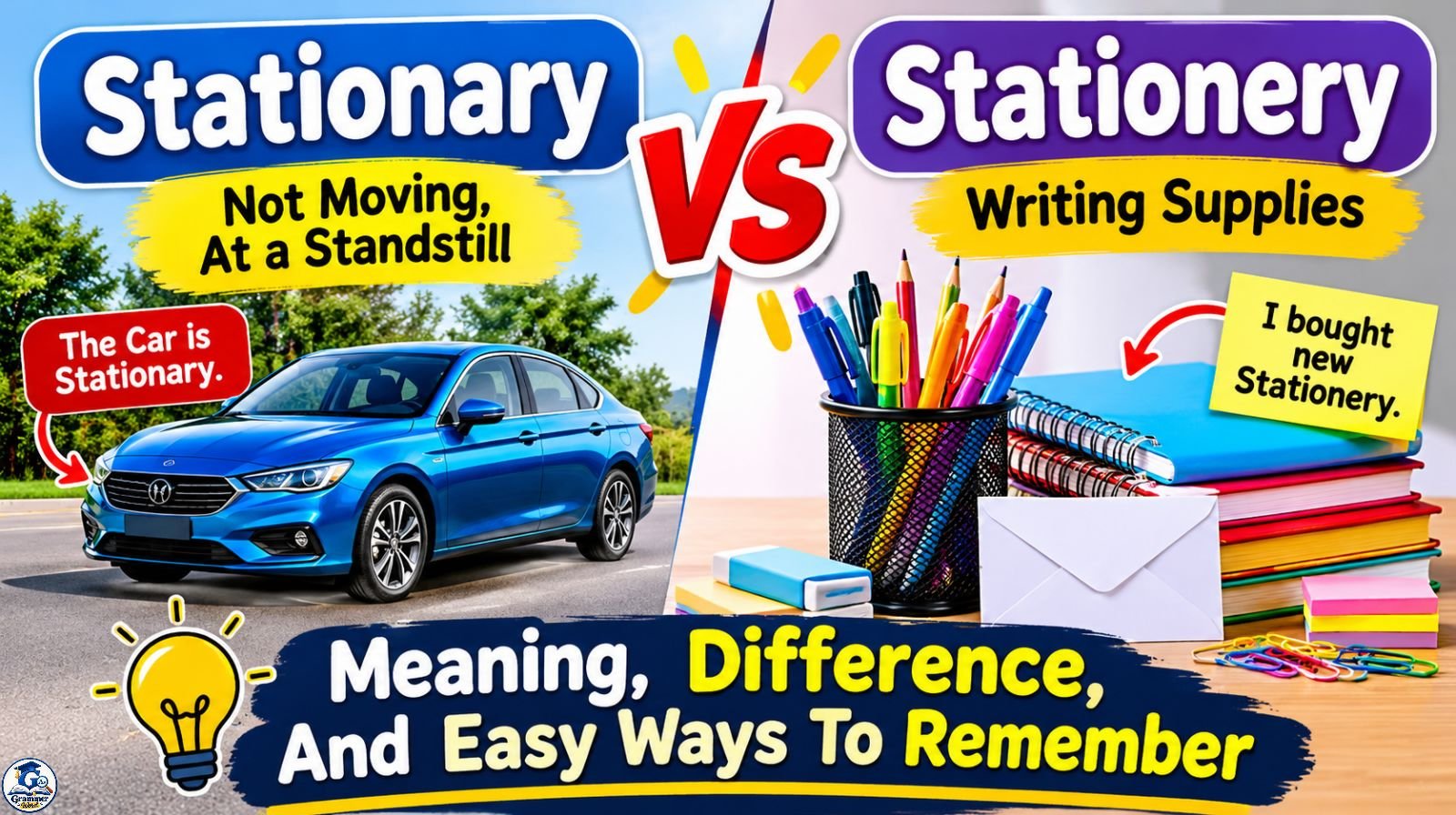
Stationary is an adjective that describes something that is not moving, standing still, or remaining in one position. It is commonly used when talking about vehicles, objects, people, or situations that remain unchanged.
On the other hand, stationery is a noun that refers to writing and office supplies, including notebooks, paper, envelopes, pens, pencils, and other materials used for writing or communication.
Both words are pronounced the same way, which makes them homophones. However, their spellings and meanings are different.
Here is a quick comparison:
| Word | Meaning | Part of Speech | Example |
|---|---|---|---|
| Stationary | Not moving or staying in one place | Adjective | The car remained stationary. |
| Stationery | Writing and office supplies | Noun | I bought new stationery for school. |
Remember: If you are describing something that is not moving, use stationary. If you are talking about pens, paper, notebooks, or other writing materials, use stationery.
What Does Stationary Mean?
Stationary is an adjective that means not moving, staying in one place, or remaining in the same position.
It describes a person, object, vehicle, or anything that remains still rather than moving from one location to another.
For example, imagine a car waiting at a red traffic light. The car is not moving, so you can describe it as stationary.
Similarly, a person standing in one place, a bicycle leaning against a wall, or a machine that is switched off can all be described as stationary.
The word can also describe something that remains unchanged over time. For example, if prices, temperatures, or certain conditions remain at the same level, they may be described as stationary in an appropriate context.
Definition of Stationary
According to its general English meaning, stationary describes something that is fixed, motionless, or not changing position.
Simple definition: Something that stays in one place and does not move.
Examples of Stationary in Sentences
Here are some everyday examples to help you understand how to use stationary correctly:
- The bus remained stationary while the driver checked the engine.
- Please keep the camera stationary while taking the photograph.
- A bicycle was left stationary outside the school.
- The teacher asked the students to remain stationary during the announcement.
- The car stayed stationary at the traffic signal.
- The machine must remain stationary during the repair.
- Daniel noticed that the boat was stationary in the middle of the lake.
- The price of the product remained stationary throughout the month.
In all these examples, stationary describes something that is not moving or changing position.
Scenario Example: Using Stationary in an Email
Imagine that James works for a delivery company. His manager wants to know why a delivery vehicle has not moved for several minutes.
James sends the following email:
Subject: Delivery Vehicle Update
Hi Michael,
The delivery truck has remained stationary near the warehouse for approximately 20 minutes. The driver is checking a possible engine issue before continuing the journey. I will share another update once the vehicle starts moving again.
Best regards,
James
Here, stationary is correct because James is describing a truck that is not moving.
Using stationery in this email would be incorrect because the message is not referring to writing supplies.
Scenario Example: Using Stationary in Everyday Conversation
Imagine that Sarah and Emily are watching a football match.
Sarah says:
“Why is the goalkeeper standing in the same position?”
Emily replies:
“He has been stationary for several minutes because the ball is on the other side of the field.”
In this conversation, stationary describes the goalkeeper’s position because he is not moving.
What Does Stationery Mean?
Stationery is a noun that refers to writing materials and office supplies. These items are commonly used in schools, offices, homes, and workplaces for writing, drawing, printing, and sending letters.
Stationery includes many everyday items, such as:
- Pens
- Pencils
- Notebooks
- Writing paper
- Envelopes
- Sticky notes
- Erasers
- Paper clips
- Folders
- Letterheads
- Diaries
- Greeting cards
Whenever you talk about these writing-related materials collectively, the correct word is stationery.
For example, if you visit a shop to purchase notebooks, pens, and envelopes, you are buying stationery.
Definition of Stationery
Stationery means the materials and supplies used for writing, printing, drawing, and general office or educational activities.
Simple definition: Paper, pens, notebooks, and other writing supplies.
Examples of Stationery in Sentences
Here are some examples showing how to use stationery correctly:
- I need to buy new stationery for the upcoming school year.
- Sarah ordered colorful stationery for her office.
- The teacher asked students to bring their own stationery.
- My sister loves collecting beautiful stationery items.
- We purchased envelopes and other stationery supplies yesterday.
- The company provides free stationery to all its employees.
- Emily received a beautiful stationery set as a birthday gift.
- Please keep your stationery organized inside your desk drawer.
In these sentences, stationery refers to writing materials and office supplies.
Scenario Example: Using Stationery in an Email
Imagine that Olivia works as an office administrator. She needs to inform her manager that the office is running out of writing supplies.
She writes the following email:
Subject: Office Stationery Requirements
Hi Robert,
I wanted to let you know that we are running low on office stationery. We need additional notebooks, pens, printer paper, and envelopes for the upcoming week. Could you please approve the purchase so we can restock these essential supplies?
Thank you,
Olivia
Here, stationery is the correct choice because Olivia is discussing office supplies.
Using stationary would be incorrect because she is not describing anything that remains still.
Scenario Example: Using Stationery at School
Imagine that a teacher asks her students to prepare for their next examination.
The teacher says:
“Please bring all your required stationery, including pens, pencils, erasers, and rulers. Make sure you have everything ready before the examination begins.”
In this situation, stationery refers to the writing materials students need for their examination.
Why Are Stationary and Stationery Confused?
The biggest reason people confuse these words is that stationary and stationery are homophones.
Homophones are words that have the same pronunciation but different spellings and meanings.
For example:
- Their and there
- Your and you’re
- Flower and flour
- Right and write
- Stationary and stationery
When spoken, stationary and stationery sound identical. Therefore, you cannot always identify the correct word by listening alone.
You must understand the context of the sentence to determine which spelling is appropriate.
For instance:
- The vehicle remained stationary outside the building.
- I purchased new stationery for my office.
Both sentences sound similar when spoken, but their meanings are entirely different.
Another reason for confusion is that both words are associated with everyday activities. People regularly talk about vehicles, movement, school supplies, and office materials, so choosing the correct spelling requires attention.
The good news is that a few simple memory tricks can help you remember the difference permanently.
Easy Ways to Remember Stationary vs Stationery
Learning the meanings is important, but remembering the correct spelling while writing can sometimes be challenging.
Fortunately, there are several easy ways to distinguish between stationary and stationery.
1. Remember the Letter A in Stationary
One of the easiest memory tricks is to associate the letter A in stationary with the word at a standstill.
Both words relate to something that is not moving.
Think about this:
- Stationary = At a standstill.
- Stationery = Writing supplies.
For example:
“The train remained stationary because of a technical problem.”
The train is at a standstill, so the word containing the letter A is correct.
Whenever you are unsure which spelling to use, remember:
A in Stationary = At a standstill.
This simple association can help you choose the correct word quickly.
2. Remember the Letter E in Stationery
Another useful trick is to associate the letter E in stationery with envelope.
An envelope is a common writing supply, and the word stationery contains the same letter E.
Think about it this way:
- Stationery contains E.
- Envelope contains E.
- Both are associated with writing and communication.
For example:
“I bought new stationery, including envelopes and notebooks.”
Since the sentence refers to writing materials, stationery is the correct spelling.
Memory trick: E in Stationery = Envelope.
Whenever you think about paper, pens, envelopes, or notebooks, remember the letter E.
3. Associate Stationary with Staying Still
You can also remember stationary by connecting it with the idea of staying in one place.
Imagine a bicycle parked outside your house. It is not moving anywhere. Therefore, it is stationary.
Here are some useful associations:
- A parked car is stationary.
- A person standing still is stationary.
- A machine that is not moving is stationary.
- A vehicle waiting at a traffic light is stationary.
For example:
“The delivery van remained stationary until the road was cleared.”
This trick works because it connects the word directly with its meaning.
4. Associate Stationery with School and Office Supplies
Think about a school bag or an office desk.
What items would you normally find inside?
You might see pens, pencils, notebooks, sticky notes, paper, and envelopes.
All these items belong to stationery.
For example:
“Jessica purchased colorful stationery for her new office.”
Whenever you think about writing, drawing, studying, or office supplies, remember to use stationery.
This association is particularly helpful for students and people who regularly write emails or workplace documents.
5. Check the Meaning Before Choosing the Spelling
Sometimes, memory tricks are not enough. In that situation, the easiest solution is to check the meaning of the sentence.
Ask yourself one simple question:
Am I talking about something that is not moving, or am I talking about writing materials?
If the answer is something that is not moving, use stationary.
If the answer is pens, paper, notebooks, or other writing supplies, use stationery.
Consider these examples:
- The car remained stationary near the entrance.
- I ordered new stationery for my business.
- The bicycle was stationary throughout the meeting.
- My desk is filled with colorful stationery.
Understanding the context will help you avoid spelling mistakes even when the two words sound identical.
Stationary vs Stationery: Common Mistakes to Avoid
Although the difference between these words is straightforward, people frequently use one in place of the other.
Let’s look at some common mistakes and their correct versions.
Mistake 1: Using Stationery for Something That Is Not Moving
Incorrect: The car remained stationery outside the house.
Correct: The car remained stationary outside the house.
Explanation: The sentence describes a car that is not moving. Therefore, the adjective stationary is required.
Mistake 2: Using Stationary for Writing Materials
Incorrect: I purchased new stationary for my children.
Correct: I purchased new stationery for my children.
Explanation: The sentence refers to writing materials, so stationery is the correct noun.
Mistake 3: Confusing Office Stationery with Stationary Equipment
Incorrect: Our office needs more stationary, including pens and notebooks.
Correct: Our office needs more stationery, including pens and notebooks.
Explanation: Pens and notebooks are writing supplies, not objects that remain still.
Mistake 4: Using the Wrong Word in a Business Email
Incorrect: Please keep the delivery vehicle stationery until further instructions.
Correct: Please keep the delivery vehicle stationary until further instructions.
Explanation: The instruction asks the driver not to move the vehicle. Therefore, stationary is correct.
More Examples of Stationary and Stationery in Different Situations
The best way to understand these words is to see how they work in different everyday situations.
Here are some additional examples from school, workplaces, homes, and daily conversations.
Examples of Stationary in Different Situations
At Work:
The office manager asked the employees to keep the equipment stationary during the maintenance process.
At School:
The teacher told the students to remain stationary while she checked their attendance.
At Home:
My brother left his bicycle stationary near the garage.
During Travel:
Our bus remained stationary for nearly half an hour because of heavy traffic.
In Sports:
The goalkeeper stayed stationary while waiting for the opposing player to take the penalty.
In Technology:
The camera should remain stationary to produce a clear and stable image.
Examples of Stationery in Different Situations
At Work:
The company ordered additional stationery for its employees.
At School:
Students must bring their own stationery for the final examination.
At Home:
My mother keeps all her stationery inside a small wooden drawer.
During Shopping:
We visited a local shop to purchase notebooks, pens, and other stationery items.
For Business:
The company designed customized stationery featuring its logo and contact information.
As a Gift:
Daniel gave his sister a beautiful stationery set containing colorful pens and notebooks.
Is Stationary or Stationery Ever Used as a Noun?
This is another interesting question because the two words have different grammatical functions.
Stationary is primarily used as an adjective. It describes something that remains still or does not move.
For example:
“The vehicle is stationary.”
Here, stationary describes the condition of the vehicle.
Stationery, however, is a noun. It refers to writing materials and supplies.
For example:
“I need some stationery for my office.”
Here, stationery is the name of the items being purchased.
It is also worth remembering that stationery is generally an uncountable noun when referring to writing supplies collectively.
For example:
- Correct: I need some new stationery.
- Correct: We purchased office stationery.
- Incorrect: I need three stationeries.
If you want to count individual items, name them separately:
- Three notebooks
- Five pens
- Two envelopes
- Four pencils
You can also say three stationery sets when referring to three complete collections of writing supplies.
Is Stationary or Stationery Correct in British and American English?
Both stationary and stationery are correct in British English and American English.
Unlike spelling variations such as colour and color or organise and organize, these two words do not represent regional spelling differences.
Their meanings remain the same in both varieties of English.
| Word | British English | American English |
|---|---|---|
| Stationary | Correct | Correct |
| Stationery | Correct | Correct |
For example:
- British English: The car remained stationary near the entrance.
- American English: The car remained stationary near the entrance.
- British English: I bought new stationery for school.
- American English: I bought new stationery for school.
Therefore, you do not need to choose a spelling based on whether you are writing for a British or American audience.
Simply choose the word that matches your intended meaning.
Quick Comparison: Stationary vs Stationery
Let’s review the main differences one more time.
| Feature | Stationary | Stationery |
|---|---|---|
| Meaning | Not moving or staying still | Writing and office supplies |
| Part of speech | Adjective | Noun |
| First distinguishing letter | A | E |
| Memory trick | At a standstill | Envelope |
| Common examples | Cars, buses, people, machines | Pens, paper, notebooks, envelopes |
| Example sentence | The car is stationary. | I bought new stationery. |
The most important thing to remember is that stationary describes a condition or position, while stationery names a collection of writing materials.
Once you understand this distinction, choosing the correct spelling becomes much easier.
Frequently Asked Questions
1. Is Stationary or Stationery Correct?
Both stationary and stationery are correct English words, but they have different meanings. Stationary means not moving or staying in one position, while stationery refers to writing materials such as pens, paper, notebooks, and envelopes.
2. What Is the Easiest Way to Remember Stationary vs Stationery?
The easiest way is to associate the letter A in stationary with “at a standstill” and the letter E in stationery with “envelope.” This helps you remember that stationary describes something that does not move, while stationery refers to writing supplies.
3. Is Stationery a Noun or an Adjective?
Stationery is a noun that refers to writing materials and office supplies. For example, “I bought new stationery for my office.” It is generally used as an uncountable noun when referring to writing supplies collectively.
4. Is Stationary an Adjective?
Yes, stationary is an adjective. It describes something that remains still, does not move, or stays in the same position. For example, “The car remained stationary during the traffic jam.”
5. Why Are Stationary and Stationery Pronounced the Same?
Stationary and stationery are homophones, meaning they have identical or very similar pronunciations but different spellings and meanings. This is why people often confuse them when writing.
6. Can I Use Stationery to Describe a Parked Car?
No. Stationery refers to writing materials, not something that is parked or not moving. The correct word is stationary because it describes an object that remains in one position.
7. What Are Some Examples of Stationery?
Common examples of stationery include pens, pencils, notebooks, writing paper, envelopes, sticky notes, erasers, folders, and other office or school supplies.
8. What Is the Opposite of Stationary?
The opposite of stationary is generally moving or mobile. For example, a stationary vehicle is not moving, while a moving vehicle is changing its position.
9. Is Stationary the Same in British and American English?
Yes. Stationary has the same spelling and meaning in both British and American English. The same is true of stationery. Neither word has a different regional spelling.
10. Is It Correct to Say Stationeries?
Generally, no. When referring to writing materials collectively, stationery is an uncountable noun and does not normally take a plural form. Instead, use expressions such as “stationery items,” “stationery supplies,” or “stationery sets.”
Conclusion
Understanding the difference between stationary vs stationery is easier than it might initially seem. Although both words sound exactly alike, they have completely different meanings and grammatical functions.
Stationary is an adjective that describes something that is not moving, remains still, or stays in one position. For example, a parked car, a stationary bicycle, or a person standing in one place can all be described using this word.
In contrast, stationery is a noun that refers to writing materials such as pens, pencils, notebooks, paper, and envelopes.
If you ever struggle to remember which spelling to use, simply associate A in stationary with “at a standstill” and E in stationery with “envelope.”
These small memory tricks can make a significant difference in your everyday writing.
Whether you are preparing a business email, completing a school assignment, writing a report, or having a casual conversation, choosing the correct word will make your English clearer and more accurate.
Discover More Articles
Optimisation or Optimization: Which Spelling Is Correct? UK vs USA Monkies or Monkes: Which Spelling Is Correct In English? Families vs. Family’s: Which Is Correct? Meaning, Difference & Examples Aether vs Ether: What’s The Real Difference? (2026) Propose vs Purpose: Which Is Correct? (2026) Mathew or Matthew: Which Spelling Is Correct?Keep learning with more easy grammar lessons on Grammer Word.

Hi, I’m Noor Fatima, the person behind this website. I created this site to make English grammar and confusing words easier to understand. I love breaking down tricky words, meanings, spellings, and grammar rules into simple explanations. My goal is to help you learn English naturally, avoid common mistakes, and feel more confident every time you write or speak.