
Have you ever wondered whether to write families or family’s in a sentence? You’re not alone! These two words look almost identical, but a tiny apostrophe makes a big difference in their meaning and usage. Choosing the wrong one can change your sentence or make your writing grammatically incorrect.
The good news is that understanding the difference between families vs. family’s is easier than you might think. Families refers to more than one family, while family’s usually shows that something belongs to one family. It can also be a shortened form of family is or family has.
For example, you would write, Several families attended the school event, but My family’s house is beautiful. Both forms are correct, but they serve different purposes.
In this guide, you’ll learn the meanings of families and family’s, discover when to use each form, and explore simple grammar rules, everyday examples, and email scenarios.
By the end, you’ll know exactly which word to choose and how to avoid common mistakes in your writing. We’ll explain their grammatical rules and provide practical examples to help you use both forms correctly.
Families vs. Family’s: What Is the Difference?
The main difference between families and family’s is their grammatical function.
Families is the plural form of the singular noun family. It refers to two or more separate families.
Family’s is the possessive form of the singular noun family. It shows that something belongs to, relates to, or is associated with one family. It can also be a contraction of family is or family has.
Here is a quick comparison:
| Word | Meaning | Grammatical Function |
|---|---|---|
| Family | One household or group of related people | Singular noun |
| Families | Two or more households or groups | Plural noun |
| Family’s | Something belonging to one family | Singular possessive noun |
| Families’ | Something belonging to multiple families | Plural possessive noun |
For example:
- Family: My family lives in London.
- Families: Several families attended the celebration.
- Family’s: My family’s garden looks beautiful.
- Families’: The families’ houses were decorated for Christmas.
The easiest way to remember the distinction is that families means more than one family, while family’s usually indicates ownership by one family.
What Does Families Mean?
Families is the plural form of the noun family. We use it when talking about two or more groups of people who are related by blood, marriage, adoption, or other family relationships.
A family usually includes parents, children, siblings, grandparents, or other relatives. When we refer to multiple such groups, we use the word families.
To form the plural, we change the final -y in family to -ies.
- Family → Families
- Baby → Babies
- City → Cities
- Story → Stories
This spelling rule applies to many English nouns ending in a consonant followed by y.
Examples of Families in Sentences
Here are some everyday examples showing how to use families correctly:
- Several families attended the annual community festival.
- Many families prefer spending their weekends together.
- The school organized a special event for local families.
- Different families have different traditions and customs.
- The charity provides financial support to struggling families.
- Many families moved into the new residential neighborhood.
In each example, the word refers to more than one family.
Scenario 1: Using Families in an Email
Imagine that Sarah works at a school and needs to inform parents about an upcoming family event.
She might write:
Dear Parents,
We are pleased to invite all local families to our annual Family Day celebration next Friday. The event will include fun activities, educational games, food stalls, and entertainment for children. We hope many families will join us and enjoy this special occasion. Please confirm your attendance by Wednesday.
Sarah Williams
Here, families is correct because Sarah is inviting multiple households to participate in the event.
Scenario 2: Using Families in Everyday Conversation
Imagine two friends discussing a neighborhood celebration.
Daniel: Are many people coming to the community festival?
Emily: Yes! Several families from our neighborhood have already registered.
Daniel: That sounds wonderful. It should be a great event for everyone.
Emily uses families because she is referring to multiple households rather than one particular family.
When Should You Use Families?
Use families when:
- You are talking about more than one family.
- You are describing different households.
- You are discussing community activities involving multiple families.
- You are writing about family traditions across different households.
- You are referring to groups of parents and children.
For example:
Correct: Many families attended the school meeting.
Incorrect: Many family’s attended the school meeting.
The second sentence is incorrect because an apostrophe does not make a noun plural.
What Does Family’s Mean?
Family’s is the singular possessive form of the noun family. It indicates that something belongs to, relates to, or is associated with one particular family.
To create the singular possessive form, we add an apostrophe followed by s to the singular noun.
Family + ’s = Family’s
For example:
- My family’s house is quite large.
- Her family’s traditions are interesting.
- The family’s decision surprised everyone.
In these sentences, the apostrophe shows possession or association.
Examples of Family’s in Sentences
Here are some examples that demonstrate the correct use of family’s:
- My family’s house is located near the city center.
- Sarah attended her family’s annual reunion.
- The family’s decision was respected by everyone.
- We enjoyed the family’s traditional holiday dinner.
- His family’s support helped him achieve his goals.
- The family’s history dates back several generations.
Notice that each sentence refers to one particular family.
Scenario 1: Using Family’s in a Personal Email
Imagine that James is writing an email to his manager to explain why he needs a day off.
Dear Mr. Anderson,
I hope you are doing well. I would like to request Friday off because my family’s annual gathering is scheduled for that day. It is an important occasion for us, and I would appreciate the opportunity to spend some time with my relatives. I will make sure all my pending tasks are completed before taking leave. Thank you for your understanding.
James Miller
Scenario 2: Using Family’s in Everyday Conversation
Imagine that Olivia is visiting her friend Emma.
Olivia: Your garden looks beautiful. Did you decorate it yourself?
Emma: Thank you! It was my family’s idea to create a small garden outside the house.
Olivia: That’s lovely. Everyone must enjoy spending time there.
Emma uses family’s because the idea belongs to or comes from one family.
Family’s Can Also Be a Contraction
There is another important use of family’s that many English learners overlook.
Besides showing possession, family’s can be a contraction of:
- Family is
- Family has
The correct meaning depends on the surrounding sentence.
Family’s as a Contraction of Family Is
When family’s means family is, it combines the noun family with the verb is.
Examples:
– My family’s coming over for dinner tonight.
(My family is coming over for dinner tonight.)
– The family’s planning a vacation next month.
(The family is planning a vacation next month.)
– Our family’s excited about the new house.
(Our family is excited about the new house.)
In these sentences, the apostrophe replaces the missing letters in is.
Family’s as a Contraction of Family Has
Family’s can also mean family has when the sentence uses the present perfect tense.
Examples:
– My family’s lived here for twenty years.
(My family has lived here for twenty years.)
– The family’s already arrived at the hotel.
(The family has already arrived at the hotel.)
– Her family’s always supported her decisions.
(Her family has always supported her decisions.)
Helpful tip: If you can replace family’s with family is or family has without changing the meaning, it is being used as a contraction rather than a possessive noun.
Families vs. Family’s: Understanding the Grammar Rules
Although the difference between these two words seems small, understanding their grammatical functions will help you avoid mistakes.
Let’s look at the rules more closely.
Rule 1: Use Families for More Than One Family
When discussing multiple households or groups, use families without an apostrophe.
Examples:
- Several families live on this street.
- The organization helps low-income families.
- Many families attended the school event.
Remember that plural nouns do not normally require apostrophes.
Rule 2: Use Family’s to Show Singular Possession
When something belongs to one family, add an apostrophe and s.
Examples:
- The family’s car is parked outside.
- My family’s business has grown significantly.
- Her family’s vacation plans changed unexpectedly.
The apostrophe indicates that the car, business, or plans are associated with one family.
Rule 3: Use Families’ for Multiple Families’ Possessions
This is another form worth understanding.
Families’ is the plural possessive form. It shows that something belongs to or is shared by multiple families.
To create it, first make the noun plural (families), then add an apostrophe after the final s.
Family → Families → Families’
Examples:
- The families’ homes were decorated for the festival.
- The school considered the families’ suggestions.
- The families’ concerns were discussed during the meeting.
Here, the apostrophe comes after the s because the possession belongs to multiple families.
Rule 4: Check Whether Family’s Means Is or Has
If you see family’s in a sentence, try replacing it with family is or family has.
For example:
My family’s visiting us tomorrow.
Replacement:
My family is visiting us tomorrow.
The sentence makes sense, so the contraction is correct.
However:
My family’s house is beautiful.
Replacing it with family is would produce:
My family is house is beautiful.
That does not make sense. Therefore, family’s is possessive in this sentence.
Common Mistakes When Using Families and Family’s
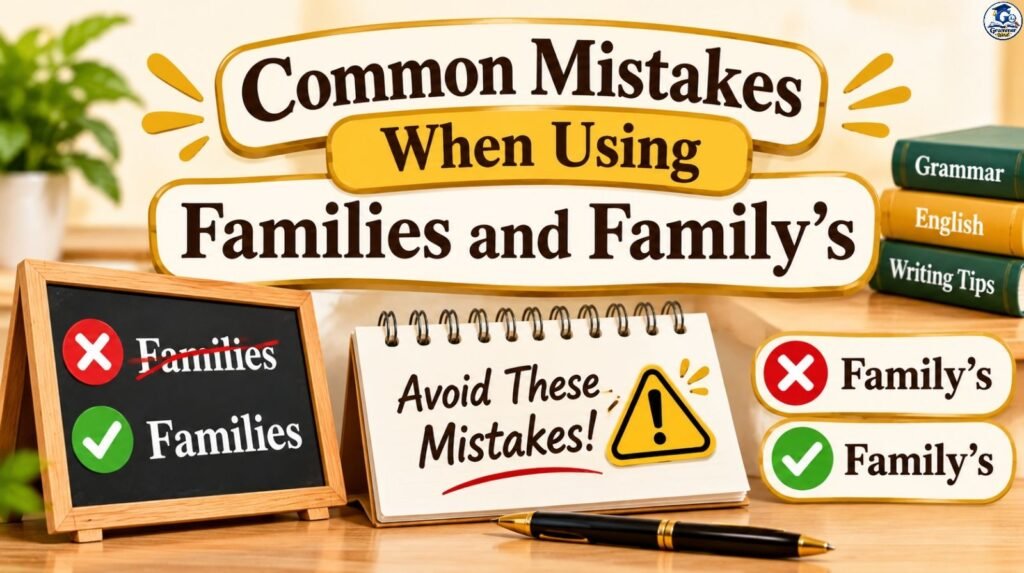
Even fluent English speakers sometimes confuse these forms, particularly when writing quickly.
Here are some common mistakes and how to correct them.
Mistake 1: Using Family’s Instead of Families
Incorrect: Many family’s attended the wedding.
Correct: Many families attended the wedding.
Explanation: The sentence refers to several households. Therefore, the plural form families is needed, not the possessive form family’s.
Mistake 2: Using Families Instead of Family’s
Incorrect: My families house is very large.
Correct: My family’s house is very large.
Explanation: The speaker is referring to one family’s house. The singular possessive form requires an apostrophe before the s.
Mistake 3: Confusing Family’s and Families’
Incorrect: The families’ home is located near the park. (If you mean one family’s home.)
Correct: The family’s home is located near the park.
Explanation: The placement of the apostrophe matters. Use family’s for one family and families’ for multiple families.
Mistake 4: Adding an Apostrophe to Make a Plural
Incorrect: Two family’s are moving next door.
Correct: Two families are moving next door.
Explanation: Apostrophes are not used to form ordinary plural nouns. The correct plural spelling is families.
Mistake 5: Misunderstanding the Contraction
Incorrect: My family’s very supportive. (If the intended meaning is unclear in a formal context.)
Better: My family is very supportive.
Explanation: Although family’s can represent family is, writing the complete phrase may make the meaning clearer, particularly in formal or professional communication.
Families vs. Family’s: Comparison in Everyday Situations
Understanding grammar rules is useful, but seeing these words in practical situations makes the difference easier to remember.
Here are some examples from everyday writing.
| Situation | Correct Example | Reason |
|---|---|---|
| Community event | Many families attended. | Multiple households |
| Personal property | My family’s car is new. | One family’s possession |
| School activity | Several families participated. | Multiple households |
| Family tradition | Our family’s tradition is special. | One family’s tradition |
| Shared concerns | The families’ concerns were heard. | Multiple families |
| Future plans | My family’s visiting tomorrow. | Family is visiting |
Example: Writing a School Announcement
Suppose a school administrator is preparing an announcement for parents.
Correct:
Dear Parents,
We are excited to welcome all families to our annual school celebration. Each family’s participation makes this event more meaningful, and we appreciate your continued support.
Thank you,
The School Administration
Why are both forms correct?
- Families refers to all the different households invited.
- Family’s refers to the participation of each individual family.
This example shows how both words can appear naturally in the same paragraph.
Example: Writing a Social Media Caption
Imagine that Olivia wants to share pictures from a holiday celebration.
Using Families:
“Beautiful memories created with wonderful families this holiday season!”
Using Family’s:
“Nothing feels better than spending time at my family’s home during the holidays.”
Both sentences are correct, but they communicate different meanings.
The first refers to multiple households, while the second refers to one family’s home.
Is Families or Family’s Correct?
Both families and family’s are correct English words. However, neither can replace the other in every sentence because they have different grammatical functions.
The correct choice depends on what you want to communicate.
Use families when referring to two or more families.
For example:
- Several families attended the meeting.
- Different families celebrate holidays in different ways.
- The organization provides assistance to families.
Use family’s when showing ownership or using a contraction.
For example:
- My family’s house is beautiful.
- Her family’s business is successful.
- My family’s coming home tonight.
If you are referring to something belonging to multiple families, use families’.
For example:
- The families’ opinions were considered.
- The families’ homes were inspected.
The key is to understand whether you are talking about multiple families, something belonging to one family, or something belonging to multiple families.
Simple Tricks to Remember the Difference
If you frequently confuse these words, a few simple tricks can help you choose the correct form.
1. Remember That Families Means More Than One
Think of families as the plural form of family.
If you can replace the word with multiple families, you probably need families.
Example:
Many families attended the event.
2. Remember That Family’s Shows Ownership
If something belongs to one family, use family’s.
Example:
My family’s house is beautiful.
Ask yourself: Whose house is it?
Answer: My family’s house.
3. Try the Is or Has Test
When you see family’s, try expanding it.
- Family’s = Family is
- Family’s = Family has
Example:
My family’s arriving soon.
My family is arriving soon.
If the expanded version makes sense, the contraction is correct.
4. Remember That Families’ Belongs to Multiple Families
When several families own or share something, place the apostrophe after the final s.
Example:
The families’ opinions were important.
This means the opinions belonged to or came from multiple families.
Frequently Asked Questions
Is Families or Family’s Correct?
Both are correct, but they have different meanings. Families is the plural form of family and refers to multiple households. Family’s is the singular possessive form or a contraction of family is or family has. The correct choice depends on the sentence.
What Is the Plural of Family?
The plural of family is families. To form the plural, replace the final y with ies. For example, “One family lives here” becomes “Several families live here.”
Is Family’s Possessive?
Yes. Family’s is the singular possessive form of family. It shows that something belongs to or is associated with one family. For example, “My family’s car is parked outside.”
What Is the Difference Between Families and Families’?
Families is the plural form of family and refers to multiple households. Families’ is the plural possessive form and indicates that something belongs to or is associated with multiple families. For example, “Many families attended” versus “The families’ homes were decorated.”
Is Families’ Grammatically Correct?
Yes. Families’ is grammatically correct when you want to show possession by multiple families. For example, “The families’ opinions were considered during the meeting.” The apostrophe comes after the final s because the noun is already plural.
Can Family’s Mean Family Is?
Yes. Family’s can be a contraction of family is. For example, “My family’s coming over tonight” means “My family is coming over tonight.” This construction is common in informal writing and everyday conversations.
Can Family’s Mean Family Has?
Yes. Family’s can also represent family has, particularly in present perfect constructions. For example, “My family’s lived here for ten years” means “My family has lived here for ten years.”
Should I Use Families or Family’s in Formal Writing?
Use whichever form matches your intended meaning. Families is appropriate when discussing multiple households, while family’s indicates singular possession or a contraction. In formal writing, spelling out family is or family has may improve clarity.
Why Is Family’s Sometimes Written With an Apostrophe?
The apostrophe in family’s indicates either possession or omitted letters in a contraction. It shows that something belongs to one family or that is or has has been shortened.
How Do You Use Families and Family’s in the Same Sentence?
You can use both forms in the same sentence when referring to multiple households and the possessions of individual households.
For example:
“Several families attended the event, and each family’s children participated in the games.”
Here, families refers to multiple households, while family’s indicates the possessions or association of each individual family.
Conclusion
Understanding families vs. family’s becomes much easier when you remember their different grammatical purposes.
Families is the plural form of family and refers to two or more households. Family’s is the singular possessive form, showing that something belongs to one family. It can also represent the contractions family is and family has.
There is also a third form worth remembering: families’, which shows possession by multiple families.
The simplest way to avoid mistakes is to consider the meaning of your sentence before choosing a spelling. If you are talking about multiple households, use families. If something belongs to one family, use family’s. If something belongs to several families, use families’.
With these simple rules and practical examples, you can use all three forms confidently in emails, professional writing, school assignments, and everyday conversations.
Discover More Articles
Keep learning with more easy grammar lessons on Grammer Word.

Hi, I’m Noor Fatima, the person behind this website. I created this site to make English grammar and confusing words easier to understand. I love breaking down tricky words, meanings, spellings, and grammar rules into simple explanations. My goal is to help you learn English naturally, avoid common mistakes, and feel more confident every time you write or speak.