You’re writing an email, a travel blog post, or a college essay, and you pause on one word: did you traveled or travelled? Spellcheck doesn’t flag either one, your favorite author uses one version, and a website you trust uses the other.
That inconsistency is confusing, and it can make your writing look careless if you mix the two by accident especially in professional or academic settings where polish matters.
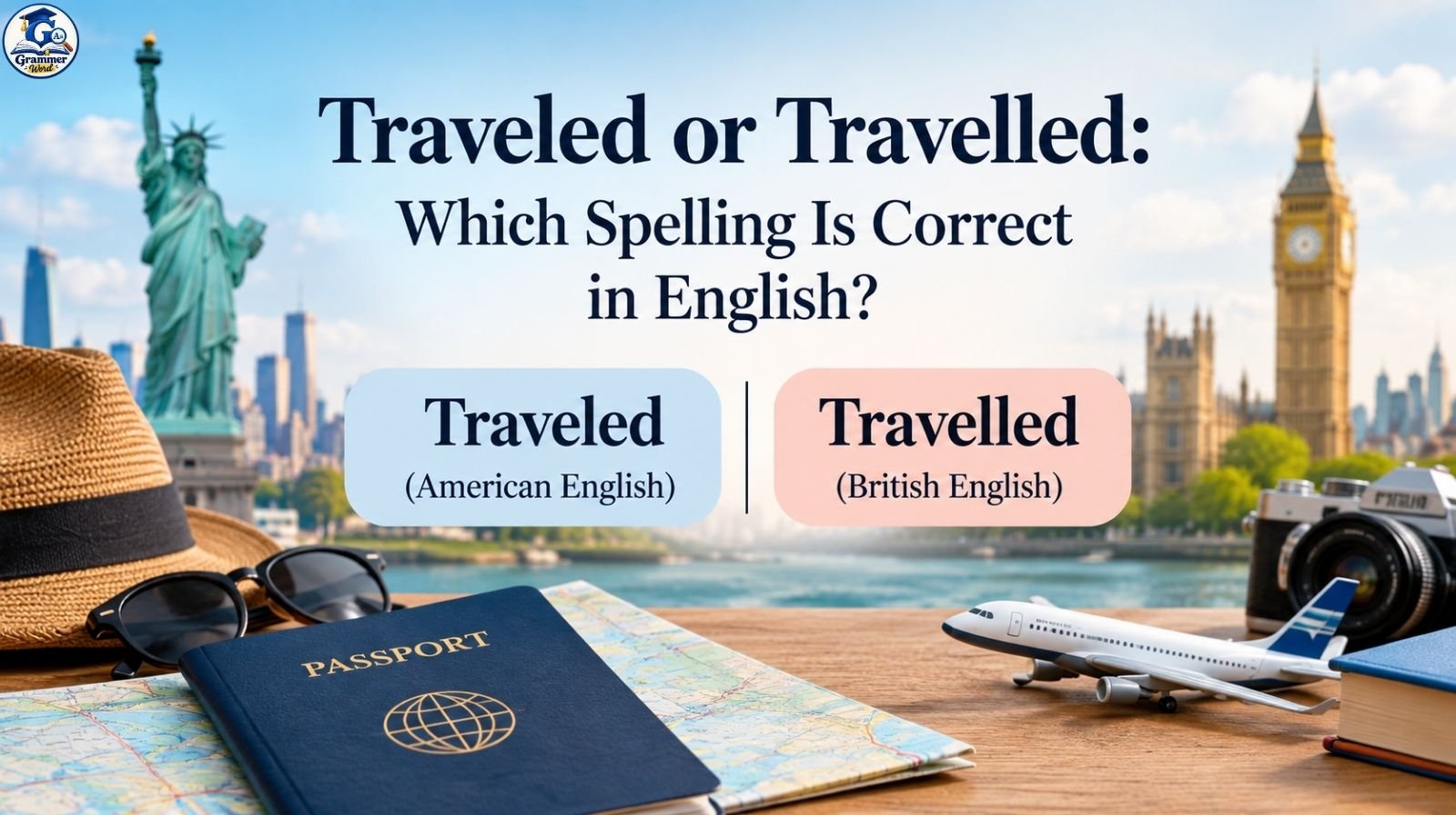
Here’s the short answer: both spellings are correct. The difference comes down to which variety of English you’re writing in, not a grammar rule you’ve forgotten.
Traveled is the standard American English spelling, while travelled is the standard British English spelling and once you know which audience you’re writing for, the choice becomes automatic.
This guide breaks down exactly why the two spellings exist, the linguistic rule behind them, how to choose the right one for your audience, and how to stay consistent across every related word form, so you never have to second-guess yourself again.
Read More: Girlie or Girly: Which Word Is Correct? Meaning, Usage, Differences, And Examples For 2026
What’s the Real Difference Between Traveled and Travelled?

The difference between traveled and travelled is purely regional. Both words are the past tense and past participle of the verb “travel,” and both are pronounced almost identically. Neither spelling is more “correct” in an absolute sense each one is correct within its own English variety.
This is fundamentally different from a true grammar error, where one form is simply wrong; here, you’re choosing between two equally valid regional standards.
- Traveled (one “l”) is used in American English.
- Travelled (two “l”s) is used in British English, along with Canadian, Australian, New Zealand, Irish, and most Commonwealth English.
For example:
- She traveled across Europe last summer. (American English)
- She travelled across Europe last summer. (British English)
Both sentences mean exactly the same thing. Therefore, the “right” spelling depends entirely on your audience, not on the rules of grammar. This is comparable to other well-known American vs. British spelling pairs, such as “color” vs. “colour” or “organize” vs. “organise,” where the underlying word and meaning never change.
Why Does This Spelling Split Exist?
The split traces back to 19th-century spelling reforms. American lexicographer Noah Webster, who published his influential dictionary in 1828, deliberately simplified many British spellings to make American English more phonetic, efficient, and visually distinct from British English.
He dropped extra letters from words like “colour” (color), “theatre” (theater), and “centre” (center) and, relevant here, reduced double consonants in words like “travelled” to “traveled.”
Webster’s motivations weren’t purely linguistic. Following American independence, there was a cultural push to establish a distinct national identity, and language was part of that project. Simplified spelling was seen as more democratic and accessible than the more ornate British conventions of the time.
Meanwhile, British English kept the older convention rooted in traditional English spelling rules, where a single-syllable suffix like “-ed” or “-ing” doubles the final consonant of a short verb, regardless of where the stress falls.
Does the Spelling Change the Meaning or Pronunciation?
No. This is one of the most reassuring facts for anyone confused by the traveled vs travelled debate: the meaning is identical, and native speakers pronounce both versions the same way roughly “TRAV-uhld.”
The only thing that changes is the written form, based on regional convention. If you read both spellings aloud to someone, they wouldn’t be able to tell which one you’d written down.
Read More: Midday vs Mid Day: Which Spelling Is Correct In Modern English?
The Spelling Rule Behind Traveled vs Travelled
Understanding the underlying spelling rule makes this far easier to remember than simply memorizing two versions of one word. Once you internalize the logic, you’ll be able to apply it instantly to dozens of similar verbs.
The British English Rule (Double “L”)
In British English, when a verb ends in a single vowel followed by a single “l” (like travel, cancel, or model), the final “l” is doubled before adding a suffix that starts with a vowel, such as “-ed,” “-ing,” or “-er.” This rule applies even though the stress doesn’t fall on the final syllable, which is unusual compared to how English normally handles consonant doubling in longer words.
- travel → travelled, travelling, traveller
- cancel → cancelled, cancelling, canceller
- model → modelled, modelling
- signal → signalled, signalling
The American English Rule (Single “L”)
American English generally follows the standard doubling rule more strictly: you only double the final consonant if the stress falls on the last syllable (like “occur” → “occurred,” or “begin” → “beginning”). Since the stress in “travel” falls on the first syllable (“TRAV-el,” not “trav-EL”), American English does not double the “l.”
- travel → traveled, traveling, traveler
- cancel → canceled, canceling
- model → modeled, modeling
- signal → signaled, signaling
This Pattern Applies to Other Words Too
Once you understand this rule, you’ll notice it in a whole family of verbs, not just “travel.” For example: labeled/labelled, fueled/fuelled, signaled/signalled, marveled/marvelled, and jeweler/jeweller all follow the same US/UK split.
If you’re consistent with “traveled,” you should be consistent with these related words too, since mixing conventions within a single document is one of the most common and most easily fixed spelling errors in professional writing.
It’s also worth noting that this rule doesn’t apply universally to every “l”-ending verb. Longer words with the stress on the final syllable, like “control” (controlled) or “excel” (excelled), double the “l” in both American and British English, because the stress rule is satisfied either way.
The traveled/travelled split specifically exists because “travel” is an exception where British English doubles the consonant despite the unstressed final syllable, and American English does not.
Traveled or Travelled: Which One Should You Use?
The practical answer depends entirely on your audience and the style guide you’re following, not on any inherent correctness of either form.
Use “Traveled” If You Are:
- Writing for a US-based company, publication, or client
- Following American style guides like AP Style or the Chicago Manual of Style
- Writing a school assignment or resume for an American institution
- Targeting a primarily American audience with your content
- Writing for a US-based app, product, or piece of software with American localization
Use “Travelled” If You Are:
- Writing for a UK, Irish, Australian, New Zealand, or Canadian audience
- Following British style guides such as those from Oxford University Press
- Working for a company headquartered in a Commonwealth country
- Publishing content aimed at international or European readers, where British spelling is more commonly taught in schools
- Writing for academic or government institutions in the UK or Commonwealth nations
Major dictionaries confirm this regional split. Merriam-Webster, the leading American dictionary, lists “traveled” as the primary spelling, while the Cambridge Dictionary and Oxford English Dictionary list “travelled” as standard British usage.
If you check either dictionary, you’ll also see the other spelling listed as a valid variant confirming that this is a matter of regional preference rather than one dictionary “correcting” the other.
Read More: Patients vs Patient’s: Meaning, Difference, And Correct Usage
What If You’re Not Sure Who Your Audience Is?
If your audience is mixed or global for example, an international blog or a brand with readers in both the US and UK the most important thing isn’t which spelling you pick. It’s staying consistent.
Choose one spelling convention for your entire piece of content and apply it uniformly, including to related words like “traveling/travelling” and “traveler/traveller.” Many international brands simply default to American English because it tends to have the largest single audience online, but this is a stylistic choice, not a rule.
If you manage a multilingual or multi-regional website, it’s also worth considering separate localized versions of your content for example, a “/en-us/” and “/en-gb/” path so each regional audience sees the spelling convention they expect.
This is a common practice among larger travel and e-commerce brands and can subtly improve trust and readability for regional visitors.
Real-Life Example: How This Trips Up Even Experienced Writers
Consider Sarah, a freelance content writer based in Canada who took on a contract with a US-based travel startup in 2025. Her early drafts consistently used “travelled,” “travelling,” and “traveller,” reflecting the Canadian English she’d grown up writing and reading.
The client’s editor flagged nearly a dozen instances in her first article, not because the spelling was wrong, but because it didn’t match the brand’s American style guide.
Sarah’s mistake wasn’t a lack of skill it was a mismatch between her instinctive spelling and her client’s target audience. Once she realized the issue, she set her word processor’s language setting to “English (United States)” and ran a full find-and-replace pass on her existing content.
This one change eliminated the inconsistency entirely and, according to her editor, made her copy read as noticeably more “on-brand” for American readers.
Sarah later mentioned that the experience changed how she approached every new client relationship. Before starting any project now, she asks two simple questions: which country is the client’s primary audience in, and does their style guide specify American or British English?
She keeps a short reference note with each client’s preferred spelling for “travel,” “color,” “organize,” and a handful of other commonly mismatched words, so she never has to rely on memory alone.
This example illustrates a broader lesson for writers, marketers, and students alike: spelling consistency signals professionalism. A single stray “travelled” in an otherwise American-English article can look like a typo, even though it’s technically correct in another English variety.
For freelancers and content teams working across borders, checking your target region’s style guide before you start writing not after your editor flags it saves time, avoids awkward revision rounds, and protects your credibility with clients.
Read More: This Is She or This Is Her? The Correct Way To Answer The Phone
Traveled vs Travelled: Usage Data and Trends
Spelling preference isn’t just a style-guide rule; it also reflects real population and platform data, which helps explain why both spellings remain so common online.
According to Ethnologue’s 2025 language data, there are roughly 390 million native English speakers worldwide, with the United States accounting for the largest single share at approximately 247–297 million American English speakers.
That population alone makes “traveled” the more frequently produced spelling in raw volume across US media, corporate content, and social platforms.
However, when you count the UK, Ireland, Canada, Australia, New Zealand, and the wider Commonwealth, along with the roughly 1.1–1.9 billion people who learn English as a second language many taught using British curricula in Europe, Africa, and parts of Asia “travelled” remains the more widely taught spelling globally, even if it’s not the most frequently produced one online.
This means a huge share of the world’s English learners are first introduced to “travelled” as the default form, even if they later encounter “traveled” through American media and software.
A few practical data points worth knowing for 2025–2026:
- Style guides like AP Style (used by most US newsrooms and marketing teams) mandate “traveled,” “traveling,” and “traveler” exclusively.
- Oxford style guides and most UK publishers mandate “travelled,” “travelling,” and “traveller.”
- SEO tools show measurable search volume for both terms, confirming that neither spelling has “won” globally search intent simply splits by region and device language settings.
- Most major word processors and browsers default to American English unless the user manually changes their language and region settings, which is one reason “traveled” appears slightly more often in casual online writing, even from non-American users.
The takeaway: neither spelling is disappearing or becoming obsolete. They coexist because English itself is regionally diverse, and both forms remain fully standard within their respective markets. Content creators, students, and businesses simply need to know which market they’re writing for.
Quick Reference: Traveled vs Travelled Comparison Table
| Feature | Traveled (American English) | Travelled (British English) |
|---|---|---|
| Spelling | One “l” | Two “l”s |
| Region | US | UK, Ireland, Australia, NZ, Canada* |
| Style guide | AP Style, Chicago Manual of Style | Oxford Style Guide |
| Related forms | traveling, traveler | travelling, traveller |
| Dictionary reference | Merriam-Webster | Cambridge Dictionary, Oxford English Dictionary |
| Pronunciation | Identical | Identical |
| Meaning | Identical | Identical |
| Common in | US publications, US software, resumes for US jobs | UK/Commonwealth publications, academic writing, international brands |
Canadian English is a hybrid; many Canadian publications use “travelled” but lean American on other spellings, so always check the specific style guide you’re following.
Read More: Masonary vs Masonry: Which Spelling Is Correct And Why It Matters
How to Choose the Right Spelling Every Time (Step-by-Step)
- Identify your audience. Are you writing primarily for American readers, or for a UK/international/Commonwealth audience? This single decision resolves almost every case.
- Check for an existing style guide. If you’re writing for a company, publication, or school, check whether they specify AP Style (American) or a British/Oxford style guide before you start drafting.
- Set your software’s language setting. In Word or Google Docs, set the document language explicitly to “English (US)” or “English (UK)” so spellcheck actively supports your choice instead of flagging the “wrong” one.
- Apply the rule to related words. Make sure “traveling/travelling” and “traveler/traveller” match your chosen spelling mixing them undermines consistency and can look like an oversight to careful readers.
- Extend the rule to similar verbs. Check other “l”-ending verbs like “cancel,” “model,” and “label” against the same standard, since they follow the identical US/UK pattern.
- Run a final consistency check. Before publishing, search your document for both spellings to confirm you haven’t accidentally mixed British and American forms, especially if you copied text from multiple sources.
Mini Quiz: Traveled or Travelled? Test Yourself!
Think you’ve got the traveled vs travelled rule down? Let’s find out. Fifteen quick questions, no pressure just a fun way to lock in what you just learned.
1. Which spelling is standard in American English?
A) Traveled B) Travelled
Answer: A) Traveled one “l” is the American way.
2. Which spelling is standard in British English?
A) Traveled B) Travelled
Answer: B) Travelled two “l”s, the British classic.
3. True or False: “Traveled” and “travelled” mean different things.
Answer: False same meaning, same pronunciation, just a regional spelling difference.
4. Fill in the blank (US style): She ___ to Italy last spring.
A) traveled B) travelled
Answer: A) traveled
5. Fill in the blank (UK style): He ___ across Scotland for weeks.
A) traveled B) travelled Answer: B) travelled
6. Who’s credited with simplifying American spelling in 1828?
A) Charles Dickens B) Noah Webster
Answer: B) Noah Webster his dictionary shaped American spelling as we know it.
7. Which style guide uses “traveled” as the standard?
A) AP Style B) Oxford Style Guide
Answer: A) AP Style
8. Which style guide uses “travelled” as the standard?
A) Chicago Manual of Style B) Oxford Style Guide
Answer: B) Oxford Style Guide
Read More: Possum or Opossum: What’s The Correct Spelling And Usage?
9. What’s the American spelling of the present participle: traveling or travelling?
Answer: Traveling one “l,” just like “traveled.”
10. What’s the British spelling for a person who travels a lot: traveler or traveller?
Answer: Traveller two “l”s, matching “travelled.”
11. True or False: Canadian English usually follows the American “traveled” spelling.
Answer: False Canadian English typically leans British here, using “travelled.”
12. Which word follows the SAME US/UK doubling pattern as “travel”?
A) Control B) Cancel
Answer: B) Cancel canceled/cancelled follows the identical rule.
13. Why doesn’t American English double the “l” in “traveled”?
A) Because the stress falls on the first syllable B) Because it’s a typo
Answer: A) American spelling doubles consonants only when the stress lands on the final syllable, and “TRAV-el” is stressed on the first.
14. If you’re writing a resume for a UK company, which spelling should you use?
A) Traveled B) Travelled
Answer: B) Travelled match the spelling to your audience, always.
15. True or False: Mixing “traveled” and “travelled” in the same document is totally fine.
Answer: False pick one and stay consistent throughout your writing for a polished, professional look.
FAQs
Q1. Is “traveled” or “travelled” more correct?
A: Neither is more correct. “Traveled” is standard in American English, and “travelled” is standard in British English. Both are grammatically correct within their respective varieties, and major dictionaries on both sides list the other version as an accepted variant.
Q2. Which spelling does Canada use?
A: Canadian English typically favors “travelled,” following British convention for this particular word, though Canadian spelling is a blend of American and British rules overall. Always check your specific publication’s style guide, since practices can vary by industry and organization.
Q3. Is “traveling” or “travelling” correct?
A: This follows the same regional rule as traveled/travelled. “Traveling” (one “l”) is American English, and “travelling” (two “l”s) is British English. Choose whichever matches the rest of your document.
Q4. What about “traveler” versus “traveller”?
A: Same pattern again: “traveler” is the American spelling, and “traveller” is the British spelling. Keep this consistent with whichever version of “traveled” you’re using.
Q5. Does Google penalize a website for using both spellings?
A: No, Google doesn’t penalize sites for regional spelling variants. However, inconsistency within a single page can look unpolished to readers and may slightly hurt readability signals, so it’s best practice to standardize on one spelling per document or site.
Q6. Which spelling should I use for a resume or job application?
A: Match the spelling convention of the country and company you’re applying to. If you’re applying to a US company, use “traveled”; for a UK or Commonwealth company, use “travelled.” This small detail can subtly signal attention to regional detail to hiring managers.
Q7. Can I use either spelling on my personal blog?
A: Yes. If you have a global audience with no specific regional focus, either spelling works, but consistency throughout your content matters more than which one you pick. Pick one and stick with it across every post.
Q8. Do other “l” verbs follow the same rule as travel?
A: Yes, most short verbs ending in a single “l” preceded by a single vowel follow this pattern, including cancel, model, label, signal, and fuel. Longer verbs where the stress falls on the final syllable, like “control” or “excel,” double the “l” in both American and British English.
Final Thoughts
The traveled vs travelled debate isn’t really a grammar problem it’s a regional style choice rooted in 19th-century spelling reform.
Traveled belongs to American English, travelled belongs to British English, and both are fully correct in their own context.
What matters most is identifying your audience, picking one spelling, and staying consistent across every related word form, from “traveling” to “traveler,” and even to other short “l”-ending verbs like “canceled” or “modeled.”
Next time you pause over this word, ask yourself one simple question: who am I writing for? Once you know the answer, the correct spelling of traveled or travelled follows automatically and your writing will read as polished, professional, and regionally accurate every time you use it.
Discover More Article
- Whoever or Whomever: A Complete Guide To Correct Usage
- Discrete vs Discreet: Which One Should You Use?
- Nosy or Nosey? The Correct Spelling Explained (With Examples)
Keep learning with more easy grammar lessons on Grammer Word.com

Hi, I’m Noor Fatima, the person behind this website. I created this site to make English grammar and confusing words easier to understand. I love breaking down tricky words, meanings, spellings, and grammar rules into simple explanations. My goal is to help you learn English naturally, avoid common mistakes, and feel more confident every time you write or speak.