Have you ever paused while writing an email, essay, or professional message because you were unsure whether to write refer or reffer? You are not alone.
English spelling can be confusing, especially when adding endings changes how a word is written.
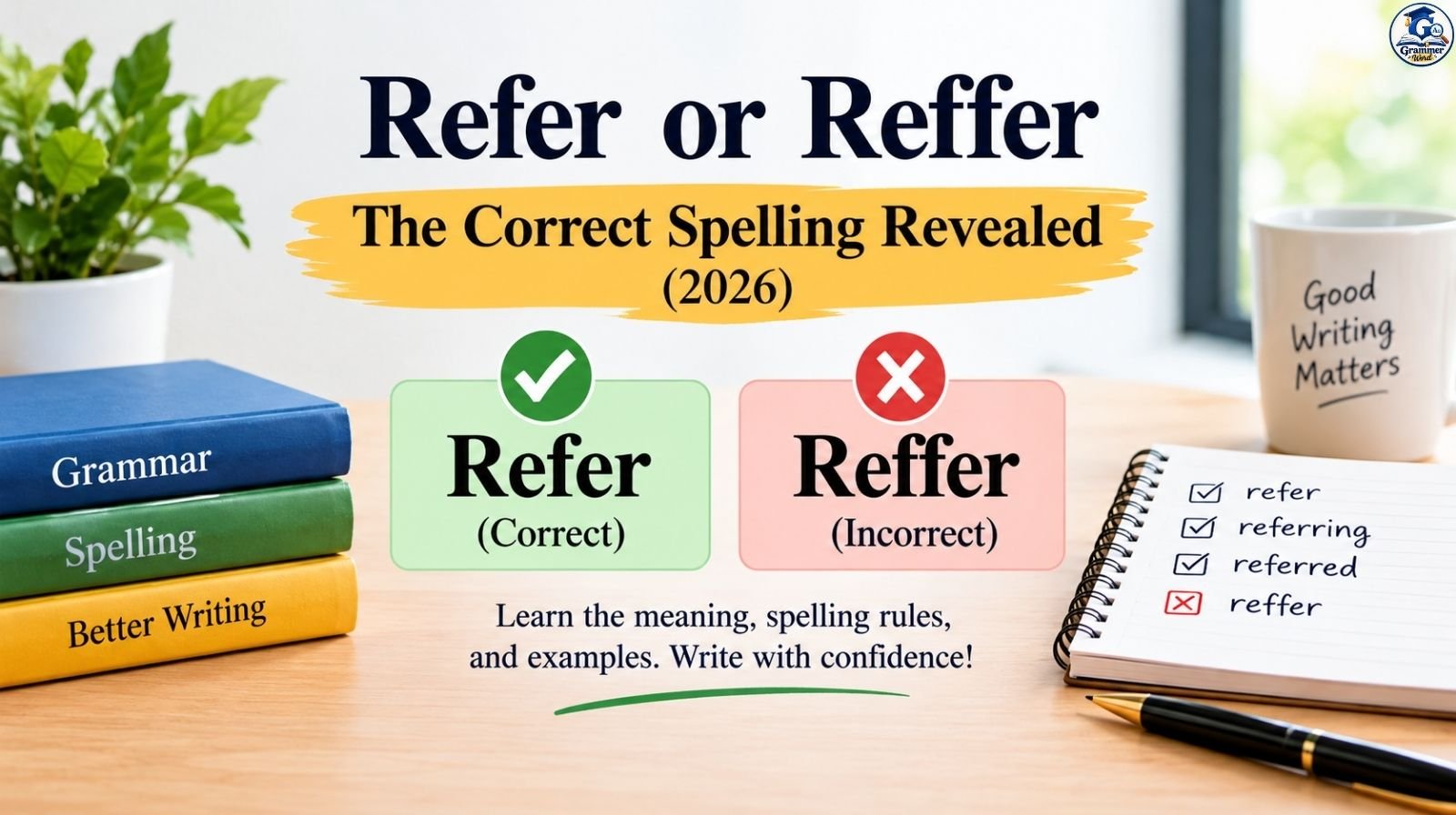
The correct spelling is refer, with one “f.” The word reffer is a common misspelling and is not accepted as the standard spelling in modern English.
However, when you add certain endings, the spelling changes: refer becomes referring or referred, with a double “r.”
In this guide, you will learn the difference between refer and reffer, understand the spelling rule, explore practical examples, and discover how to avoid this mistake in everyday writing.
Read More: Fluorescent vs Flourescent: Difference And Usage
What Is the Correct Spelling: Refer or Reffer?
The correct spelling is refer. It is a standard English verb used when directing someone to a source, mentioning something, or recommending a person or service.
Reffer is incorrect in standard English. Although people sometimes type it because they are unsure about the spelling rule, it should not be used in formal or informal writing.
What Does Refer Mean?
The verb refer has several common meanings, depending on the context.
- To mention something: She referred to the report during the meeting.
- To direct someone to a source: Please refer to the instructions before starting.
- To recommend someone: I can refer you to an experienced doctor.
- To send someone to a specialist: The general practitioner may refer the patient to a specialist.
Each example uses the same base word, refer, with the spelling adjusted when necessary to form a different verb tense.
Why Is Reffer Incorrect?
The spelling reffer incorrectly doubles the final “f.” The standard base form contains only one “f” and one “r” at the end: r-e-f-e-r.
For example:
- Correct: Please refer to the official guidelines.
- Incorrect: Please reffer to the official guidelines.
- Correct: I will refer my friend to your business.
- Incorrect: I will reffer my friend to your business.
Remember that the base form is refer, even though some of its grammatical forms contain a doubled consonant.
Refer vs. Reffer: Understanding the Difference
The main difference between refer and reffer is correctness. Only refer is the standard spelling of the verb.
Read More: Leafs vs Leaves: Which Is Correct And How To Use Them?
Refer vs. Reffer Comparison Table
| Feature | Refer | Reffer |
|---|---|---|
| Spelling status | Correct | Incorrect |
| Standard English usage | Yes | No |
| Meaning | To mention, direct, or recommend | No standard meaning as this verb |
| Suitable for professional writing | Yes | No |
| Example | Refer to the manual. | Reffer to the manual. |
Examples of Refer in Everyday Writing
Here are some natural examples showing how to use refer correctly.
- Academic writing: Refer to Chapter 4 for additional information.
- Business communication: I would like to refer a qualified candidate for the position.
- Everyday conversation: You can refer to the map if you get lost.
- Healthcare: The doctor may refer you to a specialist.
- Customer service: Please refer to your order number when contacting support.
In each sentence, refer is spelled with one “f.” Choosing the correct spelling helps your writing appear clear and professional.
Common Mistakes to Avoid
One of the most common mistakes is assuming that refer always keeps the same final spelling when an ending is added.
Compare these forms:
- Refer correct base form.
- Referring correct present participle.
- Referred correct past tense and past participle.
- Reference correct related noun.
- Reffer incorrect spelling of the intended base verb.
The important lesson is that the spelling depends on the form of the word. Doubling a consonant in referring does not make reffer correct.
Read More: Aluminum vs Aluminium: What’s The Difference And Which Spelling Is Correct?
Why Does Refer Become Referring and Referred?
English spelling rules explain why refer has one “r” in its base form but two “r”s in referring and referred.
The Consonant-Doubling Rule
In English, a short verb that ends in a consonant-vowel-consonant pattern often doubles its final consonant before adding an ending that begins with a vowel, such as -ing or -ed.
For example:
- Refer → referring
- Refer → referred
- Prefer → preferring
- Prefer → preferred
- Admit → admitting
- Admit → admitted
In refer, the final consonant is “r.” When the suffix is added, the final “r” is doubled to preserve the pronunciation of the stressed final syllable.
This rule explains why referring is correct but reffer is not.
When Should You Use Refer, Referring, or Referred?
Use the form that matches your sentence’s meaning and grammatical tense.
Refer: Use it for the base form, including after modal verbs and in the infinitive.
- I will refer to the document.
- Please refer to the instructions.
- We need to refer this issue to management.
Referring: Use it for an ongoing action or as a participle.
- She is referring to the latest report.
- The email is referring to an earlier conversation.
Referred: Use it for a completed action or in passive constructions.
- He referred me to a specialist.
- The case was referred to the appropriate department.
Understanding these forms will help you avoid spelling errors without having to memorize every sentence individually.
Read More: Period Inside or Outside Quotes? American vs. British Rules
How to Remember the Correct Spelling of Refer
Learning a simple spelling strategy can help you write refer correctly whenever you need it.
Use a Simple Memory Trick
Remember this rule:
One “f” in refer, but double the “r” in referring and referred.
You can practice by writing these three forms together:
- Refer the base verb.
- Referring the ongoing action.
- Referred the past action.
Seeing the words side by side makes the pattern easier to remember.
Read More: Afterward or Afterwards: Which Spelling Is Correct?
Follow This Quick Spelling Checklist
Before submitting an email, essay, report, or social media post, check the following:
- Use refer when writing the base verb.
- Use referring when describing an ongoing action.
- Use referred for the past tense or past participle.
- Avoid reffer when you mean the standard English verb.
- Read the complete sentence to confirm that the verb form fits the context.
For example, write “I am referring to your previous email,” not “I am reffering to your previous email.”
The correct spelling is referring, with a doubled “r,” not a doubled “f.”
Real-Life Example: Using Refer Correctly at Work
Imagine that Sarah works as a customer support representative for an online store. A customer contacts her because a recent order has not arrived. Sarah checks the order details but discovers that the shipping issue must be handled by another department.
While drafting her response, she hesitates between refer and reffer. She wants her message to sound professional, so she checks the spelling before sending it.
Sarah writes:
“Thank you for contacting us about your delayed order. I will refer your case to our shipping department for further investigation. Our team will review the details and provide an update as soon as possible.”
Her message uses refer correctly because she is describing an action she intends to take. If she later explains what happened, she might write, “I referred the case to the shipping department.”
If she describes the action in progress, she could say, “I am referring the case to the shipping department.”
These forms demonstrate how the same verb changes according to tense and sentence structure.
Read More: What Kind of vs What Kinds of: Which One Is Correct?
Now imagine that Sarah had written, “I will reffer your case to our shipping department.” The intended meaning would probably remain understandable, but the spelling error could make the message appear less polished and professional.
This example illustrates why spelling matters in practical communication. Whether you are writing customer emails, business reports, school assignments, or everyday messages, choosing the correct form helps you communicate clearly and confidently.
Spelling and Grammar: What the Available Data Tells Us

Spelling questions such as refer or reffer are part of a broader challenge in English writing: distinguishing a word’s base form from its inflected forms.
Understanding the Evidence
There is no reliable, verified 2025–2026 statistic establishing how many people misspell refer specifically as reffer. It would be misleading to invent a percentage or claim that a particular number of writers make this mistake.
However, established English dictionaries and spelling references provide a dependable basis for resolving the question:
- Cambridge Dictionary: Its entry for refer documents the standard spelling, meaning, and grammatical forms.
- Merriam-Webster: Its entry for refer provides definitions and usage information.
- Google Search Central: Its guidance on helpful, reliable content emphasizes creating useful content for readers rather than writing primarily to manipulate search rankings.
These resources serve different purposes. Dictionaries establish accepted spelling and usage, while Google’s guidance helps content creators focus on reader needs and trustworthy explanations.
Why This Matters for Modern Writing
In 2026, people write across emails, messaging platforms, online forms, academic documents, and professional websites. Correct spelling helps readers understand messages and supports a polished writing style.
For this particular question, the evidence-based answer remains straightforward: refer is correct, while reffer is a misspelling of the intended verb. The related forms referring and referred follow the consonant-doubling rule.
Read More: Mathew or Matthew: Which Spelling Is Correct?
Frequently Asked Questions
Q1. Is refer or reffer correct?
Refer is correct. Reffer is a misspelling when used as the standard English verb meaning to mention, direct, or recommend.
Q2. Why does referring have two r’s?
The final “r” is doubled when the suffix -ing is added to refer. This follows the English consonant-doubling rule for certain verbs with a stressed final syllable.
Q3. Is reffer ever an acceptable spelling?
No. Reffer is not the standard spelling of the verb refer. Use refer in formal writing, professional communication, and everyday English.
Q4. What is the past tense of refer?
The past tense is referred, with two “r”s at the end. For example: “She referred me to the correct department.”
Q5. Is it referring or reffering?
The correct spelling is referring. It contains one “f” and two consecutive “r”s at the end of the base word before the -ing ending is completed.
Q6. How do I use refer in a sentence?
You can write, “Please refer to the user manual for additional instructions.” Here, refer means to consult or look at a source for information.
Q7. What is the noun form of refer?
A common noun form is reference. For example: “The article includes a reference to an earlier study.” The related word referral is also used when someone is directed to a person, service, or specialist.
Conclusion:
When deciding between refer or reffer, the correct choice is refer. It is the standard English verb used to mention something, consult a source, or recommend someone. The spelling reffer is incorrect when used with this intended meaning.
Remember the related forms: refer, referring, and referred. The base word contains one “f,” while the final “r” doubles in referring and referred.
Whether you are writing a school assignment, professional email, business report, or online article, choosing the correct spelling makes your writing clearer and more polished.
Ready to improve your English spelling? Practice using refer, referring, and referred in your own sentences, and check your writing before publishing or sending it. A small spelling habit can make a meaningful difference in everyday communication.
Keep learning with more easy grammar lessons on Grammer Word

Hi, I’m Noor Fatima, the person behind this website. I created this site to make English grammar and confusing words easier to understand. I love breaking down tricky words, meanings, spellings, and grammar rules into simple explanations. My goal is to help you learn English naturally, avoid common mistakes, and feel more confident every time you write or speak.