Have you ever wondered whether wholey or wholly is the correct spelling? English spelling can be confusing, especially when a word looks as though it should follow a familiar spelling pattern.
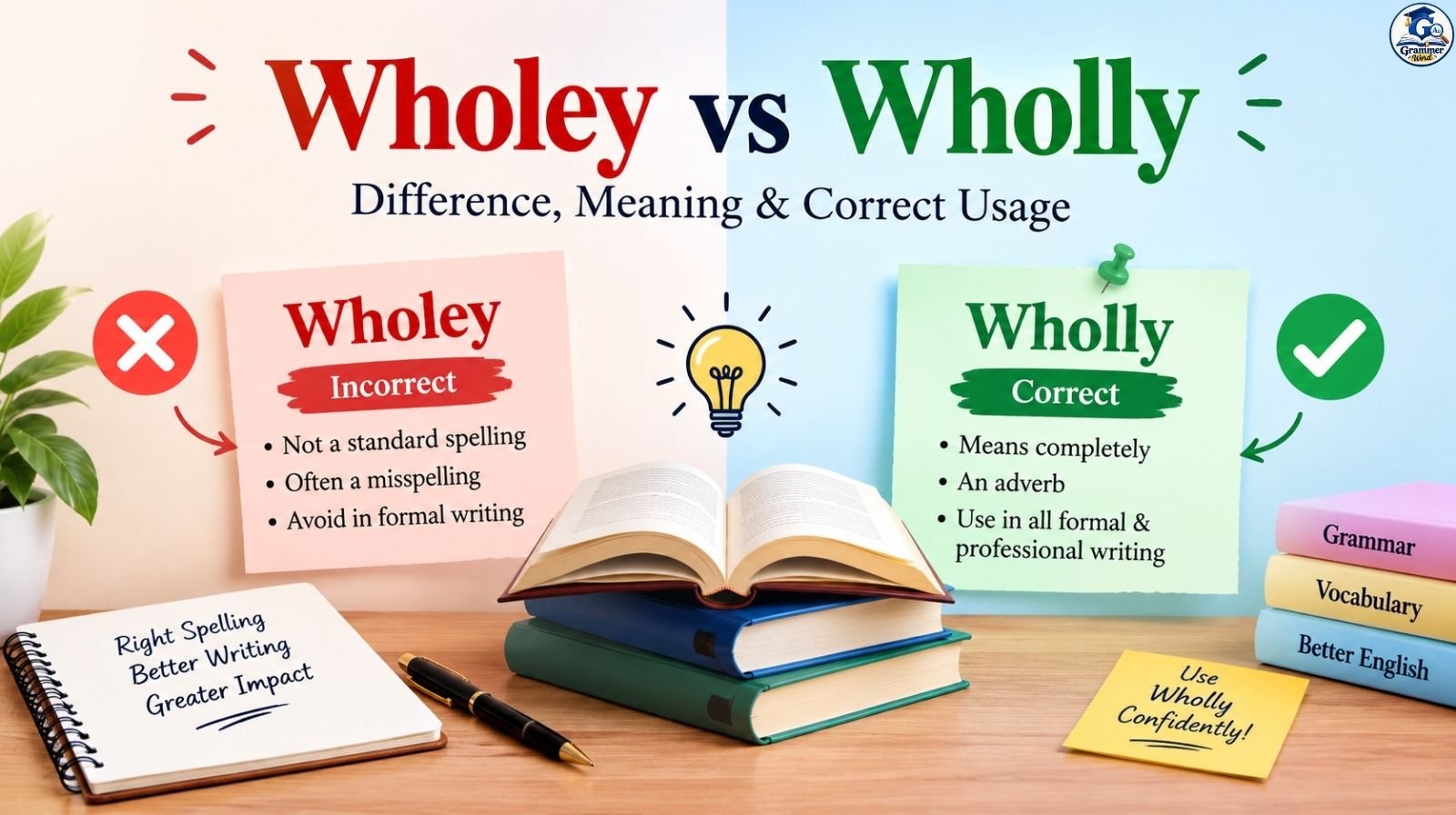
When comparing wholey vs wholly, the correct spelling in standard modern English is wholly. It is an adverb meaning completely, entirely, or totally. Wholey is generally considered a misspelling when used with this intended meaning.
In this guide, you will learn the difference between whole and wholly, understand why spelling mistakes happen, and discover practical examples to help you use the correct word confidently in everyday and professional writing.
Read More: To Much or Too Much: Which One Is Correct?
What Is the Difference Between Wholey and Wholly?
The main difference between wholey and wholly is spelling. Wholly is the standard spelling of the adverb meaning completely or entirely, whereas wholey is generally a spelling error when that meaning is intended.
Wholly: Meaning and Definition
Wholly is an adverb that describes something as complete or total. It can express complete agreement, responsibility, ownership, or the extent of a situation.
Examples:
- I wholly agree with your decision.
- The project was wholly funded by donations.
- She was wholly responsible for the mistake.
- The explanation was not wholly convincing.
In these sentences, wholly emphasizes how completely something is true or applies.
For a dictionary definition, consult the Cambridge Dictionary’s entry for wholly.
Wholey: Why Is It Usually Incorrect?
When writers want to express the meaning “completely,” they sometimes write wholey because it resembles the word whole. However, the accepted spelling of the adverb in standard contemporary English is wholly.
For example:
- Incorrect: The decision was wholey justified.
- Correct: The decision was wholly justified.
The safest approach is to use wholly in essays, business emails, blog posts, reports, and other standard writing.
Read More: Greatful or Grateful: Which One Is Correct?
Quick Comparison Table
| Feature | Wholly | Wholey |
|---|---|---|
| Standard spelling for “completely” | Yes | No |
| Meaning | Completely or entirely | Usually an attempted spelling of wholly |
| Part of speech | Adverb | Not standard in this usage |
| Formal writing | Recommended | Avoid |
| Example | The plan was wholly successful. | Use wholly instead. |
Why Is Wholly Spelled Without the E?
The spelling of wholly can seem unusual because the related adjective, whole, ends in an e. Understanding how the two words function can help you remember the correct form.
Understanding the Word Formation
Whole is an adjective that means complete or entire. Wholly is the related adverb that means completely or entirely.
When forming adverbs, English spelling does not always follow one universal rule. Some words drop a final e, while others retain it.
Compare these examples:
- Whole → wholly
- True → truly
- Gentle → gently
- Sole → solely
These examples illustrate why it is helpful to learn established spellings instead of relying entirely on a spelling pattern.
Why Writers Confuse Wholly With Wholely
The spelling wholely may look logical because it appears to combine whole with -ly. Nevertheless, familiar-looking word formations are not always correct.
For example:
- Incorrect: The company is wholely independent.
- Correct: The company is wholly independent.
This small spelling difference matters when you want your writing to look polished and professional.
An Easy Memory Trick
Remember this sentence:
“The whole project was wholly completed.”
In this sentence, whole describes the project, while wholly means completely.
Practise the sentence a few times to reinforce the difference between the adjective and the adverb.
Read More: There or Their: Clear Guide To Correct Usage
How to Use Wholly Correctly in Everyday English
Wholly is useful when you want to communicate complete agreement, responsibility, ownership, or the full extent of a condition.
Using Wholly in Formal Writing
In professional and academic writing, wholly can communicate a precise meaning without unnecessary words.
Examples:
- The research findings were wholly consistent with the original hypothesis.
- The policy is wholly inadequate for addressing the problem.
- The organization is wholly committed to improving education.
In each example, wholly emphasizes the extent of a condition or commitment.
Using Wholly in Everyday Conversations
Although wholly can sound formal, it also works in everyday communication.
Examples:
- I wholly agree with you.
- That is a wholly different situation.
- I was wholly unprepared for the surprise.
In casual conversations, you might prefer completely or totally. These alternatives often sound more natural, depending on the context.
Read More: Ageing or Aging: Which Spelling Is Correct? A Simple, Clear Guide
Common Synonyms for Wholly
Here are several words that can help you express a similar meaning.
| Synonym | Example |
|---|---|
| Completely | I completely understand. |
| Entirely | The room was entirely empty. |
| Totally | I totally agree. |
| Fully | She fully understood the instructions. |
| Altogether | The plan was altogether unsuitable. |
These words have overlapping meanings, but they are not interchangeable in every sentence. Choose the word that fits your intended meaning and tone.
A Real-Life Example: Correcting Wholly in a Blog Post
Imagine a student named Sara who is preparing an English assignment about environmental protection. She writes the following sentence in her first draft:
“The success of environmental programs depends wholely on public participation.”
Sara believes the spelling is correct because she has taken the adjective whole and added -ly. However, while proofreading her assignment, she decides to check the word in an English dictionary.
She discovers that the standard spelling is wholly. She revises her sentence:
“The success of environmental programs depends wholly on public participation.”
The revised sentence preserves her intended meaning while following standard modern English spelling.
Sara then reviews the rest of her assignment and finds another sentence: “The community was wholely responsible for organizing the event.” She changes it to “The community was wholly responsible for organizing the event.”
Read More: Carmel or Caramel: Which One Is Correct?
Finally, she checks the remaining paragraphs for similar errors and reads the assignment aloud to identify awkward phrasing.
This example demonstrates a useful editing habit: when a word looks unusual, verify its spelling instead of relying only on how it appears to be formed.
For students, bloggers, and professional writers, a quick dictionary check can improve accuracy and help readers focus on the message rather than spelling mistakes.
Wholly vs Wholey: Spelling Facts and Data for 2025–2026
Reliable spelling guidance should rely on established dictionary usage and verifiable data rather than unsupported claims about how often people make mistakes.
What Dictionaries Say
Established English references, including the Cambridge Dictionary and the Merriam-Webster Dictionary, provide definitions and usage information for wholly.
These references support using wholly to express the meaning “completely” or “entirely.”
What Recent Search Data Can Tell Us
Google’s Year in Search reports provide insights into search interests across different years. However, broad search trends do not establish how often people misspell a specific word such as wholly.
As of October 2026, this article does not cite a verified, word-specific 2025–2026 statistic for searches or spelling errors involving wholey and wholly. Providing an unsupported number would be misleading.
Instead, use the following practical checklist to verify spelling:
- Look up the word in a reputable dictionary.
- Confirm its definition and part of speech.
- Review example sentences to understand how it is used.
- Apply the standard spelling consistently throughout your writing.
You can also explore Google Trends to compare search interest in different spellings, where sufficient data is available. Search interest should not be confused with the actual number of spelling errors.
Read More: Lay Down or Lie Down – What’s The Correct Usage?
Common Mistakes to Avoid When Writing Wholly
Learning the correct spelling is the first step. Using the word naturally and distinguishing it from related words will make your writing even stronger.
Writing Wholey or Wholely
When you intend to express the meaning “completely,” use wholly.
- Incorrect: I am wholely satisfied with the result.
- Correct: I am wholly satisfied with the result.
Similarly, avoid wholey when you mean completely or entirely.
Confusing Wholly With Whole
Although these words are related, they serve different grammatical functions.
- Whole: Usually an adjective meaning complete or entire.
- Wholly: An adverb meaning completely or entirely.
Examples:
- She ate the whole cake.
- She was wholly satisfied with the meal.
The first sentence describes the cake, while the second describes the extent of her satisfaction.
Overusing Wholly
Wholly is correct, but repeating it unnecessarily can make your writing sound awkward.
For example:
- Repetitive: The report was wholly complete and wholly accurate.
- More natural: The report was complete and accurate.
Use wholly when it adds useful emphasis. Otherwise, a simpler sentence may communicate your point more effectively.
Mini Quiz: Wholey vs Wholly
Ready to test your spelling skills? 😊 Try these 15 quick and easy questions to see if you can spot the difference between wholey vs wholly. Each answer appears right after the question, so you can learn as you go!
1. Which spelling is correct in standard English?
A) Wholey B) Wholly C) Wholeyly D) Wholley
Answer: B) Wholly
2. What does “wholly” mean?
A) Partly B) Slowly C) Completely D) Rarely
Answer: C) Completely
3. Fill in the blank: “I ____ agree with you.”
A) Wholey B) Wholly C) Whole D) Wholely
Answer: B) Wholly
4. True or False: “Wholey” is the standard spelling when you mean “entirely.”
Answer: False. The standard spelling is wholly.
5. Choose the correctly spelled sentence.
A) The plan was wholely successful. B) The plan was wholly successful. C) The plan was wholey successful. D) The plan was wholley successful.
Answer: B) The plan was wholly successful.
6. What part of speech is “wholly”?
A) Noun B) Verb C) Adjective D) Adverb
Answer: D) Adverb
7. Complete the sentence: “She was ____ unprepared for the exam.”
A) Whole B) Wholly C) Wholey D) Wholely
Answer: B) Wholly
8. Which word is closest in meaning to “wholly”?
A) Completely B) Occasionally C) Partially D) Carefully
Answer: A) Completely
9. True or False: “Whole” and “wholly” have exactly the same grammatical function.
Answer: False. Whole is usually an adjective, while wholly is an adverb.
10. Which sentence is correct for professional writing?
A) The company was wholely independent. B) The company was wholey independent. C) The company was wholly independent. D) The company was wholley independent.
Answer: C) The company was wholly independent.
11. Which spelling should you use in an academic essay?
A) Wholey B) Wholely C) Wholly D) Wholley
Answer: C) Wholly
12. Fill in the blank: “The result was ____ unexpected.”
A) Wholey B) Whole C) Wholly D) Wholely
Answer: C) Wholly
13. Which word means “complete or entire”?
A) Wholly B) Whole C) Wholley D) Wholey
Answer: B) Whole
14. Which sentence uses “wholly” correctly?
A) I wholly understand the instructions. B) I wholly the instructions. C) I am wholly the instructions. D) I wholly understanding the instructions.
Answer: A) I wholly understand the instructions.
15. What is the best way to remember the correct spelling?
A) Always write “wholey.” B) Always write “wholely.” C) Remember the standard spelling “wholly.” D) Use “wholley” in formal writing.
Answer: C) Remember the standard spelling “wholly.”
Frequently Asked Questions
Q1. Is Wholly or Wholey Correct?
Wholly is the standard spelling in modern English when you mean completely or entirely. Wholey is generally a misspelling in this context.
Q2. What Does Wholly Mean?
Wholly is an adverb meaning completely, entirely, or totally. For example, “The decision was wholly unexpected” means the decision was completely unexpected.
Q3. Is Wholely Ever Correct?
Wholely appears historically as an alternative spelling in some sources, but it is not the standard contemporary spelling. For modern standard English, use wholly.
Q4. What Is the Difference Between Whole and Wholly?
Whole is usually an adjective meaning complete or entire, while wholly is an adverb meaning completely or entirely.
Example: “The whole team was wholly prepared.”
Q5. Can I Use Wholly in Academic Writing?
Yes. Wholly is appropriate in academic writing when you need to express complete agreement, responsibility, dependence, or the full extent of a condition.
Q6. What Are Some Synonyms for Wholly?
Common synonyms include completely, entirely, totally, fully, and altogether. The most suitable choice depends on the sentence and the meaning you want to communicate.
Conclusion:
When comparing wholey vs wholly, remember that wholly is the standard modern English spelling for the meaning “completely” or “entirely.”
Although wholey and wholely may look plausible, they are not the spellings you should normally use in contemporary writing.
To improve your spelling, remember the difference between whole and wholly, practise the examples in this guide, and consult a trusted dictionary whenever you are unsure.
Ready to improve your English? Bookmark this guide, practise using wholly in your own sentences, and share it with someone who wants to write more confidently.
Discover More Article
- Dieing or Dying: Which One Is Correct?
- Too or To: Complete Guide To Correct Usage
- Toward or Towards Explained: Simple Grammar Guide You Need
- CatchUp vs Catch Up: Differences, Meaning, And Correct Usage
Keep learning with more easy grammar lessons on Grammer Word.com

Hi, I’m Noor Fatima, the person behind this website. I created this site to make English grammar and confusing words easier to understand. I love breaking down tricky words, meanings, spellings, and grammar rules into simple explanations. My goal is to help you learn English naturally, avoid common mistakes, and feel more confident every time you write or speak.