If you often pause when writing complement vs compliment, you’re not alone. These two words sound the same, look almost identical, and are both perfectly valid English words. The problem is that they have completely different meanings.
The good news? Once you understand the difference, choosing the right word becomes surprisingly easy. Complement relates to completing, improving, or matching something, while compliment relates to praise or admiration.
In this guide, you’ll learn exactly when to use each word, see practical examples, discover an easy memory trick, and understand related words such as complementary and complimentary.
Complement vs Compliment: What Is the Difference?
The simplest way to remember the difference is this:
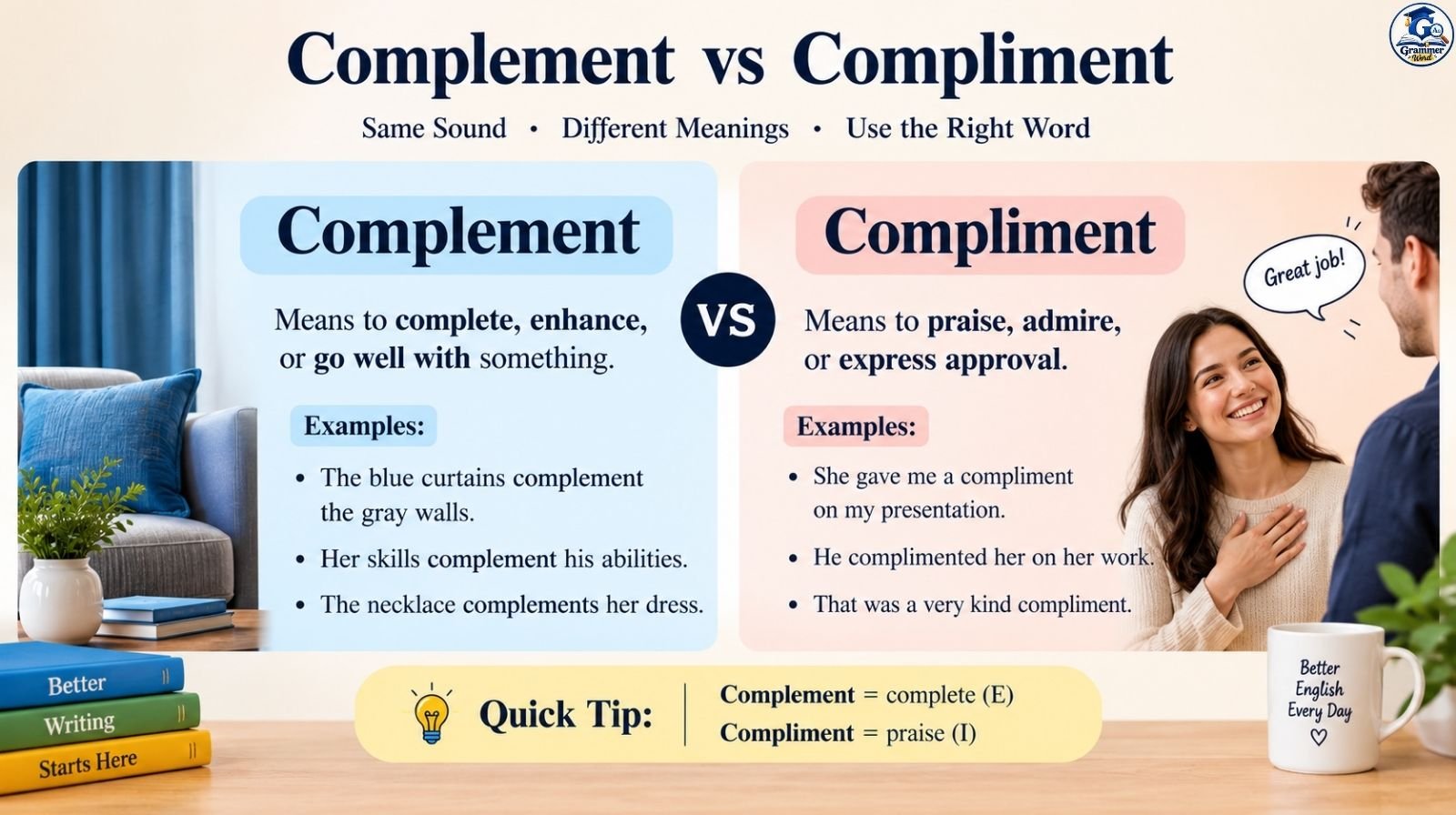
Complement = complete, enhance, or go well with something.
Compliment = praise or admiration.
Although complement and compliment are pronounced the same in standard English, they have different spellings and meanings.
They are therefore a classic example of homophones words that sound alike but have different meanings and spellings.
What Does Complement Mean?
Complement means something that completes, improves, balances, or works well with something else.
It can be used as both a noun and a verb.
For example:
- The blue curtains complement the gray walls.
- Her technical skills complement his creative abilities.
- The sauce is a perfect complement to the dish.
- These shoes complement your outfit.
Think of complete when you see the spelling complement. The two words share the important “comple-“ beginning.
What Does Compliment Mean?
Compliment means an expression of praise, admiration, approval, or respect.
It can also function as both a noun and a verb.
For example:
- She gave me a compliment about my presentation.
- He complimented her on her new dress.
- My manager complimented me on my work.
- That was a very kind compliment.
A simple way to think about it is: compliment = praise.
Scribbr and IDP both make the same fundamental distinction: compliment is associated with praise, while complement refers to completing, enhancing, or fitting well with something.
Complement vs Compliment Examples in Real Sentences
Seeing the words in context makes the distinction much easier. The key question is whether you’re talking about praise or something that works well with something else.
Examples of Complement
Use complement when something completes, enhances, balances, or matches another thing.
Example 1:
The red tie complements his black suit.
Here, the tie isn’t praising the suit. It enhances the overall appearance.
Example 2:
The fresh herbs complement the flavor of the soup.
The herbs work well with the soup and improve its overall flavor.
Example 3:
Their different skills complement each other.
Their abilities work well together and create a stronger combination.
Example 4:
The new lighting is a beautiful complement to the room.
The lighting adds something that improves the room.
Examples of Compliment
Use compliment when someone is giving or receiving praise.
Example 1:
Sarah complimented me on my presentation.
She praised your presentation.
Example 2:
I received a nice compliment from my teacher.
The teacher expressed approval or admiration.
Example 3:
He complimented her on her writing.
He praised her writing.
Example 4:
“Your article is very clear” is a compliment.
The speaker is expressing admiration.
A Quick Comparison
| Word | Meaning | Example |
|---|---|---|
| Complement | Complete, improve, or match | The shoes complement her dress. |
| Compliment | Praise or admiration | She complimented her colleague. |
| Complementary | Working well together | They have complementary skills. |
| Complimentary | Praising or provided free | The hotel offers complimentary breakfast. |
The distinction is consistent across standard English usage; it isn’t a British-versus-American spelling difference.
How to Remember Complement vs Compliment
The spelling difference is only one letter, so relying on appearance alone isn’t always enough. Fortunately, there are two simple memory tricks.
Complement = Complete
Look at:
complement → complete
Both contain “comple-“.
If you mean something completes, enhances, balances, or fits with something else, choose complement.
For example:
The necklace complements her dress.
The necklace enhances the overall outfit.
Compliment = “I” Like It
The word compliment contains an I.
You can use this as a quick mental reminder:
I give a compliment when I like or admire something.
For example:
I complimented her on her excellent presentation.
You are expressing praise, so compliment is correct.
The Five-Second Test
When you’re unsure, ask yourself:
Am I talking about praise?
If yes → compliment
Am I talking about completing, improving, or matching?
If yes → complement
This simple test works for most everyday uses.
Complementary vs Complimentary: The Next Common Confusion
Once you’ve learned complement vs compliment, there’s another pair worth understanding: complementary and complimentary.
They follow the same basic distinction, but they can create even more confusion because complimentary has two common meanings.
What Does Complementary Mean?
Complementary means things that work well together, enhance each other, or combine to form a balanced whole.
For example:
- The two colors are complementary.
- Their personalities are complementary.
- The two employees have complementary skills.
The e connects it to complement and the idea of completing or enhancing.
What Does Complimentary Mean?
Complimentary can mean expressing praise.
For example:
The review was highly complimentary of the restaurant.
But complimentary can also mean free of charge.
For example:
The hotel provides complimentary breakfast.
Here, complimentary means the breakfast is provided free as a courtesy.
This distinction is also documented by Scribbr, which notes that complimentary can mean either praising or free, while complementary refers to things that enhance or complete one another.
Why “Complimentary Breakfast” Is Correct
This is one of the most useful real-world examples.
A hotel might advertise:
Complimentary breakfast included.
That means the breakfast is free.
It doesn’t mean the breakfast completes another breakfast. Therefore, complimentary with an i is correct.
A Real-Life Example: One Letter, Two Very Different Meanings
Imagine you’re writing an email after attending a professional conference.
You want to tell your colleague that their presentation was excellent. You write:
“I really appreciated your presentation. Your examples complemented the main ideas, and your manager gave you a wonderful compliment afterward.”
Both words are correct but for completely different reasons.
The first use, complemented, means the examples worked well with or enhanced the main ideas. The examples helped make the presentation more complete.
The second use, compliment, refers to the manager’s praise.
Now imagine accidentally switching the words:
“Your examples complimented the main ideas.”
This changes the meaning. Grammatically, it suggests the examples somehow praised the main ideas rather than supported or enhanced them.
Likewise:
“Your manager gave you a wonderful complement.”
This would be incorrect if you mean the manager praised you.
This is why context matters more than pronunciation. Spellcheck may not always save you because complement and compliment are both correctly spelled words.
A sentence can therefore contain a real English word while still using the wrong word for the intended meaning. Current grammar guidance continues to highlight this exact problem.
What the 2025–2026 Evidence Shows About These Words
There isn’t a reliable 2025–2026 statistic showing that a specific percentage of English speakers confuse complement and compliment.
Claims giving an exact confusion rate without a transparent corpus or survey methodology should therefore be treated cautiously.
However, current English-learning and writing resources continue to publish dedicated explanations of the distinction.
For example, a 2025 EnglishAn guide specifically addresses the two words as commonly confused homophones, while a September 2026 grammar article again identifies them as a pair that spellcheck can miss because both spellings are legitimate English words.
That gives us a more useful takeaway than an unsupported percentage: the distinction remains relevant to modern English writing and editing.
For writers, students, professionals, and English learners, the practical rule hasn’t changed:
- Complement → complete, enhance, or match.
- Compliment → praise or admiration.
- Complementary → working well together.
- Complimentary → praising or free.
So rather than memorizing an uncertain statistic, focus on understanding the meaning and recognizing the words in context.
Common Mistakes With Complement and Compliment
Even people who understand the basic rule can make mistakes when the words appear in longer expressions.
“They Complement Each Other”
This is usually correct when you mean two people or things work well together.
Their different personalities complement each other.
The idea is that their differences create a balanced combination.
However, compliment each other can also be grammatically correct if you literally mean that two people praise one another:
The two colleagues compliment each other on their work.
The context determines which word you need.
“She Complimented Me on My Work”
This is correct.
The standard construction is:
compliment someone on something
For example:
My teacher complimented me on my essay.
The word is compliment because the teacher is expressing praise.
“The Colors Complement Each Other”
This is also correct.
Colors don’t normally praise each other. They work well together, so the correct spelling is:
The colors complement each other.
“With Compliments”
The phrase with compliments uses the i spelling because it relates to a polite expression or courtesy.
For example:
A complimentary note was included with the gift.
The related noun is compliments, not complements.
Quick Checklist: Which Word Should You Use?
Before choosing between these commonly confused words, use this checklist:
Use “Complement” If…
- You mean complete.
- You mean enhance.
- You mean improve.
- You mean match well.
- You mean two things work well together.
- You’re talking about a complementary combination.
Example:
The dark wood complements the light walls.
Use “Compliment” If…
- You mean praise.
- You mean admiration.
- Someone says something positive about another person.
- Someone praises a person’s work, appearance, ability, or behavior.
Example:
She complimented him on his excellent work.
The E vs. I Shortcut
| If you mean… | Choose… | Memory clue |
|---|---|---|
| Complete | Complement | E = complete |
| Enhance | Complement | Works well with |
| Match | Complement | Fits together |
| Praise | Compliment | I = “I like it” |
| Admiration | Compliment | A kind remark |
| Free | Complimentary | Given as a courtesy |
Mini Quiz: Complement vs Compliment
Quiz 1: Pick the Right Word
Which word means praise or admiration?
A) Complement
B) Compliment
Answer: B) Compliment
Quiz 2: Complete the Sentence
“The blue curtains ______ the white walls.”
A) compliment
B) complement
Answer: B) complement
Quiz 3: Quick Meaning Check
What does complement usually mean?
A) To praise someone
B) To complete or enhance something
Answer: B) To complete or enhance something
Quiz 4: Which One Sounds Right?
“She ______ me on my new haircut.”
A) complemented
B) complimented
Answer: B) complimented
Quiz 5: Spot the Correct Spelling
Which sentence is correct?
A) The shoes compliment her dress.
B) The shoes complement her dress.
Answer: B) The shoes complement her dress.
Quiz 6: Think About Praise
“He gave me a nice ______ about my writing.”
A) complement
B) compliment
Answer: B) compliment
Quiz 7: Complete the Sentence
“The two colors ______ each other perfectly.”
A) complement
B) compliment
Answer: A) complement
Quiz 8: One-Letter Challenge
Which word is connected to complete?
A) Complement
B) Compliment
Answer: A) Complement
Quiz 9: Choose the Natural Sentence
Which sentence uses compliment correctly?
A) The sauce complimented the chicken.
B) My teacher complimented my essay.
Answer: B) My teacher complimented my essay.
Quiz 10: What About Hotels?
“The hotel offers ______ breakfast.”
A) complementary
B) complimentary
Answer: B) complimentary
Quiz 11: Match the Meaning
Which word means things that work well together?
A) Complementary
B) Complimentary
Answer: A) Complementary
Quiz 12: Can Both Be Correct?
Which sentence means that two people praise each other?
A) They complement each other.
B) They compliment each other.
Answer: B) They compliment each other.
Quiz 13: Outfit Check
“Her necklace ______ her dress beautifully.”
A) complements
B) compliments
Answer: A) complements
Quiz 14: Easy Memory Trick
Which memory clue works for complement?
A) Think “complete”
B) Think “praise”
Answer: A) Think “complete”
Quiz 15: Final Challenge
Which sentence is correct?
A) She complimented him on his excellent work.
B) She complemented him on his excellent work.
Answer: A) She complimented him on his excellent work.
FAQs
Q1. Is it complement or compliment?
It depends on what you mean. Complement means to complete, enhance, or work well with something. Compliment means to praise or express admiration.
Q2. What is an easy way to remember complement vs compliment?
Connect complement with complete because both relate to completing or enhancing something. For compliment, remember the I: “I like it” or “I admire it.”
These memory tricks are consistent with commonly recommended explanations of the distinction.
Q3. Is “compliment each other” correct?
Yes, but it has a different meaning from complement each other. Complement each other means two things work well together. Compliment each other means two people or things praise one another.
Q4. Is it “complementary” or “complimentary”?
Use complementary when things work well together or enhance each other. Use complimentary when something expresses praise or is provided free of charge.
For example:
- The colors are complementary.
- The hotel offers complimentary breakfast.
Q5. Is “complimentary” the same as “free”?
One meaning of complimentary is free of charge, especially when something is provided as a courtesy.
For example:
Guests receive complimentary Wi-Fi.
However, complimentary can also mean expressing praise, so context matters.
Q6. Are complement and compliment pronounced the same?
Yes. In standard English, complement and compliment are homophones: they have the same or very similar pronunciation but different spellings and meanings.
Conclusion:
The difference between complement vs compliment comes down to one simple question: Are you talking about completing or praising?
If something completes, enhances, balances, or works well with something else, use complement.
If someone praises or expresses admiration, use compliment.
Remember the shortcut:
Complement = complete.
Compliment = praise.
Once you connect the spelling to the meaning, this commonly confused word pair becomes much easier to handle.
The next time you’re unsure, don’t rely on how the word sounds. Stop for a second, identify the meaning, and choose the spelling that matches it.
Discover More Article
- Theater or Theatre: Which Spelling Is Correct?
- Dreamt or Dreamed: Which One Is Correct?
- Skillset or Skill Set: Which Term Is Correct In Modern English?
- Repetition vs Parallelism: What’s The Difference In Writing In 2026?
Keep learning with more easy grammar lessons on Grammer Word.com

Hi, I’m Noor Fatima, the person behind this website. I created this site to make English grammar and confusing words easier to understand. I love breaking down tricky words, meanings, spellings, and grammar rules into simple explanations. My goal is to help you learn English naturally, avoid common mistakes, and feel more confident every time you write or speak.