The English language is full of words that look and sound almost identical but have completely different meanings. Bogey and bogie are two such words.
Although they differ by only one letter, they are used in different contexts and can refer to entirely different things. If you have ever wondered whether to write bogey or bogie when discussing golf, trains, or everyday situations, understanding their meanings can help you avoid confusion.
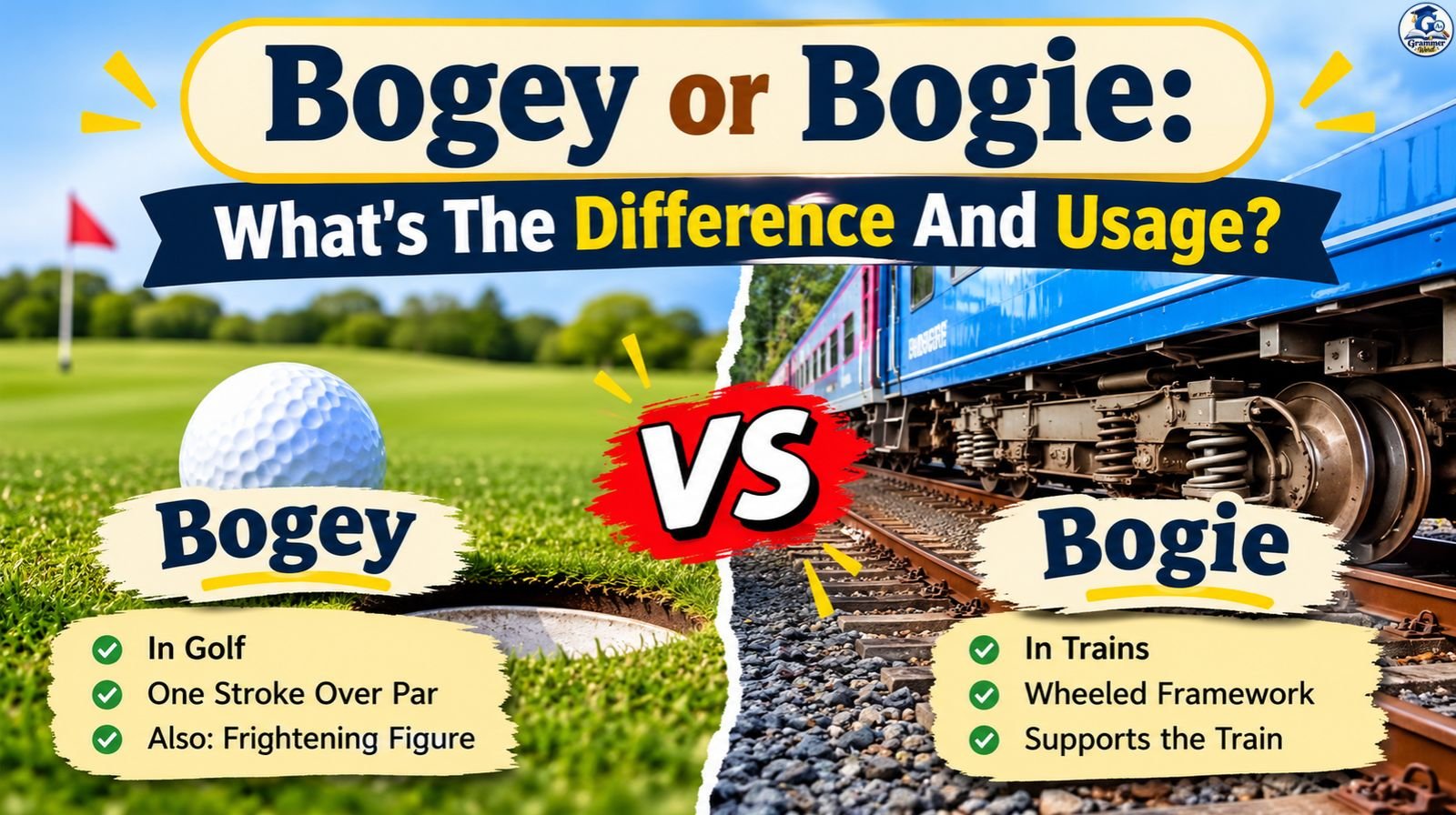
Both bogey and bogie are legitimate English words, but they are not always interchangeable. The word bogey is commonly associated with golf, where it describes a score of one stroke over par on a hole. It can also refer to an unidentified or suspicious object, particularly in aviation and military language.
On the other hand, bogie is commonly used in railway terminology to describe the wheeled framework beneath a train or railway vehicle. In some varieties of English, it also has informal meanings.
In this article, we will explore the meanings, differences, pronunciations, and correct usage of bogey and bogie. You will also find practical examples, everyday conversations, and email scenarios to help you understand when and how to use each spelling correctly.
Bogey or Bogie: Which Spelling Is Correct?
The correct spelling depends on what you are trying to communicate. Both bogey and bogie are correct English words, but they have different meanings and applications.
Here is a quick comparison:
| Word | Meaning | Common Usage |
|---|---|---|
| Bogey | A golf score of one stroke over par | Golf, sports, aviation |
| Bogie | A wheeled framework supporting a railway vehicle | Railways, engineering |
| Bogey | An unidentified or suspicious object | Military and aviation |
| Bogie | An informal term used in certain varieties of English | Everyday conversation |
For example:
- Bogey: Sarah scored a bogey on the seventh hole during her golf game.
- Bogie: The railway engineer inspected the bogie beneath the passenger train.
In the first sentence, bogey describes a golf score. In the second, bogie refers to a mechanical part of a train.
Therefore, neither spelling is universally incorrect. The important thing is to understand the context before choosing one.
What Does Bogey Mean?
Bogey is a noun with several meanings, depending on the situation in which it is used. Its most familiar meaning comes from golf, where it describes a score of one stroke over the expected number of strokes (par) for a particular hole.
For example, if a golf hole has a par of four and a player takes five strokes to complete it, the player has scored a bogey.
However, the word has other meanings as well. In military and aviation contexts, bogey can describe an unidentified aircraft or radar target. It can also refer informally to something frightening, imaginary, or difficult to understand.
Let’s explore its different uses.
1. Bogey in Golf
In golf, bogey is a standard scoring term. It means completing a hole using one more stroke than its assigned par.
For example:
- Par 3: Four strokes equal a bogey.
- Par 4: Five strokes equal a bogey.
- Par 5: Six strokes equal a bogey.
Golfers use this word when discussing their performance during a round.
Example sentences:
- Daniel made a bogey on the fourth hole but recovered with a birdie on the next.
- I was hoping to finish under par, but I scored a bogey on the final hole.
- Emily avoided another bogey by making a careful shot near the green.
- The golfer recorded three bogeys during the first nine holes.
Scenario Example: Golf Competition
Imagine that James is participating in a weekend golf tournament. He completes a par-four hole in five strokes.
His friend asks:
“How did you do on the fourth hole?”
James replies:
“I made a bogey. I needed one extra stroke to finish it.”
Here, bogey is the correct spelling because the conversation is about golf scoring.
2. Bogey in Aviation and Military Language
Another important meaning of bogey appears in aviation and military communication.
In these contexts, a bogey is an unidentified aircraft or radar target. It is used when a radar system detects an object but its identity has not yet been established.
For example:
- The radar operator detected a bogey approaching from the north.
- The pilot reported an unidentified bogey near the restricted airspace.
- Military personnel monitored the bogey until its identity was confirmed.
- The aircraft changed direction after detecting a possible bogey.
Scenario Example: Aviation Communication
Imagine that an air traffic monitoring team detects an unknown aircraft on its radar screen.
The supervisor sends a message to the monitoring team:
“An unidentified bogey has appeared on the radar. Please monitor its movement and report any changes in direction.”
In this situation, bogey is appropriate because it refers to an unidentified radar target.
3. Bogey as Something Frightening or Imaginary
The word bogey can also refer to an imaginary creature or something used to frighten children. It is sometimes associated with the idea of a bogeyman, a fictional character traditionally used to scare children into behaving.
For example:
- The little boy was afraid that a bogey was hiding under his bed.
- Her grandmother jokingly told her that a bogey would come if she stayed awake too late.
- The children laughed when they discovered that the scary noise was not a bogey at all.
Scenario Example: Family Conversation
A young child named Oliver hears a strange noise coming from his bedroom cupboard.
He asks his mother:
“Mom, is there a bogey hiding in my cupboard?”
His mother smiles and replies:
“No, Oliver. There is no bogey in your cupboard. It is probably just your toys moving around.”
Here, bogey refers to an imaginary frightening creature.
4. Bogey in Everyday Expressions
In some English-speaking regions, particularly British English, bogey can also appear in informal expressions.
For example, the phrase bogeyman refers to an imaginary frightening figure. The word can also be used figuratively to describe something that people fear or blame.
Example sentences:
- The manager became the bogeyman of the office after announcing the new rules.
- For some students, mathematics is the biggest bogey.
- The mysterious noise turned out to be nothing more than an imagined bogey.
These expressions are generally informal, so they may not be suitable for every professional situation.
What Does Bogie Mean?
Bogie is a noun most commonly used in railway engineering. It refers to the wheeled framework or assembly located beneath a railway vehicle, such as a train carriage or locomotive.
A bogie typically contains wheels, axles, suspension systems, and other mechanical components. It supports the weight of the railway vehicle and helps it move smoothly along curved tracks.
In simple terms, a bogie is the mechanical structure that carries the wheels beneath a railway carriage.
The spelling bogie is particularly common in British English, Indian English, Australian English, and other varieties influenced by British railway terminology.
1. Bogie in Railway Terminology
The most common use of bogie is in the railway industry.
A train carriage usually has bogies positioned underneath it. These assemblies help distribute the vehicle’s weight, improve stability, and allow the train to navigate curves.
For example:
- The railway engineer inspected the front bogie before the train departed.
- The damaged bogie was removed for maintenance.
- Each passenger carriage has two bogies to support its weight.
- The technician examined the bogie suspension system for signs of wear.
Scenario Example: Railway Maintenance
Imagine that a railway maintenance team is inspecting a passenger train before its scheduled departure.
The supervisor sends an email to a technician:
Subject: Inspection of the Train Bogie
Hi Ahmed,
Please inspect the rear bogie of passenger carriage number 204 before the train leaves the station. We noticed unusual vibration during the previous journey, so I would like you to check the wheels, suspension, and related components. Please let me know if you find anything that requires repair.
Best regards,
Michael
In this email, bogie is the correct word because the message concerns a mechanical component beneath a train.
2. Bogie in Railway Engineering and Manufacturing
The word bogie is also frequently used in engineering, manufacturing, and railway design.
Engineers use different types of bogies depending on the railway vehicle’s design, speed, weight, and operating conditions.
Some examples include:
- Passenger train bogie: Supports passenger carriages and provides stability during travel.
- Freight wagon bogie: Supports heavy goods wagons carrying cargo.
- Locomotive bogie: Helps support and guide the locomotive along the railway tracks.
- High-speed train bogie: Designed to provide stability and smooth movement at higher speeds.
Example sentences:
- The company designed a new bogie for its high-speed passenger trains.
- Engineers tested the bogie to ensure that it could handle heavy loads.
- The manufacturing team replaced the damaged bogie before conducting further tests.
- The new railway model features an improved suspension system in its bogies.
Scenario Example: Engineering Project
Suppose a railway manufacturing company is developing a new passenger train.
During a project meeting, the engineering manager says:
“We need to improve the bogie design to reduce vibration and provide a smoother journey for passengers.”
The design team then discusses wheel arrangements, suspension systems, and weight distribution.
Here, bogie is correct because the discussion focuses on railway engineering.
3. Bogie in Informal English
In some varieties of English, particularly British and Australian informal usage, bogie can have meanings unrelated to railway engineering.
For example, bogie can informally refer to nasal mucus, commonly called a booger in American English.
This usage is casual and is generally more common in everyday conversation than in formal writing.
Example sentences:
- The little boy had a bogie on his nose.
- Emma asked her brother to wipe the bogie from his face.
- The children laughed when their friend noticed a bogie on his sleeve.
Scenario Example: Everyday Conversation
Imagine that two friends, Daniel and Ryan, are getting ready for a family photograph.
Ryan notices something on Daniel’s nose and says:
“Daniel, you have a bogie on your nose. You might want to clean it before the picture!”
Daniel laughs and replies:
“Thanks for telling me. I would rather not have that in the family photo!”
In this informal British-style conversation, bogie is an acceptable spelling for the intended meaning.
What Is the Main Difference Between Bogey and Bogie?

The main difference between bogey and bogie is their meaning and the situations in which they are used.
Although both words are nouns and have similar pronunciations, they generally belong to different vocabulary contexts.
Bogey is primarily associated with golf scoring, unidentified aircraft, and imaginary frightening figures. Bogie, on the other hand, is mainly associated with railway equipment and can also have informal meanings in certain English-speaking regions.
Let’s look at some important differences.
1. Difference in Meaning
The clearest distinction is their definitions.
- Bogey: A golf score of one stroke over par or an unidentified radar target.
- Bogie: A wheeled framework beneath a railway vehicle.
For example:
- The golfer scored a bogey on the last hole.
- The mechanic repaired the damaged bogie.
Both sentences are grammatically correct, but replacing one spelling with the other would change the intended meaning.
2. Difference in Context
The context determines which spelling you should use.
Use bogey when discussing golf, unidentified aircraft, or imaginary frightening figures.
Use bogie when discussing train components, railway engineering, or the informal meaning of nasal mucus in varieties of English that use this word.
For example:
- Correct: The pilot reported an unidentified bogey.
- Correct: The railway engineer examined the bogie.
Choosing the appropriate spelling makes your writing clearer and prevents misunderstandings.
3. Difference in Professional Usage
The two words also appear in different professional environments.
Bogey is commonly used in:
- Golf competitions and sports reporting.
- Aviation and military communication.
- Discussions about golf scores and performance.
Bogie is commonly used in:
- Railway engineering.
- Train maintenance.
- Mechanical design and manufacturing.
- Railway transportation.
For example, a golf coach might discuss a player’s bogey count, while a railway engineer might discuss the condition of a train’s bogies.
4. Difference in Spelling
The words differ by only one letter:
- Bogey ends with -ey.
- Bogie ends with -ie.
This small spelling difference is important because the words have distinct established meanings.
A simple way to remember the difference is to associate bogey with golf and bogie with railway machinery.
Bogey vs Bogie: Examples in Sentences
One of the easiest ways to understand the difference between these words is to see them in practical sentences.
Below are examples showing how each word works in different situations.
Examples of Bogey in Sentences
- James scored a bogey on the sixth hole during the golf tournament.
- The professional golfer was disappointed after making another bogey.
- Sarah managed to avoid a bogey on the final hole.
- The pilot reported an unidentified bogey on the radar.
- The military team continued tracking the suspicious bogey.
- The child believed that a bogey was hiding in the dark room.
- Michael made two bogeys during the first half of the competition.
- The golf coach explained how to avoid unnecessary bogeys.
- An unknown bogey appeared on the monitoring screen.
- The story frightened the children with its imaginary bogey.
Examples of Bogie in Sentences
- The technician inspected the train’s bogie before departure.
- The damaged bogie needed immediate replacement.
- Each passenger carriage has two bogies.
- The railway company introduced a new bogie design.
- Engineers tested the bogie suspension system.
- The mechanic discovered a problem with the rear bogie.
- The freight train required stronger bogies to support heavy loads.
- The railway team completed the bogie inspection before the scheduled journey.
- The manufacturer improved the bogie to provide better stability.
- Ryan noticed a bogie on his friend’s nose.
These examples demonstrate that bogey and bogie are both correct, but their meanings depend on the context.
Common Mistakes When Using Bogey and Bogie
Because these words look and sound similar, people sometimes use them incorrectly. Understanding a few common mistakes can help you choose the right spelling.
1. Using Bogie Instead of Bogey in Golf
One common mistake is writing bogie when referring to a golf score.
Incorrect: Sarah scored a bogie on the ninth hole.
Correct: Sarah scored a bogey on the ninth hole.
The standard spelling for the golf term is bogey.
2. Using Bogey Instead of Bogie in Railway Terminology
Another mistake occurs when people use bogey to describe the mechanical framework beneath a train.
Incorrect: The engineer inspected the train’s bogey.
Correct: The engineer inspected the train’s bogie.
In standard railway terminology, bogie is the correct spelling.
3. Assuming One Word Is Always Incorrect
Some people believe that bogey is the only correct spelling, while others assume that bogie is simply a spelling mistake.
Both assumptions are incorrect.
Bogey and bogie are legitimate English words. They simply have different meanings and applications.
The correct choice depends on what you want to say.
4. Ignoring the Context
Another mistake is choosing a spelling based only on how the word sounds.
Since the two words are pronounced similarly in many English varieties, pronunciation alone may not help you distinguish them.
Instead, consider the subject of your sentence.
- Talking about golf? Use bogey.
- Talking about a train’s wheel assembly? Use bogie.
- Talking about an unidentified radar target? Use bogey.
Paying attention to context is the easiest way to avoid confusion.
Easy Tricks to Remember Bogey vs Bogie
If you frequently confuse these spellings, a few simple memory tricks can make them easier to remember.
1. Associate Bogey With Golf
Remember the spelling bogey when discussing golf.
A bogey means one stroke over par. Whenever you see a sentence about golf scores, think of the -ey ending.
Example:
“Michael made a bogey on the fifth hole.”
2. Associate Bogie With Trains
Remember bogie when discussing railway equipment.
A train’s bogie is the wheeled structure underneath the carriage. Whenever you see a sentence about railway maintenance or engineering, think of the -ie ending.
Example:
“The mechanic repaired the bogie before the train departed.”
3. Focus on the Subject of the Sentence
Before writing either word, ask yourself what the sentence is describing.
If it refers to a golf score or an unidentified aircraft, choose bogey.
If it refers to a train’s mechanical assembly, choose bogie.
This simple habit can help you make the correct spelling choice without memorizing complicated rules.
Bogey or Bogie in British and American English

Regional English differences can sometimes make spelling choices confusing. However, the distinction between bogey and bogie is not simply a British-versus-American spelling difference.
Both spellings are used in different English-speaking regions, but their meanings and frequency depend on context.
Bogey in American English
In American English, bogey is the standard spelling for the golf scoring term.
It is also used in aviation and military terminology to describe an unidentified radar target.
For example:
- The American golfer recorded a bogey on the final hole.
- The radar operator identified an unknown bogey approaching the aircraft.
Bogie in American English
In American English, the railway term is often expressed using truck rather than bogie, particularly in North American railroad terminology.
However, bogie is also understood and used in technical contexts.
For example:
- The railway technician inspected the train’s wheel assembly.
- The engineering team discussed the bogie design for the new railway vehicle.
Bogey and Bogie in British English
In British English, bogey is commonly used for the golf score and unidentified radar target.
Bogie is widely used in railway terminology and can also appear in informal expressions.
For example:
- The golfer made a bogey on the final hole.
- The railway engineer checked the bogie before departure.
The key point is that both spellings are correct in British and American English, but their usage depends on the intended meaning and regional vocabulary.
Practical Email Examples Using Bogey and Bogie
Understanding these words in everyday writing is particularly useful when communicating professionally.
Here are a few realistic email examples showing how each spelling can be used correctly.
Email Example 1: Using Bogey in a Golf Discussion
Subject: Golf Tournament Performance
Hi Daniel,
I reviewed your performance during yesterday’s golf tournament. You played very well overall, although you recorded a bogey on the seventh hole. Your short-game performance was impressive, and I believe a little more practice could help you avoid similar mistakes in the next competition. Keep working hard!
Best regards,
Ryan
Explanation: The word bogey is correct because the email discusses a golf score that is one stroke over par.
Email Example 2: Using Bogie in Railway Maintenance
Subject: Train Bogie Inspection Report
Hi Ahmed,
The maintenance team has completed the inspection of the passenger train. However, we noticed a minor issue with the rear bogie. Please arrange a detailed examination of its wheels and suspension system before the next scheduled departure. Let me know once the inspection has been completed.
Regards,
Michael
Explanation: The word bogie is correct because the email refers to the mechanical assembly beneath a railway carriage.
Email Example 3: Using Bogey in Aviation Communication
Subject: nidentified Radar Target
Hi James,
The monitoring team detected an unidentified bogey approximately 20 miles from the designated airspace. Please review the radar information and coordinate with the relevant team to establish its identity. Keep me updated if there are any significant changes.
Regards,
David
Explanation: Here, bogey refers to an unidentified radar target, making it the appropriate spelling.
Email Example 4: Using Bogie in an Engineering Project
Subject: Updated Bogie Design
Hi Sarah,
The engineering department has completed the initial review of the new railway bogie design. The updated model appears to offer improved stability and better weight distribution. We will conduct additional testing before approving the final design. Please share your feedback with the development team.
Best regards,
Oliver
Explanation: Bogie is correct because the message concerns the design of a railway component.
Frequently Asked Questions
1. Is Bogey or Bogie Correct?
Both bogey and bogie are correct English words. However, they have different meanings. Bogey is commonly used in golf to describe a score of one stroke over par, while bogie refers to the wheeled framework beneath a train carriage.
2. What Is the Difference Between Bogey and Bogie?
The main difference is their usage. Bogey is commonly associated with golf, unidentified aircraft, and imaginary frightening figures. Bogie is mainly used in railway terminology to describe the mechanical assembly supporting a train’s wheels.
3. Is Bogey the Correct Spelling in Golf?
Yes, bogey is the correct and standard spelling in golf. It describes a score of one stroke over par on a particular hole. For example, if a player completes a par-five hole in six strokes, the player has scored a bogey.
4. Is Bogie a Correct Word in English?
Yes, bogie is a correct English word. It is commonly used in railway engineering to describe the wheeled framework beneath a train or railway carriage. In some varieties of English, it also has informal meanings.
5. Is Bogie Used in American English?
Yes, bogie is understood in American English, particularly in technical contexts. However, North American railway terminology more commonly uses the word truck for the wheeled assembly beneath a railway vehicle.
6. Does Bogey Mean One Stroke Over Par?
Yes. In golf, bogey means completing a hole using one more stroke than its assigned par. For example, completing a par-four hole in five strokes results in a bogey.
7. What Is a Bogie on a Train?
A bogie is the wheeled framework beneath a railway vehicle. It generally contains wheels, axles, suspension components, and other mechanical parts that support the train and help it travel smoothly along railway tracks.
8. Are Bogey and Bogie Pronounced the Same?
In many English accents, bogey and bogie are pronounced the same or very similarly. However, their meanings and spellings are different, so the context is important when choosing between them.
9. What Is the Plural of Bogey?
The plural of bogey is bogeys. For example: “The golfer scored three bogeys during the competition.”
10. What Is the Plural of Bogie?
The plural of bogie is bogies. For example: “The railway company inspected all the bogies before approving the train for service.”
Conclusion
Understanding the difference between bogey and bogie is easier once you know what each word means. Although their spellings and pronunciations are similar, they are used in different situations.
Bogey is the appropriate spelling when discussing a golf score of one stroke over par, an unidentified aircraft or radar target, or an imaginary frightening figure. Bogie is primarily used in railway terminology to describe the wheeled framework beneath a train or carriage. It can also have informal meanings in certain varieties of English.
The easiest way to remember the distinction is to associate bogey with golf and bogie with trains.
Ultimately, both words are correct, but choosing the right one depends on your intended meaning. By understanding their definitions and practical applications, you can use bogey and bogie confidently in everyday conversations, professional emails, and written English.
Discover More Articles
Families vs. Family’s: Which Is Correct? Meaning, Difference & Examples Referred vs Refered: Which Spelling Is Correct? Nineth vs. Ninth: Which Spelling Is Correct? Bellies or Bellys: Which Spelling Is Correct In English? Memorise vs. Memorize: What’s The Real Difference In English? Monkies or Monkes: Which Spelling Is Correct In English?Keep learning with more easy grammar lessons on Grammer Word.

Hi, I’m Noor Fatima, the person behind this website. I created this site to make English grammar and confusing words easier to understand. I love breaking down tricky words, meanings, spellings, and grammar rules into simple explanations. My goal is to help you learn English naturally, avoid common mistakes, and feel more confident every time you write or speak.