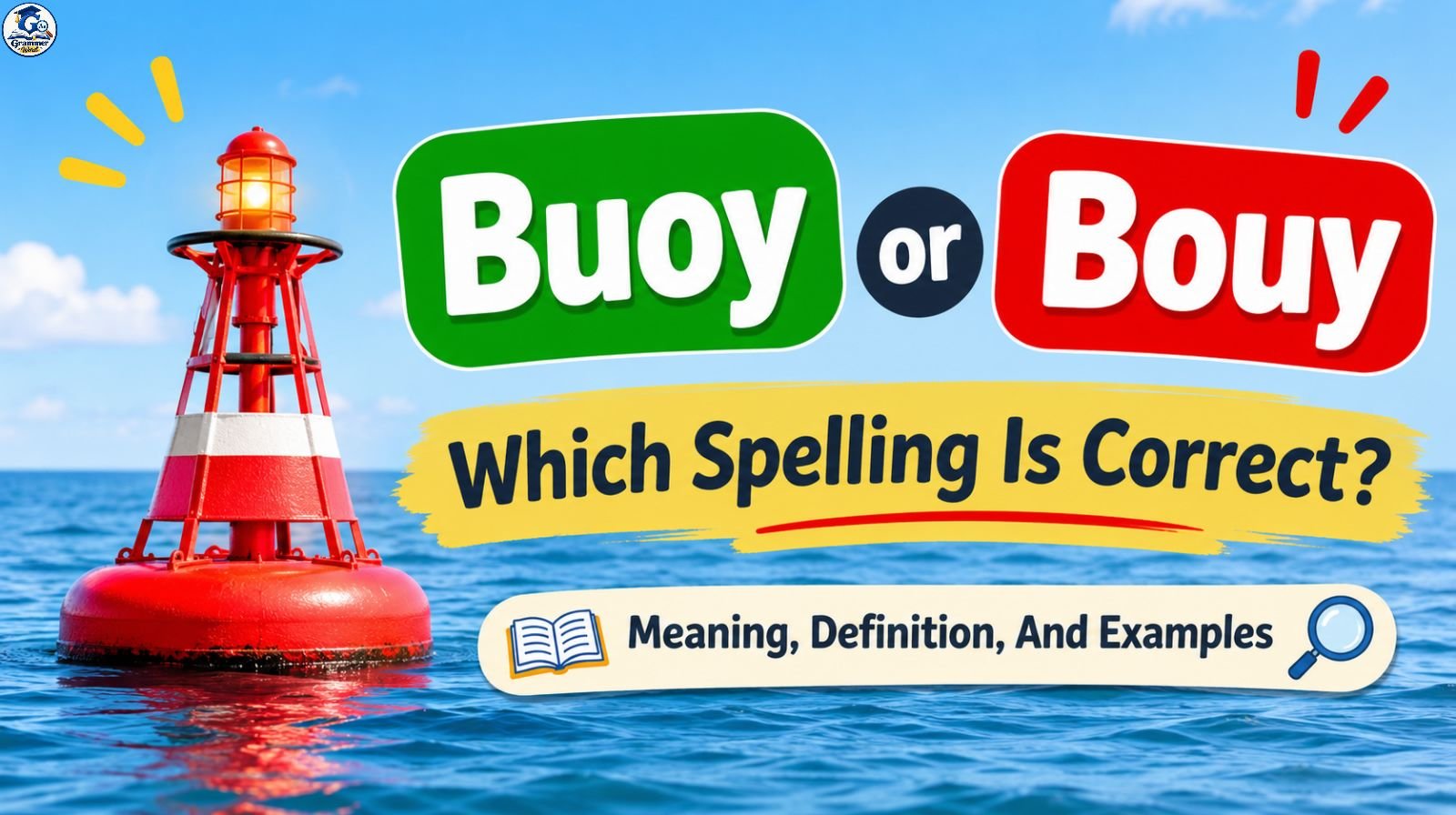
Have you ever wondered whether the correct spelling is buoy or bouy? These two spellings look almost identical, and it is easy to mix them up when writing about boats, oceans, swimming areas, or navigation. However, only one spelling is accepted in standard English.
The correct spelling is buoy, while bouy is a common misspelling. A buoy is a floating object placed in water to mark a particular location, warn boat operators about potential dangers, or provide navigational information. You may see buoys near beaches, harbors, rivers, lakes, and shipping routes.
Although bouy might look reasonable because of the way some people pronounce the word, it is not the standard English spelling. Knowing the difference can help you avoid spelling mistakes in professional emails, school assignments, reports, and everyday conversations.
In this article, we will explore the meanings, definitions, pronunciation, and correct usage of buoy and bouy. We will also look at practical examples and everyday scenarios to help you remember the correct spelling.
Buoy or Bouy: Which Spelling Is Correct?
The correct spelling is buoy. It is the standard English word used to describe a floating object that helps mark locations, indicate water conditions, or guide boats and ships.
On the other hand, bouy is an incorrect spelling. It is a common spelling mistake, but it does not have a recognized meaning in standard English dictionaries.
The confusion often occurs because the word buoy has an unusual spelling and pronunciation. People sometimes rearrange its letters and write bouy instead.
Here is a simple comparison:
- Buoy: Correct spelling. A floating object used in water for navigation, safety, or marking locations.
- Bouy: Incorrect spelling. It is a common misspelling of buoy.
For example:
- Correct: The fishermen tied their boat to a yellow buoy.
- Incorrect: The fishermen tied their boat to a yellow bouy.
In the correct sentence, buoy describes a floating object that provides a convenient point for securing a boat.
Remember that buoy is always the correct spelling when referring to a floating marker in water.
What Does Buoy Mean?
The word buoy is a noun that refers to a floating object anchored in water. It is commonly used to mark specific areas, provide warnings, indicate safe routes, or help boats navigate safely.
Buoys are generally made from durable materials such as plastic, metal, or other water-resistant materials. They are designed to remain visible on the water’s surface, even when waves and changing weather conditions make navigation difficult.
Different types of buoys serve different purposes. Some indicate safe navigation routes, while others warn boat operators about underwater obstacles, restricted areas, or dangerous water conditions.
For example, a red buoy may be used as a navigational marker, while a yellow buoy might indicate a special area or activity depending on the local marking system.
Example sentences:
- The captain followed the green buoy to reach the harbor safely.
- A yellow buoy marked the area reserved for swimmers.
- The fishermen spotted a floating buoy near the coastline.
- The rescue team placed a buoy in the water to identify the dangerous area.
In each sentence, buoy refers to a floating object that provides useful information or marks a particular location.
Definition of Buoy
A buoy is:
A floating object anchored in a body of water to indicate a location, mark a hazard, guide vessels, or provide other navigational information.
The word is particularly common in maritime activities, boating, fishing, swimming, and water safety.
Different Types of Buoys
Buoys come in different shapes, sizes, and colors depending on their purpose. Understanding these types can help you recognize how the word is used in everyday situations.
1. Navigation Buoy
Navigation buoys help boat operators identify safe routes through waterways. They are especially important in harbors, rivers, and coastal areas.
Example: The sailor followed the navigation buoys to avoid entering shallow water.
2. Mooring Buoy
A mooring buoy provides a secure point where boats can be temporarily attached without dropping an anchor.
Example: We secured our small boat to a mooring buoy before going ashore.
3. Warning Buoy
Warning buoys alert people to potentially dangerous areas, restricted zones, or special water conditions.
Example: The warning buoy reminded swimmers to stay away from the restricted area.
4. Swimming Buoy
Swimming buoys are often used to mark designated swimming areas and help keep swimmers away from boat traffic.
Example: The lifeguard checked the swimming buoys before allowing visitors into the water.
What Does Bouy Mean?
Bouy is an incorrect spelling of the word buoy. It is not recognized as the standard spelling in English.
People commonly write bouy because they are unfamiliar with the unusual letter arrangement in buoy. Since the word is pronounced differently from how many people expect, they sometimes place the letters in the wrong order.
However, there is no need to treat bouy as an alternative spelling. Whether you are writing American English, British English, or another variety of standard English, buoy is the correct form.
For example:
- Incorrect: The ship passed a red bouy near the shore.
- Correct: The ship passed a red buoy near the shore.
Another example:
- Incorrect: Please check whether the bouy is still attached to the rope.
- Correct: Please check whether the buoy is still attached to the rope.
In both examples, bouy should be replaced with buoy.
Why Do People Spell Buoy as Bouy?
There are several reasons why people confuse these spellings.
1. Unusual Letter Arrangement
The spelling buoy is not particularly common in everyday English. Its unusual combination of vowels can make it difficult to remember, especially for people who do not regularly write about boating or water activities.
2. Pronunciation Confusion
The pronunciation of buoy can vary between English-speaking regions. Some speakers pronounce it like “boy,” while others pronounce it more like “boo-ee.”
This variation can make the spelling less obvious to learners.
3. Typing Mistakes
Sometimes, people accidentally rearrange the letters while typing quickly. Since bouy looks similar to buoy, the mistake may go unnoticed during proofreading.
4. Limited Exposure to the Word
People who rarely encounter maritime vocabulary may not immediately recognize the correct spelling. As a result, they may assume that bouy is an acceptable alternative.
The easiest way to avoid this mistake is to remember that buoy contains the letters B-U-O-Y, in that exact order.
Buoy vs. Bouy: Understanding the Difference

The difference between buoy and bouy is straightforward. One is a correctly spelled English word, while the other is a spelling error.
| Word | Correct or Incorrect? | Meaning |
|---|---|---|
| Buoy | Correct | A floating object used to mark locations or guide boats. |
| Bouy | Incorrect | A common misspelling of buoy. |
You should always use buoy in formal and informal writing.
For instance, if you are describing a floating object near a beach, writing a report about marine safety, or sending an email about a boat’s location, the correct spelling is buoy.
Consider these additional examples:
- Correct: The yellow buoy was visible from the beach.
- Incorrect: The yellow bouy was visible from the beach.
- Correct: We noticed a damaged buoy near the fishing area.
- Incorrect: We noticed a damaged bouy near the fishing area.
- Correct: The coast guard installed a new buoy to improve navigation.
- Incorrect: The coast guard installed a new bouy to improve navigation.
The key difference is not related to meaning or regional preference. Bouy is simply a misspelling of buoy.
How to Use Buoy in Everyday Sentences
Understanding the definition of buoy is useful, but learning how to use it in different situations can make the spelling easier to remember.
Here are some practical examples from everyday life.
1. In a Conversation About Boating
Imagine that two friends are discussing a boating trip. One friend notices a floating marker near the water and explains its purpose.
Example:
“Daniel, do you see that orange buoy near the rocks? We should keep the boat away from that area because it may indicate a dangerous section of water.”
In this conversation, buoy refers to a floating marker that helps identify a particular area and warns boat operators.
2. In a Professional Email
Suppose a marina employee needs to inform a colleague about a damaged navigation marker. The correct spelling should be used because the email is part of professional communication.
Example Email:
Subject: Damaged Navigation Buoy Near the Harbor
Hi Michael,
I wanted to let you know that the navigation buoy near the eastern entrance of the harbor appears to be damaged. It may need inspection and repair before the next scheduled boating season. Could you please arrange for the maintenance team to check it? Thank you for your assistance.
Best regards,
Emily
Here, navigation buoy correctly describes the floating marker that helps guide boats entering the harbor.
3. In a School Assignment
Students may encounter the word buoy when studying marine environments, geography, or water safety.
Example:
“Buoys are important tools in marine navigation because they help ships identify safe routes and avoid underwater obstacles.”
In this example, the word is used to explain the importance of floating markers in maritime activities.
4. In a Beach Safety Announcement
Imagine a lifeguard explaining swimming safety rules to visitors at a crowded beach.
Example:
“All swimmers must remain inside the designated swimming area marked by the orange buoys. Please do not swim beyond these markers because boats may be operating nearby.”
Here, buoys is the plural form of buoy. It refers to multiple floating objects marking the swimming area’s boundaries.
5. In a Fishing Report
A fisherman might use the word when describing where fishing equipment or boats are located.
Example:
“Robert noticed that the fishing buoy had moved away from its original position after the strong winds last night.”
The word buoy describes the floating marker used to identify the fishing location.
Common Mistakes to Avoid When Using Buoy
Even though the difference between buoy and bouy is simple, people sometimes make other mistakes when using the word.
Here are a few common errors and their corrections.
Mistake 1: Writing Bouy Instead of Buoy
This is the most common spelling mistake.
- Incorrect: The boat was tied to a bouy.
- Correct: The boat was tied to a buoy.
Always remember the correct letter sequence: B-U-O-Y.
Mistake 2: Using Buoy as the Plural Form
When referring to more than one floating marker, you should use buoys, not buoy.
- Incorrect: Several buoy were placed near the beach.
- Correct: Several buoys were placed near the beach.
The plural form is created by adding -s to the singular word.
Mistake 3: Confusing Buoy With Other Maritime Terms
A buoy is not the same thing as an anchor.
An anchor is a heavy object used to hold a boat in position, while a buoy is a floating marker or object that remains on the water’s surface.
For example:
- The captain lowered the anchor to keep the boat stationary.
- The captain noticed a buoy marking a safe navigation route.
Understanding this distinction helps you use maritime vocabulary accurately.
Buoy or Bouy: Which One Should You Use in Professional Writing?

If you are writing a business email, school assignment, technical report, safety announcement, or article, you should always use buoy.
Professional writing requires accurate spelling because even small errors can affect the clarity and credibility of your message.
For example, imagine that a marine equipment company is sending a maintenance report to its customers.
Incorrect:
“The maintenance team inspected the damaged bouy near the harbor and recommended replacing it.”
Correct:
“The maintenance team inspected the damaged buoy near the harbor and recommended replacing it.”
The second sentence uses the accepted English spelling and looks more professional.
Similarly, if you are writing an article about ocean safety, fishing equipment, or navigation systems, using buoy will ensure that your content follows standard English spelling conventions.
Tips to Remember the Correct Spelling of Buoy
If you frequently confuse buoy and bouy, a few simple memory tricks can help.
1. Remember the Letter Order
The correct spelling is B-U-O-Y. Try saying each letter slowly when writing the word until the spelling becomes familiar.
2. Associate Buoy With Water
Think of a buoy floating in the ocean. Connecting the word with its meaning can make it easier to remember.
3. Remember That Bouy Is Not an Alternative
Unlike some English words that have multiple accepted spellings, bouy is not an alternative form of buoy.
4. Practice With Short Sentences
Write a few simple sentences using the correct spelling:
- The buoy is floating near the shore.
- A red buoy marks the navigation channel.
- The boat passed three yellow buoys.
Repeated exposure to the correct spelling can help you avoid the mistake in future writing.
Frequently Asked Questions
1. Is Buoy or Bouy Correct?
Buoy is correct. It is the standard English spelling of a floating object used to mark locations, guide boats, and identify hazards in water. Bouy is an incorrect spelling and should not be used in standard English writing.
2. What Does Buoy Mean?
A buoy is a floating object anchored in water to mark a specific location, indicate a hazard, guide vessels, or provide navigational information. It is commonly used in oceans, rivers, lakes, harbors, and swimming areas.
3. Is Bouy a Real Word?
No, bouy is not a standard English word. It is a common misspelling of buoy. When referring to a floating object used in water, always write buoy.
4. What Is the Plural of Buoy?
The plural of buoy is buoys. You simply add the letter s to the singular form.
For example: Several buoys were placed along the coastline to mark the swimming area.
5. How Do You Pronounce Buoy?
The pronunciation of buoy varies by region. In American English, it is commonly pronounced like “boo-ee,” while in some other English-speaking regions, it is pronounced like “boy.”
Both pronunciations are recognized.
6. Is Buoy Used in American and British English?
Yes. Buoy is the standard spelling in both American and British English. Unlike words such as color/colour or center/centre, there is no regional spelling difference between these varieties.
7. What Is a Buoy Used For?
A buoy is used for several purposes, including marking navigation routes, identifying dangerous areas, indicating swimming boundaries, and providing a place for boats to attach temporarily.
Its specific purpose depends on its design, color, and location.
8. Can I Use Bouy in an Email?
No. You should use buoy in emails and other forms of professional or personal communication. Bouy is a spelling mistake and is not accepted as a standard alternative.
9. Is Buoy a Noun or a Verb?
Buoy can be used as both a noun and a verb.
As a noun, it describes a floating object used in water.
Example: The boat passed a red buoy.
As a verb, buoy means to keep something afloat or to support, encourage, or uplift someone.
Example: Her encouraging words helped buoy his confidence.
Conclusion
When choosing between buoy or bouy, the correct spelling is always buoy. It is the standard English word for a floating object used to mark locations, guide boats, and provide important information about water conditions.
On the other hand, bouy is simply a common spelling mistake and should not be used in formal or informal writing.
Remember that buoy is spelled B-U-O-Y, and its plural form is buoys. Whether you are writing an email, preparing a school assignment, discussing boating safety, or describing marine navigation, using the correct spelling will make your writing clearer and more accurate.
The easiest way to remember the difference is simple: Buoy is correct; Bouy is incorrect.
Discover More Articles
Monkies or Monkes: Which Spelling Is Correct In English? Happy Holiday or Happy Holidays: Which Is Correct? 2026 He Is Risen or He Has Risen – Which Is Correct? 2026 Whiskey or Whisky – Which Spelling Is Correct? (2026) Propose vs Purpose: Which Is Correct? (2026)Keep learning with more easy grammar lessons on Grammer Word.

Hi, I’m Noor Fatima, the person behind this website. I created this site to make English grammar and confusing words easier to understand. I love breaking down tricky words, meanings, spellings, and grammar rules into simple explanations. My goal is to help you learn English naturally, avoid common mistakes, and feel more confident every time you write or speak.