Have you ever typed “to much” and then stopped to wonder whether it should actually be “too much”? You’re not alone. Because to and too sound alike, this is an easy mistake to make even though they have completely different grammatical roles.
So, to much or too much which one is correct?
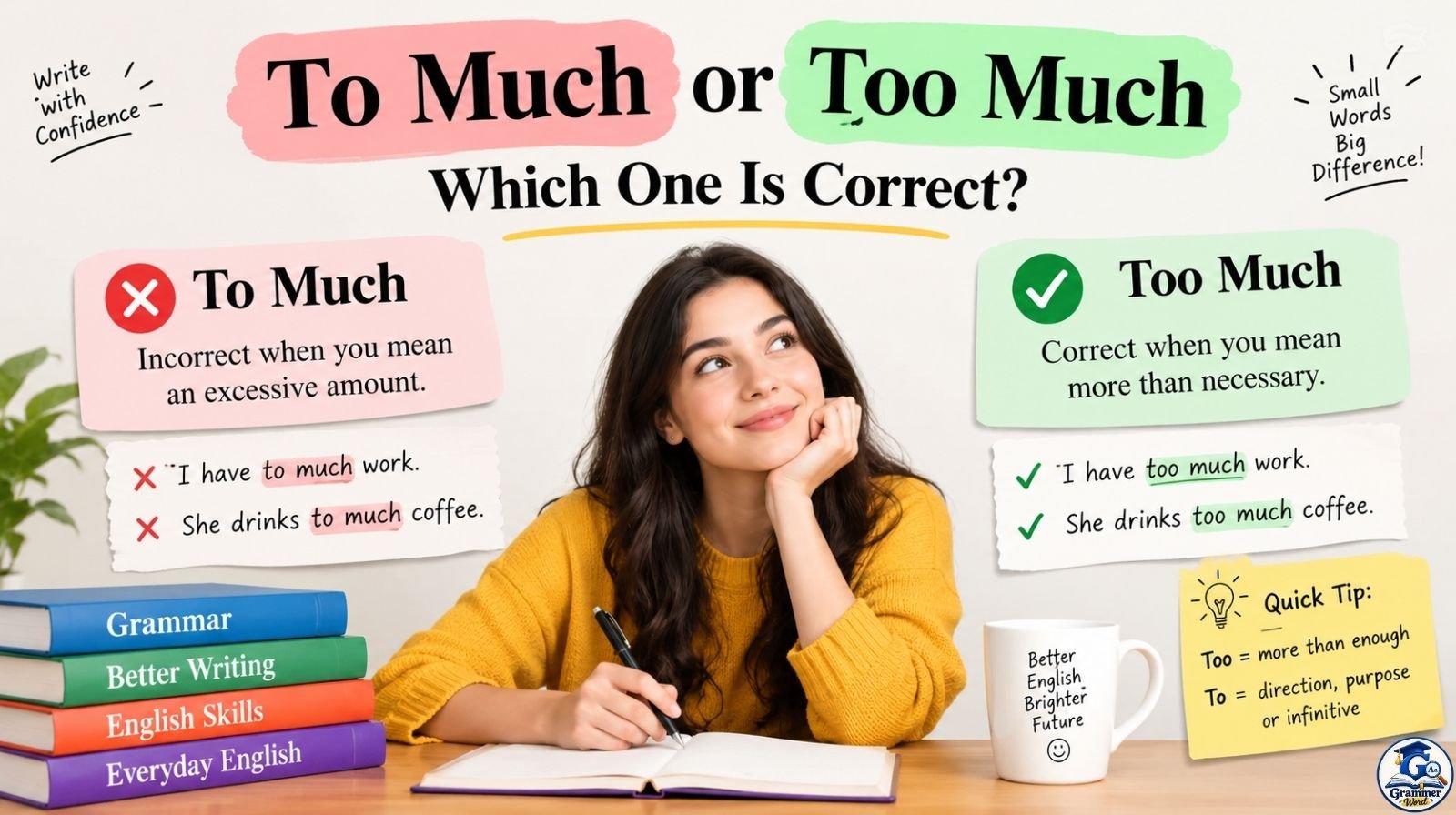
The correct phrase is “too much” when you mean more than necessary, more than wanted, or an excessive amount. Cambridge explains that too can mean “more than is needed or wanted,” while too much is used with quantities that exceed what is appropriate.
In this guide, you’ll learn the difference between to much and too much, see real examples, understand why the mistake happens, and discover a simple trick for remembering the correct form.
Read More: Quite or Quiet? Simple Guide To The Common English Confusion
Is It “To Much” or “Too Much”?
The short answer is simple: “too much” is correct when you are talking about an excessive amount.
“Too Much” Is the Correct Phrase
Too much means more than necessary, more than wanted, or more than is appropriate.
For example:
- I ate too much food.
- She spends too much money.
- There is too much noise here.
- He has too much homework.
- You are putting too much sugar in my coffee.
Cambridge’s grammar guidance specifically explains that too much is used before uncountable nouns when describing an excessive quantity.
Why “To Much” Is Usually Incorrect
To much is not the standard phrase when you mean an excessive amount.
For example:
- ❌ I have to much work.
- ✅ I have too much work.
- ❌ She drinks to much coffee.
- ✅ She drinks too much coffee.
The problem happens because to and too have the same pronunciation in many varieties of English.
What Is the Difference Between “To” and “Too”?
Understanding the individual words makes the difference much easier to remember.
“To” Shows Direction, Relationship, or Purpose
To is commonly used as a preposition or as part of an infinitive verb.
Examples:
- We went to school.
- She walked to the store.
- I want to sleep.
- He needs to study.
- They came to help us.
Purdue OWL explains that to can function as a preposition or as the first part of an infinitive verb.
“Too” Can Mean Excess or “Also”
Too has several uses. In too much, it expresses excess.
Examples:
- This bag is too heavy.
- The coffee is too hot.
- She talks too much.
- There is too much traffic.
But too can also mean also:
- I want to come too.
- She likes pizza too.
- He is coming with us too.
Purdue OWL notes that too can mean “very” or “also,” while Cambridge identifies its meaning of “more than is needed or wanted.”
A Quick Memory Trick
Think of the extra o in too as meaning “more.”
Too = more than enough
To = direction, purpose, or infinitive
So:
too much = more than enough
That simple connection can help you avoid the mistake.
Read More: Lay or Lie? The Simple Grammar Rule Most People Get Wrong
How to Use “Too Much” Correctly
The phrase too much is especially common when talking about quantities, amounts, activities, or things that exceed a reasonable level.
Too Much + Uncountable Noun
Use too much with singular uncountable nouns.
Examples:
- too much water
- too much money
- too much time
- too much information
- too much sugar
- too much traffic
- too much noise
- too much work
For example:
There is too much traffic on this road.
Here, traffic is treated as an uncountable noun, so too much is appropriate.
“Too Much” Without a Noun
Sometimes the noun is already obvious and doesn’t need to be repeated.
For example:
I ate too much.
The listener understands that you mean you ate too much food.
Similarly:
Don’t worry too much.
Here, too much describes the degree of worrying rather than directly modifying a noun.
Too Much With Verbs
Too much can also describe an excessive amount of an activity.
Examples:
- He talks too much.
- She worries too much.
- I think too much about small problems.
- They complain too much.
- You work too much.
This is different from too much + noun:
She drinks too much coffee.
versus:
She talks too much.
Both are correct, but the grammatical structure is different.
Common “To Much” Mistakes and Their Corrections
Because to and too sound alike, people often choose the wrong spelling while writing.
Mistake 1: Talking About an Excessive Amount
❌ I have to much homework.
✅ I have too much homework.
Why? Too much means more homework than necessary or manageable.
Mistake 2: Talking About Food or Drinks
❌ He drank to much water.
✅ He drank too much water.
❌ She eats to much sugar.
✅ She eats too much sugar.
Mistake 3: Talking About Time
❌ You spend to much time online.
✅ You spend too much time online.
Mistake 4: Talking About Money
❌ That phone costs to much money.
✅ That phone costs too much money.
Mistake 5: Confusing “Too Much” With “Too”
Another common issue is placing too much where too should be used.
❌ This bag is too much heavy.
✅ This bag is too heavy.
Cambridge distinguishes these structures: too normally comes directly before an adjective or adverb, while too much is used with an uncountable quantity.
“Too Much” vs. “Too Many”: Don’t Mix Them Up
One useful rule is to remember that much and many don’t normally work with the same kinds of nouns.
Too Much for Uncountable Nouns
Use too much with uncountable nouns:
- too much water
- too much rice
- too much information
- too much money
- too much work
Examples:
There is too much information on this page.
We spent too much money.
Too Many for Countable Plural Nouns
Use too many with plural countable nouns.
Examples:
- too many books
- too many people
- too many questions
- too many cars
- too many mistakes
For example:
There are too many people in the room.
Not:
❌ There are too much people in the room.
Cambridge explains that too much is used with uncountable nouns, while too many is used with plural countable nouns.
Quick Comparison Table
| Expression | Use With | Example |
|---|---|---|
| too much | Uncountable nouns | too much water |
| too many | Plural countable nouns | too many books |
| too | Adjectives/adverbs | too expensive |
| to | Direction/infinitive | to school, to eat |
A Real-Life Example: Catching the Mistake in an Email
Imagine that a student is writing an email to a teacher about an assignment.
The student writes:
“I am sorry, but there is to much information in the assignment, and I don’t have enough time to finish it.”
The meaning is understandable, but to much is incorrect because the student is describing an excessive amount of information.
The corrected sentence is:
“I am sorry, but there is too much information in the assignment, and I don’t have enough time to finish it.”
This small spelling change matters because to and too perform different grammatical jobs.
The student might then write another sentence:
Read More: Carmel or Caramel: Which One Is Correct?
“I need to ask you for an extension.”
Here, to is correct because it comes before the verb ask and forms the infinitive to ask.
Notice the difference:
There is too much information.
I need to ask a question.
The two words sound similar, but their functions are completely different. Purdue OWL specifically identifies to/too/two as commonly confused words and recommends paying special attention to such homophones during proofreading.
This is why proofreading matters, especially in emails, assignments, resumes, articles, and professional communication.
A spell-checker may not always catch the mistake because to and too are both correctly spelled English words. The problem is the context, not the spelling of the individual word.
2025–2026 Language Data and Usage Snapshot
Grammar advice should be based on established language references rather than invented search-volume numbers.
What Current Reference Sources Show
As of 2026, Cambridge’s current English grammar reference continues to classify too as an adverb and explains its use for meanings such as “more than enough.” It specifically gives too much as the appropriate construction for an excessive quantity with an uncountable noun.
Cambridge also identifies much as a word used with singular uncountable nouns and explains the distinction between too much and too many.
Purdue OWL’s current guidance likewise identifies to and too as commonly confused sound-alike words and gives their different grammatical functions.
A useful 2025 reference point comes from Merriam-Webster’s May 2025 discussion of vocabulary related to excessive talking, where too much appears as an established English phrase in contemporary usage.
Important: These sources provide authoritative grammar and usage evidence, not a measured 2025–2026 global error rate for “to much.” There is no sound basis for inventing a percentage of English users who make this mistake.
A Simple Step-by-Step Guide to Choosing “To” or “Too”
When you’re unsure, don’t guess. Follow these steps.
Step 1: Ask What You Mean
Are you talking about more than necessary?
If yes, use too.
I have too much work.
Step 2: Check the Word After “To”
If to comes before a verb, it may be part of an infinitive.
I want to learn.
She needs to leave.
We decided to stay.
Read More: Ageing or Aging: Which Spelling Is Correct? A Simple, Clear Guide
Step 3: Check for Direction
If you’re indicating movement or a destination, to is often correct.
We went to school.
She drove to work.
Step 4: Try the “More Than Necessary” Test
Replace too with the idea of “more than necessary.”
There is too much noise.
→ There is more than necessary noise.
The meaning works, so too is correct.
Step 5: Proofread for Homophones
If you are writing something important, specifically check to, too, and two. Purdue OWL recommends paying special attention to sound-alike words because ordinary spell-checking may not identify a contextual mistake.
Mini Quiz: To Much or Too Much
1. Pick the Correct Phrase
Which is correct?
A) To much
B) Too much
Answer: B) Too much
2. Fill in the Blank
“I have ___ homework tonight.”
A) to much
B) too much
Answer: B) too much
3. Spot the Mistake
Which sentence is correct?
A) She drinks to much coffee.
B) She drinks too much coffee.
Answer: B) She drinks too much coffee.
4. Quick Grammar Check
Which word means more than necessary?
A) To
B) Too
Answer: B) Too
5. Choose the Right One
“There is ___ noise in this room.”
A) to much
B) too much
Answer: B) too much
6. To or Too?
“I want ___ learn English.”
A) to
B) too
Answer: A) to
7. Too Much or Too Many?
Which sounds correct?
A) too much books
B) too many books
Answer: B) too many books
8. Coffee Time!
Which sentence is correct?
A) I drank too much coffee.
B) I drank to much coffee.
Answer: A) I drank too much coffee.
Read More: Traveled or Travelled: Which Spelling Is Correct In English?
9. Find the Correct Sentence
A) He talks to much.
B) He talks too much.
Answer: B) He talks too much.
10. Remember This Rule
Which word is used for an excessive amount?
A) To
B) Too
Answer: B) Too
11. Money Matters
Choose the correct sentence:
A) She spends too much money.
B) She spends to much money.
Answer: A) She spends too much money.
12. Which One Fits?
“I need ___ go home.”
A) too
B) to
Answer: B) to
13. Information Overload
Which is correct?
A) There is too much information.
B) There is to much information.
Answer: A) There is too much information.
14. Final Challenge
Which sentence uses too much correctly?
A) I have too much work.
B) I went too much school.
Answer: A) I have too much work.
15. The Easy Memory Trick
Complete the rule:
Too = ______ than enough
A) more
B) less
Answer: A) more
FAQs
Q1. Is “to much” ever correct?
Not when you mean an excessive amount. In that meaning, the standard phrase is too much.
For example:
❌ I have to much work.
✅ I have too much work.
However, to can appear next to the word much in a larger grammatical structure where it has its normal function. The issue is not that the two words can never appear near each other; it is that “to much” is not the standard phrase meaning “an excessive amount.”
Q2. Is “too much” grammatically correct?
Yes. Too much is grammatically correct when referring to an excessive amount or degree. Cambridge specifically describes too much as a construction used with uncountable quantities.
Q3. What does “too much” mean?
Too much means more than necessary, wanted, suitable, or acceptable.
Example:
There is too much sugar in this tea.
The sentence means there is more sugar than is appropriate.
Q5. Is “too much” one word?
No. Too much is written as two separate words.
Correct:
too much
Incorrect:
toomuch
Q6. What is the difference between “too much” and “too many”?
Use too much with uncountable nouns:
too much water
Use too many with plural countable nouns:
too many bottles
Cambridge makes this same distinction in its grammar guidance.
Q6. How can I remember “to” vs. “too”?
Remember:
To = direction or infinitive
go to school
want to eat
Too = excess or also
too much food
I want some too
The extra o in too can remind you of more.
Final Takeaway:
When you’re asking “To much or too much?”, the answer is straightforward: “too much” is correct when you mean more than necessary or an excessive amount.
Use:
- ✅ too much water
- ✅ too much money
- ✅ too much time
- ✅ too much work
- ✅ too much information
Use to for purposes such as direction or infinitive verbs:
- to school
- to work
- to learn
- to eat
The easiest rule is:
Too = more than enough
To = direction, purpose, or infinitive
Once you connect too with the idea of excess, choosing between to much and too much becomes much easier.
If this guide helped you understand the difference, save it for your next writing session and share it with someone who often mixes up to and too.
Discover More Article
- Greatful or Grateful: Which One Is Correct?
- There or Their: Clear Guide To Correct Usage
- Ax vs Axe: The Simple Difference Most People Don’t Know
Keep learning with more easy grammar lessons on Grammer Word.com

Hi, I’m Noor Fatima, the person behind this website. I created this site to make English grammar and confusing words easier to understand. I love breaking down tricky words, meanings, spellings, and grammar rules into simple explanations. My goal is to help you learn English naturally, avoid common mistakes, and feel more confident every time you write or speak.