Quite or quiet which one should you use? These two English words look almost identical, but they have completely different meanings and grammatical jobs.
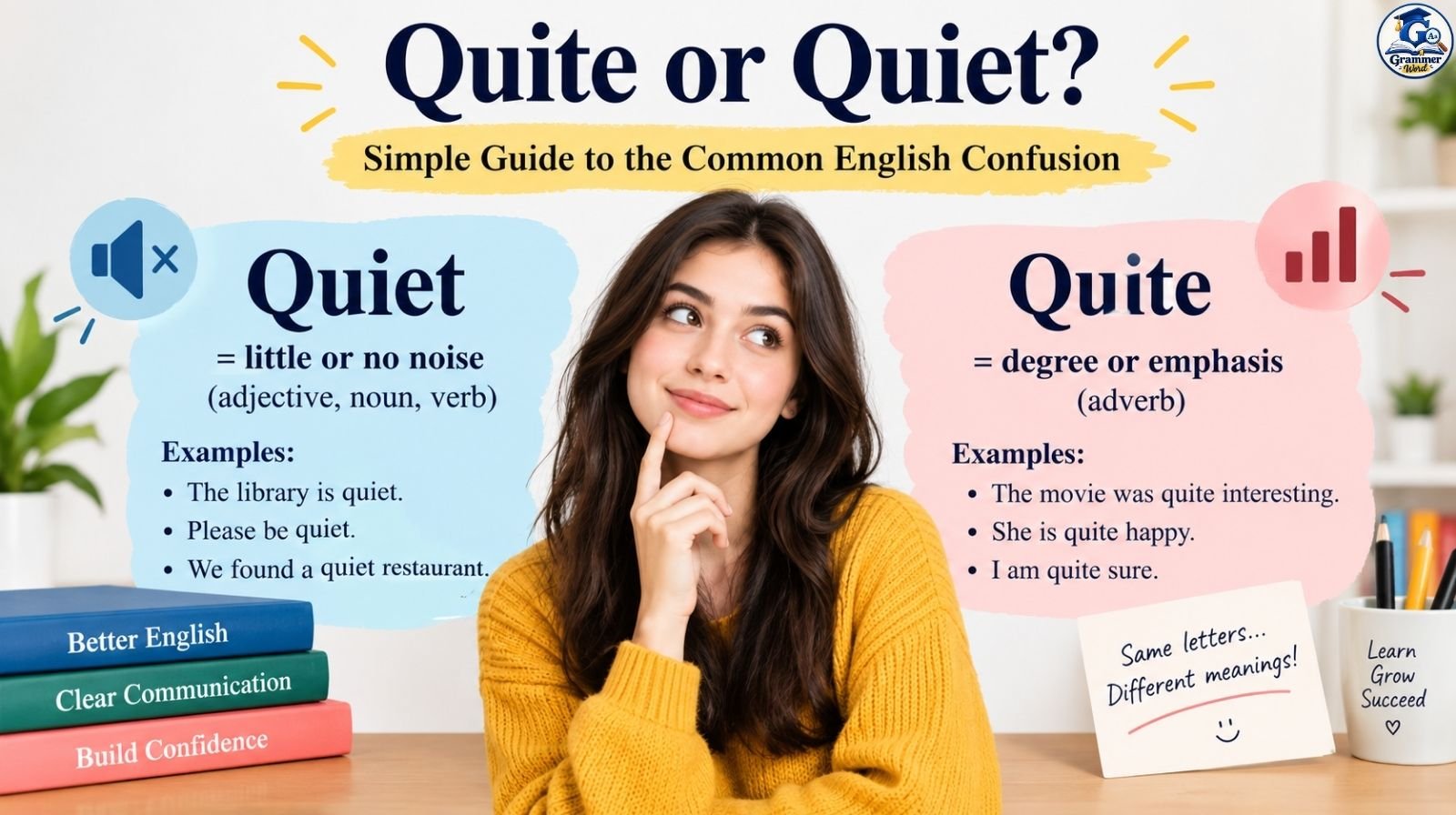
Quiet usually relates to little or no noise, calmness, or a lack of activity. Quite, on the other hand, is an adverb used to express degree or emphasis. Cambridge specifically notes that the words are spelled and pronounced differently and have different meanings.
For example:
- The library is quiet. → The library has little noise.
- The test was quite difficult. → The test was fairly or very difficult.
The good news is that you do not need to memorize complicated grammar rules. Once you understand what each word means, the quite or quiet difference becomes much easier to remember.
Read More: Patients vs Patient’s: Meaning, Difference, And Correct Usage
Quite or Quiet: What Is the Difference?
The simplest way to remember the difference is this:
Quiet = little or no noise
Quite = degree, amount, or emphasis
Although they look similar, quiet and quite perform different grammatical functions.
| Word | Part of Speech | Main Meaning | Example |
|---|---|---|---|
| Quiet | Usually adjective | Not noisy, calm, peaceful | The room is quiet. |
| Quite | Adverb | Fairly, very, or completely, depending on context | The room is quite large. |
| Quiet | Noun/verb in some uses | Silence/calm; make less noisy | We enjoyed the quiet. |
| Quite | Adverb | Shows degree or emphasis | She is quite happy. |
Cambridge describes quiet as an adjective meaning that something makes very little noise or has little activity. Quite is an adverb that can express degree, ranging from a moderate level to a stronger sense such as “very” or “completely,” depending on context.
Quiet Means “Not Noisy”
Use quiet when you are talking about sound, silence, calmness, or a place or person that is not very active.
Examples:
- The classroom is quiet.
- Please be quiet.
- We found a quiet restaurant.
- She is a quiet person.
- It was a quiet evening at home.
Here, the idea is related to silence or calmness.
Quite Means “To a Degree”
Use quite when you want to modify another word and express its degree or intensity.
Examples:
- The movie was quite interesting.
- She is quite tired.
- The question was quite difficult.
- I am quite sure.
- The new phone is quite expensive.
In these examples, quite does not mean silent. It adds information about how much or to what degree something is true.
Read More: Possum or Opossum: What’s The Correct Spelling And Usage?
How to Use Quite Correctly
Understanding quite can be slightly more complicated because its meaning changes with context.
Quite + Adjective
Quite commonly comes before an adjective.
Examples:
- The book is quite interesting.
- The weather is quite pleasant.
- This exercise is quite easy.
- She looks quite happy.
- The instructions are quite clear.
With many gradable adjectives, especially in British English, quite can mean “fairly,” “rather,” or “moderately.” Cambridge explains that with gradable adjectives, quite usually means a moderate degree rather than the maximum possible degree.
Quite Can Also Mean “Completely”
In certain contexts, quite can have a stronger meaning.
For example:
- I am quite sure.
- That is quite impossible.
- The two situations are quite different.
- Are you quite certain?
Cambridge notes that when quite occurs with non-gradable or absolute adjectives, it can mean “very,” “totally,” or “completely.”
Therefore, it is not always accurate to translate quite simply as “very.”
Quite in Common Expressions
You will often see quite in expressions such as:
- quite a few
- quite a lot
- quite a bit
- quite different
- quite sure
- quite enough
- not quite
For example:
There were quite a few people at the event.
I have quite a lot of work today.
The two answers are quite different.
I’m not quite ready yet.
The phrase not quite usually means “not completely” or “almost, but not entirely.”
How to Use Quiet Correctly
Unlike quite, quiet is mainly connected with silence, calmness, and low activity.
Quiet as an Adjective
This is the most common use.
Examples:
- We live on a quiet street.
- The baby is finally quiet.
- Please keep your voice quiet.
- I need a quiet place to study.
- It was a quiet morning.
Cambridge gives similar uses of quiet, including describing something that makes very little noise or a place with little activity.
Quiet as a Noun
Quiet can also be a noun meaning a state of silence or calm.
Examples:
- I enjoy the quiet of the countryside.
- After a busy day, she wanted some quiet.
- We finally had some peace and quiet.
The expression peace and quiet is especially common.
Quiet as a Verb
Quiet can also function as a verb meaning “to make someone or something less noisy or calmer.”
Examples:
- The teacher tried to quiet the students.
- The mother managed to quiet the crying baby.
- The crowd slowly quieted down.
So remember that quiet has more grammatical flexibility than quite.
Read More: Whoever or Whomever: A Complete Guide To Correct Usage
Quite or Quiet: Common Mistakes Explained
Because the letters are so similar, these words are easy to mix up while typing or writing.
“Please Be Quiet” vs. “Please Be Quite”
The correct sentence is:
Please be quiet. ✅
Not:
Please be quite. ❌
Why? Because you are asking someone to stop making noise. Therefore, quiet is required.
“Quite Difficult” vs. “Quiet Difficult”
The correct sentence is:
The exam was quite difficult. ✅
Not:
The exam was quiet difficult. ❌
Here, quite modifies the adjective difficult.
“A Quiet Room” vs. “A Quite Room”
The correct sentence is:
I need a quiet room. ✅
Not:
I need a quite room. ❌
The room is being described as having little noise, so quiet is the correct adjective.
“Quite Sure” vs. “Quiet Sure”
The correct phrase is:
I am quite sure. ✅
Here, quite adds degree to sure.
Quiet sure does not express the intended meaning in standard English.
A Simple Trick to Remember Quite or Quiet
If you frequently confuse these words, use the replacement test.
The “Silent” Test
Try replacing the word with silent or calm.
The library is ___.
“The library is silent” makes sense.
Therefore:
The library is quiet. ✅
The “Very” Test
Now try replacing the word with very.
She is ___ happy.
“She is very happy” makes sense.
Therefore:
She is quite happy. ✅
This quick test can help you choose the right word without thinking about complicated grammar terminology.
Remember the Pronunciation
There is also a pronunciation difference:
- quiet = /ˈkwaɪ.ət/ → usually two syllables
- quite = /kwaɪt/ → one syllable
Cambridge lists these pronunciations separately.
Say them slowly:
quiet → qui-et
quite → quite
That extra sound in quiet can be a useful reminder when speaking.
Real-Life Case Study: A Small Spelling Error With a Big Meaning Difference

Imagine a student writing an email to a teacher after an examination.
The student wants to say:
“The classroom was very silent during the test.”
But they accidentally write:
“The classroom was quite during the test.”
The teacher may understand what the student intended from context, but the sentence is grammatically incorrect because quite does not mean “silent.” The correct version is:
“The classroom was quiet during the test.”
Now consider a different sentence:
“The examination was quite difficult.”
Here, quite is exactly what the writer needs because it expresses the degree of difficulty.
This small example shows why the distinction matters in real communication. Imagine a workplace email saying, “The meeting room was quite,” when the writer means that nobody was making noise. The recipient may understand the intended meaning, but the sentence contains a word-choice error.
Conversely, writing “The presentation was quiet impressive” creates a different problem. The writer is trying to express degree, so quite impressive is correct.
The useful lesson is simple: check the meaning before checking the spelling. If your sentence is about noise, silence, or calmness, think quiet. If you are adding degree or emphasis to another word, think quite.
2025–2026 Usage and Data Snapshot
There is no widely published 2025–2026 dataset that gives a reliable percentage of English writers who confuse quite and quiet, so it would be misleading to invent one.
However, current dictionary and language-reference data still give us useful evidence about how the two words are treated.
As of 2026:
- Cambridge lists quiet with the pronunciation /ˈkwaɪ.ət/ and quite with /kwaɪt/.
- Cambridge’s grammar guidance explicitly treats quiet or quite as a word-confusion issue because the spelling, pronunciation, and meanings differ.
- Quiet is classified as an adjective in its core use, while quite is an adverb.
- Current 2026 language guidance continues to identify the same practical distinction: quiet relates to silence/calm, while quite expresses degree.
This is useful because it shows that the fundamental distinction remains stable in modern English: the words may look almost identical, but their grammatical functions are different.
Quick Checklist: Should You Use Quite or Quiet?
Before publishing an email, article, assignment, or social post, use this checklist:
- Am I talking about noise or silence?
→ Use quiet. - Am I describing a calm or peaceful place?
→ Use quiet. - Am I asking someone to stop making noise?
→ Use quiet. - Am I expressing degree or intensity?
→ Use quite. - Can I replace the word with “very” or “fairly”?
→ Use quite. - Can I replace it with “silent” or “calm”?
→ Use quiet. - Am I describing how an action happens?
→ You may need quietly, not quite.
For example:
She spoke quietly. ✅
Here, quietly tells us how she spoke.
Read More: Laid Off or Layed Off: Which One Is Correct?
Quite vs. Quiet: More Examples
| Sentence | Correct Word | Why? |
|---|---|---|
| Please be ___ in the library. | quiet | Refers to noise |
| The movie was ___ interesting. | quite | Shows degree |
| We found a ___ place to study. | quiet | Describes low noise |
| I am ___ confident about the answer. | quite | Adds degree |
| It was a ___ evening. | quiet | Calm, peaceful evening |
| The exam was ___ difficult. | quite | Modifies “difficult” |
| She is a ___ person. | quiet | Describes personality |
| There were ___ a few students there. | quite | Shows quantity |
| The room became ___ after the announcement. | quiet | Became silent |
| The two answers are ___ different. | quite | Emphasizes difference |
Mini Quiz: Quite or Quiet?
1. Which word means “not noisy”?
A) Quite
B) Quiet
C) Quit
D) Quiety
Answer: B) Quiet
2. Choose the correct sentence.
A) Please be quite.
B) Please be quiet.
C) Please quiet be.
D) Please quite be.
Answer: B) Please be quiet.
3. Which word shows degree or emphasis?
A) Quiet
B) Quite
C) Quickly
D) Quieter
Answer: B) Quite
4. Fill in the blank: “The movie was ___ interesting.”
A) Quiet
B) Quite
C) Quietly
D) Quieter
Answer: B) Quite
5. Fill in the blank: “I need a ___ place to study.”
A) Quite
B) Quiet
C) Quickly
D) Quitted
Answer: B) Quiet
6. Which sentence is correct?
A) She is quite happy.
B) She is quiet happy.
C) She is quite happily.
D) She is quiet happiness.
Answer: A) She is quite happy.
7. What does “quiet” usually relate to?
A) Noise and silence
B) Amount and degree
C) Speed and movement
D) Time and distance
Answer: A) Noise and silence
8. What does “quite” usually express?
A) Silence
B) Noise
C) Degree or emphasis
D) Location
Answer: C) Degree or emphasis
9. Pick the correct phrase.
A) Quite room
B) Quiet room
C) Quiet difficult
D) Quite silently
Answer: B) Quiet room
10. Which sentence is correct?
A) The exam was quiet difficult.
B) The exam was quite difficult.
C) The exam was quiet difficulty.
D) The exam quite was difficult.
Answer: B) The exam was quite difficult.
11. Complete the sentence: “I am ___ sure.”
A) Quiet
B) Quite
C) Quietly
D) Quieter
Answer: B) Quite
12. Which word fits? “The library was very ___.”
A) Quite
B) Quiet
C) Quietly
D) Quitely
Answer: B) Quiet
13. What is the correct spelling for “fairly” or “to a degree”?
A) Quiet
B) Quite
C) Quiete
D) Quight
Answer: B) Quite
14. Which sentence uses “quiet” correctly?
A) The baby is quiet.
B) The baby is quite noise.
C) The baby is quiet difficult.
D) The baby is quite silence.
Answer: A) The baby is quiet.
15. Which sentence uses both words correctly?
A) The room was quite quiet.
B) The room was quiet quite.
C) The room was quite loudly quiet.
D) The room was quiet difficult.
Answer: A) The room was quite quiet.
FAQs
Q1. Is it “quite” or “quiet”?
A: Both words are correct, but they have different meanings. Use quiet for silence, calmness, or low noise. Use quite to express degree or emphasis.
Q2. Is “Please be quite” correct?
A: No, not when you mean “stop making noise.” The correct sentence is:
Please be quiet.
Q3. Is it “quite sure” or “quiet sure”?
A: The correct expression is quite sure.
I am quite sure that she is right.
Here, quite adds emphasis to sure.
Q4. Is “quite difficult” correct?
A: Yes.
The test was quite difficult.
Here, quite modifies the adjective difficult and expresses its degree.
Q5. Can “quite” mean “very”?
A: Yes, depending on context and variety of English. It can express a strong degree, while in other contexts particularly with gradable adjectives in British English it can mean something closer to “fairly” or “rather.”
Q6. Can you use “quite” and “quiet” together?
A: Yes. In fact, this is a useful example:
The library was quite quiet.
Here, quiet describes the library’s low noise level, while quite describes the degree of quietness.
Q7. What is the difference between “quiet” and “quietly”?
A: Quiet is usually an adjective:
It is a quiet room.
Quietly is an adverb:
She entered the room quietly.
Do not use quite as a replacement for quietly.
Conclusion:
The difference between quite or quiet is simple once you focus on meaning rather than spelling.
Quiet is connected with silence, calmness, and little noise:
The classroom is quiet.
Quite is an adverb that expresses degree or emphasis:
The classroom is quite large.
When you are unsure, use the simple replacement trick: if silent or calm works, choose quiet. If very or fairly works, choose quite.
And remember the pronunciation: quiet has two syllables, while quite has one.
With this simple rule, the quite or quiet confusion becomes much easier to avoid. Before you hit publish, send an email, or submit an assignment, take one second to ask: Am I talking about silence, or am I expressing degree? That quick check can help you choose the correct word every time.
Discover More Article:
- Lay or Lie? The Simple Grammar Rule Most People Get Wrong
- Traveled or Travelled: Which Spelling Is Correct In English?
- Theater or Theatre: Which Spelling Is Correct?
Keep learning with more easy grammar lessons on Grammer Word.com

Hi, I’m Noor Fatima, the person behind this website. I created this site to make English grammar and confusing words easier to understand. I love breaking down tricky words, meanings, spellings, and grammar rules into simple explanations. My goal is to help you learn English naturally, avoid common mistakes, and feel more confident every time you write or speak.