If you have ever paused before writing a sentence like “Give it to whoever…” or “Give it to whomever…”, you are not alone. Whoever or whomever can be confusing because both words refer to people, but they do not always perform the same grammatical role.
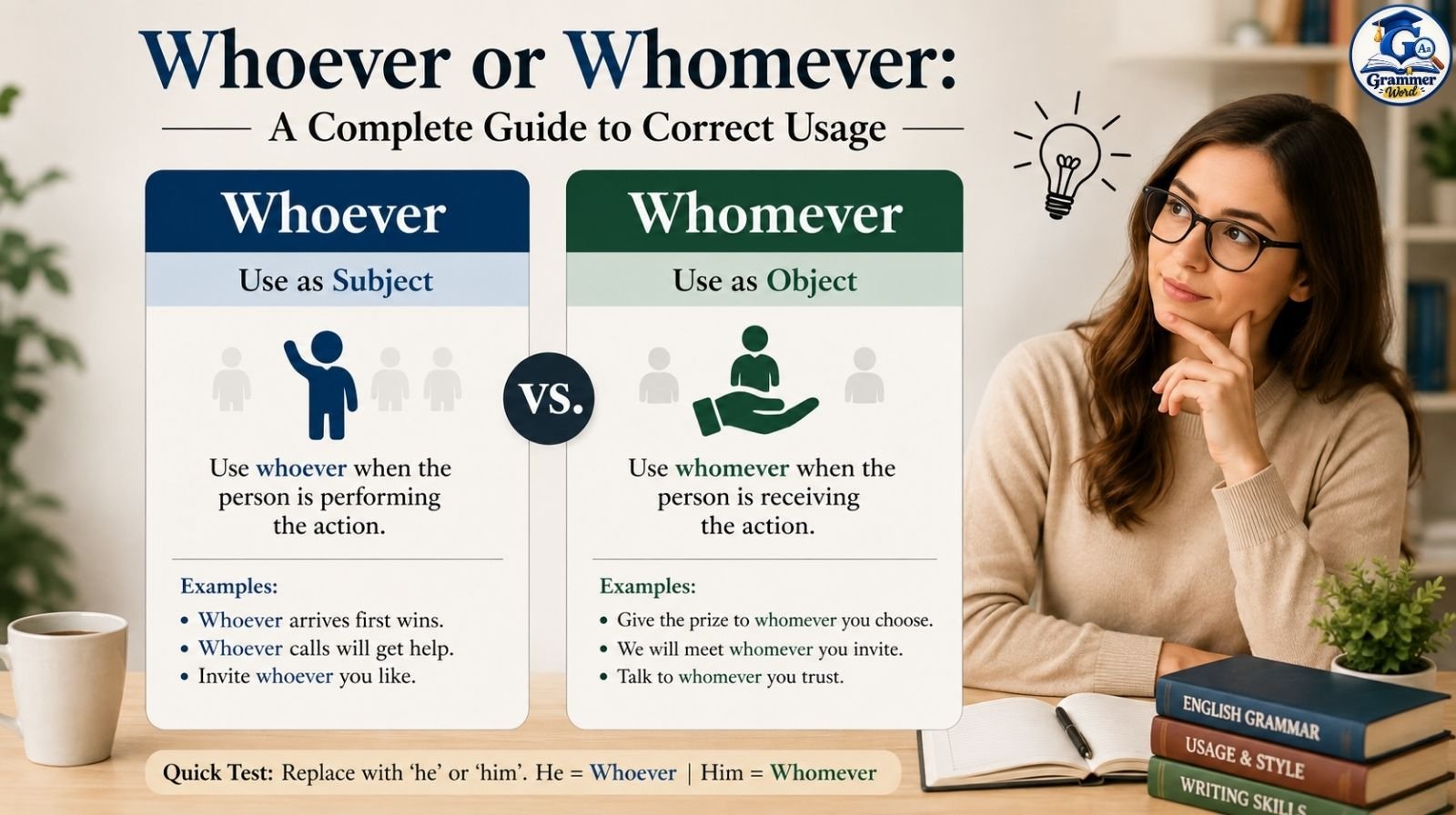
The simplest rule is this: whoever generally functions as a subject, while whomever functions as an object in formal English. However, when these words introduce a clause, you need to examine the grammar inside that clause, not simply the word immediately before it.
This guide explains whoever vs. whomever in plain English, with practical examples, a quick comparison, common mistakes, and a simple test you can use whenever you are unsure.
Read More: Midday vs Mid Day: Which Spelling Is Correct In Modern English?
Whoever vs. Whomever: What Is the Difference?
The difference between whoever and whomever is essentially the same as the difference between who and whom.
Whoever is the subjective form, while whomever is the objective form in formal usage. Cambridge describes whomever as the formal form of whoever when it is used as an object. It also notes that whoever is more common in informal speech and writing.
Whoever Is the Subject
Use whoever when the person is performing the action.
For example:
- Whoever arrives first can choose a seat.
- Whoever wins will receive the prize.
- Whoever called left no message.
- Invite whoever wants to participate.
In each sentence, whoever is connected to the person performing an action.
For example, in “Whoever wins will receive the prize,” the person represented by whoever is the one who wins.
Whomever Is the Object
Use whomever when the person is receiving an action or is the object of a preposition in formal English.
Examples:
- Give the documents to whomever you choose.
- We will interview whomever the manager recommends.
- She spoke with whomever she trusted.
- Choose whomever you prefer.
Cambridge specifically gives the example “Give it to whomever you please” to illustrate the objective use.
However, there is an important complication: the word directly before whoever or whomever does not always determine the answer. You must look at the grammatical role of the pronoun inside its own clause.
How to Choose Whoever or Whomever
The easiest way to choose between the two is to examine the clause that follows the word.
Use the “He or Him” Test
A useful traditional test is to replace whoever/whomever with he/him.
- If he sounds correct → use whoever.
- If him sounds correct → use whomever.
Consider:
Whoever arrives first gets the tickets.
Replace whoever with he:
He arrives first.
That works, so whoever is correct.
Now consider:
Give the ticket to whomever you choose.
Inside the clause, the implied structure is:
You choose him.
Because him is the object of choose, whomever is appropriate in formal grammar.
Look Inside the Clause
This is the most important rule when learning whoever vs. whomever.
Consider:
I will support whoever wins.
At first glance, support is a verb that takes an object, so you might think whomever must be correct.
But that would be a mistake.
The clause is:
whoever wins
Within that clause, whoever is the subject of wins.
Therefore:
I will support whoever wins.
is the traditional formal choice.
Compare that with:
I will support whomever the committee selects.
Here, the committee selects him. Therefore, whomever is the object of selects.
Whoever or Whomever After a Preposition
Prepositions often make this distinction easier.
Examples:
- Give the award to whomever you select.
- Speak with whomever you trust.
- Send the email to whomever is responsible.
But notice the last sentence.
Send the email to whomever is responsible.
Although to normally takes an object, whomever is the subject of the clause whoever is responsible. In modern English, many writers would naturally use whoever here.
This is one reason the traditional rule can feel complicated. Cambridge notes that whomever is more common immediately after prepositions, while whoever is more common in informal usage.
Common Whoever and Whomever Mistakes
Many errors happen because writers try to apply a simple “after a preposition, always use whomever” rule.
Mistake: “To Whomever Is Available”
A very formal writer might produce:
Please give this form to whomever is available.
But the clause is:
whoever is available
The person represented by the pronoun is the subject of is.
A clearer modern version is:
Please give this form to whoever is available.
This follows the grammatical role inside the clause.
Mistake: “Whomever Wins”
Another common error is:
Whomever wins the competition gets the scholarship.
The correct formal construction is:
Whoever wins the competition gets the scholarship.
Why? Because the person is performing the action wins.
You can test it with he:
He wins the competition.
Therefore, whoever is appropriate.
Mistake: “Whoever You Choose” in Formal Objective Use
Consider:
You can invite whoever you choose.
In everyday modern English, this sentence is completely natural and widely used. In especially formal writing, however, whomever may be chosen because the person is the object of choose:
You can invite whomever you choose.
Cambridge notes that whoever is more common in informal speech and writing, while whomever is associated with formal usage.
Whoever or Whomever: Quick Comparison
| Feature | Whoever | Whomever |
|---|---|---|
| Grammatical role | Subject | Object |
| Related form | Who | Whom |
| Formality | Neutral/common | More formal |
| Example | Whoever calls can leave a message. | Call whomever you trust. |
| Common in conversation | Yes | Less common |
| Common after prepositions | Sometimes | More formal choice |
| Main test | He | Him |
The key is not simply where the word appears. Look at what role it plays in its own clause.
A Simple Step-by-Step Guide
When you are unsure whether to use whoever or whomever, follow these steps.
Step 1: Find the Clause
Look at the words connected to whoever/whomever.
Example:
I will hire whoever/whomever the director recommends.
The relevant clause is:
the director recommends ___
Read More: This Is She or This Is Her? The Correct Way To Answer The Phone
Step 2: Find the Verb
The verb is recommends.
Ask:
The director recommends him.
Because the pronoun is the object of recommends, the formal choice is:
I will hire whomever the director recommends.
Step 3: Try “He” or “Him”
Use the substitution test:
- He → whoever
- Him → whomever
For example:
Whoever finishes first wins.
→ He finishes first.
So use whoever.
Another:
We will select whomever you nominate.
→ You nominate him.
So whomever works in formal English.
Step 4: Consider Your Audience
If you are writing a formal legal, academic, business, or highly edited document, maintaining the traditional distinction can be useful.
In everyday conversation, however, whoever is often the more natural choice. Cambridge explicitly notes that whoever is more common in informal speech and writing.
A Real-Life Example: Choosing the Right Word at Work
Imagine a company is hiring a new project manager. During a meeting, the team leader says:
“We will interview whoever applies before Friday.”
This sentence is natural and grammatically straightforward. The people represented by whoever are the ones who apply, so whoever functions as the subject of applies.
Later, the team leader says:
“We will hire whomever the interview panel recommends.”
This time, the structure changes. The interview panel performs the action recommends, and the person being recommended is the object.
The underlying structure is:
The panel recommends him or her.
Therefore, whomever is the traditional formal choice.
Now imagine another employee writes:
“Send the final contract to whomever is responsible for legal approval.”
Although to is a preposition, the clause whomever is responsible makes the pronoun the subject of is responsible. In modern usage, whoever is responsible is often the clearer choice.
This example shows why blindly applying “after a preposition, use whomever” can lead to awkward or incorrect constructions. The best approach is to examine the grammatical function of the pronoun within the clause. Cambridge similarly explains that whom is the object form of who and is mainly associated with formal styles and writing.
2025–2026 Usage Snapshot: Is Whomever Still Common?
Current dictionary evidence shows that the distinction remains recognized, but whomever is clearly the more formal and less conversational choice.
As of the current 2026 dictionary listings:
- Cambridge classifies whoever as a B2 pronoun and gives several everyday uses.
- Cambridge labels whomever as formal.
- Cambridge’s American Dictionary note says whoever is more often used in informal speech and writing.
- The same source notes that whomever occurs more often immediately after prepositions than in other positions.
That is useful practical data for modern writers: the traditional distinction has not disappeared, but whoever is the safer everyday choice when natural contemporary English is the goal.
Older corpus research also demonstrates that whomever has a relatively low frequency compared with more common pronouns, reinforcing the point that it is not an everyday conversational word. For example, one English-language corpus table reports 391 occurrences of whoever versus 11 of whomever in its cited 16-million-word corpus.
Important: that corpus is historical rather than a 2025–2026 live usage database, so it should not be presented as current-year frequency. The 2025–2026 takeaway comes from current dictionary usage labeling, not from pretending an old corpus is new data.
Read More: Patients vs Patient’s: Meaning, Difference, And Correct Usage
Whoever or Whomever in Modern English
Modern English is more flexible than many traditional grammar guides suggest.
Whoever Is Often the Natural Choice
In everyday English, people frequently use whoever in places where traditional grammar might recommend whomever.
For example:
Talk to whoever you need to talk to.
This sounds natural to most modern speakers.
Similarly:
Invite whoever you want.
is extremely common.
That does not mean the traditional distinction has become meaningless. Rather, usage and formality matter.
Whomever Still Has a Place
Whomever can be useful when you deliberately want a formal tone.
Examples include:
We will provide the information to whomever the committee appoints.
The award will be presented to whomever the judges select.
The manager may consult with whomever she considers qualified.
For formal business, academic, or legal writing, preserving the objective form can demonstrate careful grammatical control.
Sometimes Rewriting Is Best
If whoever vs. whomever makes a sentence feel awkward, rewrite it.
Instead of:
Send the document to whoever is responsible.
You could write:
Send the document to the person responsible.
Instead of:
Give the information to whomever you choose.
You could write:
Give the information to the person you choose.
A clear sentence is often better than a sentence that sounds artificially formal.
Mini Quizzes
1. Quick Pick: “Whoever” or “Whomever”?
_____ arrives first can choose a seat.
A) Whoever
B) Whomever
Answer: Whoever the person is the subject of “arrives.”
2. The Easy One
Give the prize to _____ you choose.
A) whoever
B) whomever
Answer: Whomever in formal English, the person is the object of “choose.”
3. Spot the Subject
_____ wins the race gets the trophy.
A) Whoever
B) Whomever
Answer: Whoever the person performs the action “wins.”
4. Trust Your Grammar
Talk to _____ you trust.
A) whoever
B) whomever
Answer: Whomever in formal usage, the person is the object of “trust.”
5. Which Sounds Right?
_____ calls first will get the information.
A) Whoever
B) Whomever
Answer: Whoever “whoever” is the subject of “calls.”
6. Try the He/Him Trick
If “He wins” sounds correct, which word should you use?
A) Whoever
B) Whomever
Answer: Whoever “whoever” matches the subject form “he.”
7. Now Try Him
If “You choose him” is the correct structure, which word fits?
A) Whoever
B) Whomever
Answer: Whomever “whomever” corresponds to the object form “him.”
8. Fill the Gap
Invite _____ you want to join us.
A) whoever
B) whomever
Answer: Whoever is very common and natural in modern everyday English; “whomever” is also used in formal grammar when treated as the object of “want to invite.”
9. Find the Winner
_____ finishes the task first can leave early.
A) Whoever
B) Whomever
Answer: Whoever the pronoun is the subject of “finishes.”
Read More: Possum or Opossum: What’s The Correct Spelling And Usage?
10. Formal English Check
We will select _____ the committee recommends.
A) whoever
B) whomever
Answer: Whomever the committee recommends that person, making the pronoun the object of “recommends.”
11. Don’t Let “To” Fool You
Send the message to _____ is responsible.
A) whoever
B) whomever
Answer: Whoever “whoever” is the subject of “is responsible.”
12. Which One Is More Formal?
Which word is generally considered more formal?
A) Whoever
B) Whomever
Answer: Whomever it is the formal objective form.
13. Everyday English
Which word is generally more common in informal speech and writing?
A) Whoever
B) Whomever
Answer: Whoever modern everyday English commonly favors “whoever.”
14. The Golden Rule
Complete the rule:
Whoever = _____
A) Subject
B) Object
Answer: Subject use “whoever” when it functions as the subject of its clause.
15. Final Grammar Challenge
Complete the rule:
Whomever = _____ in formal English
A) Subject
B) Object
Answer: Object “whomever” is traditionally used for the objective form.
Quick memory trick:
👉 Whoever = he
👉 Whomever = him
That one little trick can save you from most whoever vs. whomever mistakes.
FAQs
Q. Is whoever or whomever correct?
A: Both are correct, but they have different grammatical functions. Whoever is traditionally the subjective form, while whomever is the objective form in formal English.
Q. Is it “whoever you choose” or “whomever you choose”?
A: Both can be encountered in modern English. In traditional formal grammar, “whomever you choose” is preferred because the person is the object of choose. In everyday English, “whoever you choose” is very common. Cambridge notes that whoever is more common in informal speech and writing.
Q. Is it “whoever wins” or “whomever wins”?
A: Use “whoever wins.”
The pronoun is the subject of wins:
Whoever wins will receive the prize.
Q. Is “to whoever” grammatically correct?
A: It can be correct, particularly when whoever is the subject of the clause that follows.
For example:
Give this to whoever is waiting outside.
In the clause whoever is waiting, whoever is the subject of is waiting.
Q. Is whomever outdated?
A: No. Whomever is still a recognized English word, but it is formal and considerably less common in everyday language. Cambridge explicitly labels it formal.
Q. What is the easiest way to remember whoever vs. whomever?
A: Use the he/him test:
- He → whoever
- Him → whomever
For example:
Whoever called?
→ He called.
Therefore, whoever.
Speak to whomever you trust.
→ You trust him.
Therefore, whomever in formal usage.
Conclusion: Whoever or Whomever?
The difference between whoever or whomever becomes much easier once you stop looking only at the words immediately before the pronoun.
Remember the core rule:
Whoever = subject
Whomever = object in formal English
When a clause follows the pronoun, check the grammatical role inside that clause. The simple he/him test can help you make the decision quickly.
For everyday English, whoever is often the more natural choice. For formal writing, whomever remains useful when the pronoun functions as an object. Current Cambridge guidance confirms both the traditional distinction and the stronger modern preference for whoever in informal usage.
If you are editing an important email, essay, business document, or website, take a few seconds to apply the he/him test before publishing. That small check can make your writing more precise, natural, and polished.
Authoritative References
Keep learning with more easy grammar lessons on Grammer Word.com

Hi, I’m Noor Fatima, the person behind this website. I created this site to make English grammar and confusing words easier to understand. I love breaking down tricky words, meanings, spellings, and grammar rules into simple explanations. My goal is to help you learn English naturally, avoid common mistakes, and feel more confident every time you write or speak.