If you have ever wondered whether girlie or girly is the correct spelling, you are not alone. The two words sound almost identical, and both appear in dictionaries and everyday English. However, they are not always used in exactly the same way.
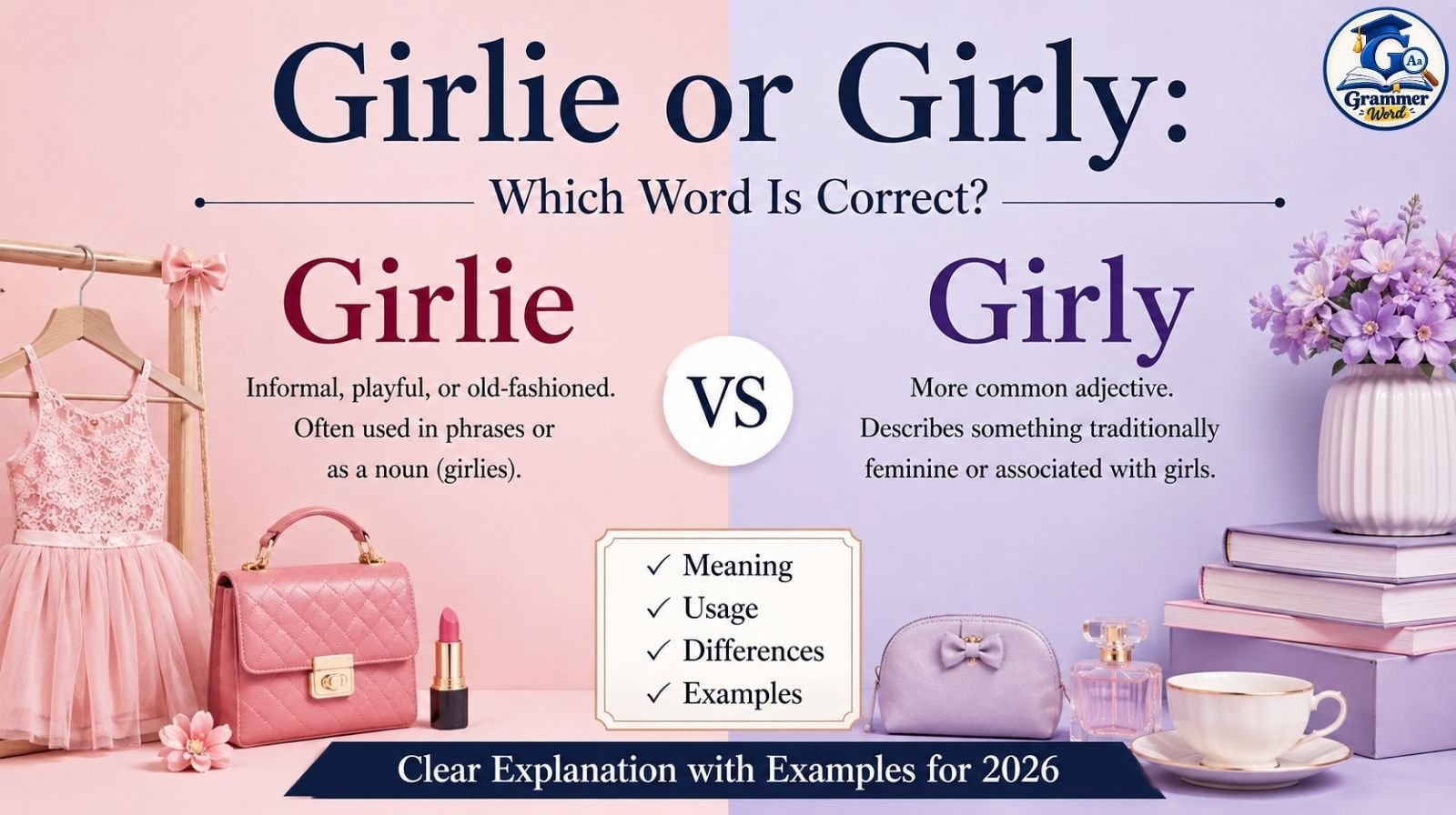
Girly is generally the better choice when you need an adjective describing something traditionally associated with girls or women. Girlie is also a real English word, but it can feel more informal, playful, old-fashioned, or context-specific.
In this guide, we will explain girlie vs. girly, their meanings, differences, examples, grammar, modern usage, and when to choose each form in 2026.
Girlie or Girly: Which Word Is Correct?
The short answer is: both “girly” and “girlie” are legitimate English words, but “girly” is usually the safer choice for modern adjective use.
Oxford lists girly as an informal adjective and explicitly gives girlie as an alternative spelling. Cambridge likewise defines girly as an adjective and notes girlie as an alternative form.
When should you use “girly”?
Use girly when describing something considered traditionally feminine or associated with girls.
Examples:
- She loves girly clothes.
- The room has a very girly design.
- Pink is often considered a girly color.
- She prefers a girly aesthetic.
- The party had a fun and girly atmosphere.
For most ordinary writing, girly is the clearest and most natural option.
When can you use “girlie”?
Girlie can also describe something associated with girls or women, particularly in informal contexts.
Examples:
- She bought a girlie dress.
- We had a girlie weekend.
- They planned a girlie night out.
- The room has a playful, girlie style.
Cambridge specifically gives examples such as “girlie chat” and “girlie weekend,” while Oxford identifies girlie as an alternative form of girly.
Bottom line: If you are unsure, choose girly for normal modern adjective use.
Read More: Midday vs Mid Day: Which Spelling Is Correct In Modern English?
What Does “Girly” Mean?
Girly is an informal adjective meaning associated with girls or women, or considered traditionally feminine.
It can describe clothing, colors, behavior, interests, designs, styles, hobbies, or aesthetics.
Girly meaning in simple English
In simple terms:
Girly = traditionally feminine, or associated with girls or women.
For example:
- girly dress = a dress considered traditionally feminine
- girly room = a room decorated in a traditionally feminine style
- girly hairstyle = a hairstyle perceived as feminine
- girly colors = colors traditionally associated with girls
Cambridge defines girly as involving or being considered typical of women or girls. It also notes that the word can sometimes carry a disapproving tone depending on context.
Examples of “girly” in sentences
Here are some natural examples:
- She chose a girly pink dress for the party.
- My sister has always loved girly accessories.
- The bedroom has a soft, girly design.
- She thinks floral patterns are too girly for her taste.
- The brand has a cute and girly aesthetic.
“Girly” does not always mean childish
This is an important distinction.
Although girly can sometimes suggest youthfulness, it does not automatically mean childish. The exact meaning depends on the noun and context.
Compare:
- girly dress → traditionally feminine dress
- girly voice → voice perceived as feminine or youthful
- girly aesthetic → feminine visual style
- girly behavior → behavior stereotypically associated with girls
Oxford notes that girly can sometimes be used disapprovingly and can describe something considered suitable for or typical of girls rather than boys.
What Does “Girlie” Mean?
Girlie is a genuine English word and is not simply a spelling mistake.
Major dictionaries recognize it as a variant of girly. However, its tone and meaning can vary considerably depending on context.
Girlie meaning in modern English
In everyday informal English, girlie can mean something traditionally associated with girls or women.
For example:
- girlie clothes
- girlie weekend
- girlie chat
- girlie style
Cambridge lists girlie alongside girly and provides examples involving informal expressions such as “girlie chat” and “girlie weekend.”
“Girlie” can also be a noun
This is one of the biggest differences between the two words.
In informal language, girlie can refer to a girl or woman. Oxford labels this noun use informal and often offensive, while Collins also notes that referring to women as girlies can be considered offensive.
For example:
“The girlies are meeting for coffee.”
In contemporary social-media language, girlies can also be used playfully among friends, but the tone depends heavily on who is saying it and who is being addressed.
Therefore, it is better not to assume that girlie is always interchangeable with girly.
Girly vs. Girlie: Key Differences
Although the words overlap, their usage is not identical.
Girly vs. girlie in grammar
The simplest distinction is:
| Feature | Girly | Girlie |
|---|---|---|
| Common adjective | Yes | Yes |
| Dictionary-recognized | Yes | Yes |
| Meaning “feminine” | Yes | Yes |
| Informal | Yes | Yes |
| Common modern adjective choice | Very common | Less neutral |
| Can be a noun | Yes, informal | Yes, informal |
| Social-media slang | Common | Very common in some expressions |
| Can sound old-fashioned | Less often | More often |
| Best default choice | Yes | Use when context calls for it |
Dictionaries support the important point here: girlie is not simply “wrong.” Merriam-Webster lists girlie with girly as a variant, while Oxford and Cambridge also recognize the relationship between the two forms.
Which spelling is better for formal writing?
For most professional, academic, informational, and general-purpose writing, girly is the safer choice.
However, even girly is informal. If you are writing a formal academic paper, a more precise word such as feminine, girlish, or traditionally feminine may be better.
For example:
Casual:
She has a very girly style.
More formal:
She has a traditionally feminine style.
Oxford separately defines girlish as meaning “like a girl” or “of a girl,” making it a useful alternative when a more descriptive or formal tone is appropriate.
Girlie or Girly Examples You Can Actually Use
Understanding the difference becomes easier when you see the words in real sentences.
Examples with “girly”
Here are common natural uses:
- She bought a girly pink handbag.
- That dress looks really girly.
- Her room has a cute, girly theme.
- I don’t usually wear girly clothes.
- The website uses a soft and girly color palette.
- She loves everything from floral prints to girly accessories.
Examples with “girlie”
These examples show informal or stylistic usage:
- We’re having a girlie weekend.
- Let’s have a girlie chat.
- She chose a girlie dress for the event.
- The decorations have a very girlie feel.
- The girlies are going out tonight.
Notice something important: “girly” and “girlie” can overlap when they function as adjectives, but “girlie” has additional informal noun and stylistic uses.
Common phrases with “girly”
Some natural combinations include:
- girly girl
- girly clothes
- girly style
- girly aesthetic
- girly outfit
- girly room
- girly colors
- girly hairstyle
- girly accessories
- girly things
Common phrases with “girlie”
Common informal combinations include:
- girlie chat
- girlie weekend
- girlie night
- girlie dress
- the girlies
- beauty girlie
- book girlie
- fitness girlie
The last group illustrates how girlie has developed a noticeable informal/social-media identity beyond its traditional adjective use.
Real-Life Usage Case Study: Why “Girlie” Feels Different in 2026
Consider a social-media creator who posts a picture of a pink outfit with the caption:
“Feeling extra girly today!”
Here, girly works naturally as an adjective. It describes the creator’s appearance, style, or mood.
Now imagine the same creator writes:
“The girlies are going shopping!”
Here, girlies is functioning as a noun. It refers informally to a group of girls or women.
The difference is subtle but important.
The first sentence describes a quality or style. The second identifies a group of people.
This distinction helps explain why simply saying “girly is correct and girlie is incorrect” is misleading. Major dictionaries recognize both forms, and contemporary usage gives girlie additional informal roles. Merriam-Webster’s current entry, for example, treats girlie as a variant of girly and includes recent examples showing the word in contemporary publications.
There is also an important historical dimension. Dictionary.com dates girlie to the early 1940s in its etymology, while Merriam-Webster records an earlier first-known use of girlie in 1857.
So, if you see girlie in a modern social-media post, do not automatically assume the writer made a spelling error. The word has a legitimate history and continues to be used today although the intended tone and grammatical role matter.
What Does Current 2025–2026 Evidence Tell Us?
There is an important difference between dictionary evidence and search-volume claims.
As of 2026, major dictionaries continue to recognize both spellings. Cambridge identifies girlie as an alternative form of girly, Oxford does the same, and Merriam-Webster lists girlie with girly as a variant.
2025–2026 usage snapshot
Recent dictionary examples also show that both forms remain active in contemporary English. Merriam-Webster’s current entry includes examples from publications dated in 2025, including uses of both girlie and girly.
Dictionary.com similarly includes recent 2025–2026 examples of girlie, including expressions such as “pop girlie” and “protest girlie.”
This tells us something useful:
The spelling “girlie” has not disappeared. Instead, modern informal language has given it some distinctive uses, especially as a playful noun or label.
At the same time, dictionary definitions continue to treat girly as the straightforward adjective for something considered typical of girls or women.
SEO/editorial takeaway: If your goal is clear, general-purpose English, use girly as your default adjective. If you are reproducing an informal phrase, social-media expression, nickname, or established expression, girlie may be exactly right.
How to Choose Between Girly and Girlie
Use this quick decision guide whenever you are unsure.
Step 1: Are you describing something?
If yes, girly is usually your best choice.
Example:
She bought a girly dress.
Step 2: Are you writing a playful or informal expression?
If yes, girlie may work naturally.
Example:
We’re having a girlie weekend.
Step 3: Are you referring to people?
If girlie is being used as a noun, be careful with tone.
Example:
The girlies are meeting later.
This can sound friendly and playful among peers, but calling women girlies in other situations may sound patronizing or offensive. Oxford and Collins both flag concerns around some noun uses.
Step 4: Is the writing formal?
If the context is professional or academic, consider girly only if the concept itself is appropriate. Otherwise, a more precise term such as feminine, girlish, or traditionally feminine may communicate your meaning better.
Common Mistakes With Girly and Girlie
Mistake 1: Thinking “girlie” is always wrong
It isn’t.
Both major dictionaries and current dictionary entries recognize girlie as an English word or variant.
Mistake 2: Assuming both forms have exactly the same tone
They don’t always.
Girly generally feels more neutral as an adjective.
Girlie can feel more playful, informal, old-fashioned, or stylistically marked depending on the sentence.
Mistake 3: Using “girly” when “girlish” is more precise
Compare:
She gave a girly laugh.
with:
She gave a girlish laugh.
Both can work, but girlish may be more appropriate when you specifically mean a quality resembling that of a girl rather than a stereotypically feminine style.
Mistake 4: Ignoring context
Words do not exist in isolation.
For example:
girly aesthetic
sounds natural.
But:
girlies aesthetic
is incorrect if you simply mean an aesthetic associated with girls.
Likewise:
The girlies are here.
uses girlies as a noun, not as an adjective.
1. Quick Pick: Which One Is Usually the Safer Choice?
Which word is generally the better default adjective in modern English?
A) Girlie
B) Girly
C) Girlies
D) Girl
Answer: B) Girly
Why: Girly is generally the safer, more neutral choice when describing something traditionally associated with girls or women.
2. Is “Girlie” a Real Word?
True or false: “Girlie” is simply a spelling mistake.
A) True
B) False
C) Only in British English
D) Only online
Answer: B) False
Why: Girlie is a recognized English word and a variant of girly. Its use can be more informal or playful.
3. Pick the Natural Sentence
Which sentence uses “girly” naturally?
A) She has a girly style.
B) She has a girlies style.
C) She has a girlying style.
D) She has a girls style.
Answer: A) She has a girly style.
Why: Girly works naturally as an adjective describing a style.
4. Spot the Informal Phrase
Which phrase sounds naturally informal?
A) Girlie weekend
B) Girlying weekend
C) Girl weekendly
D) Girlness weekend
Answer: A) Girlie weekend
Why: Girlie weekend is an established informal expression for a fun or social weekend with female friends.
5. What Does “Girly” Usually Mean?
What is the closest meaning of “girly”?
A) Traditionally feminine
B) Extremely serious
C) Professionally trained
D) Completely formal
Answer: A) Traditionally feminine
Why: Girly commonly describes something considered traditionally associated with girls or femininity.
6. Which One Is a Noun?
In which sentence is “girlies” being used as a noun?
A) She bought a girly dress.
B) The girlies are going out tonight.
C) She likes girly colors.
D) That room looks girly.
Answer: B) The girlies are going out tonight.
Why: Here, girlies refers to a group of girls or women, so it functions as a noun.
7. Girly or Girlie?
You are describing a traditionally feminine room. Which sounds most natural?
A) A girly room
B) A girlied room
C) A girlies room
D) A girl room
Answer: A) A girly room
Why: Girly naturally works as an adjective before room.
8. Which Word Can Sound More Playful?
Which form can have a particularly playful or informal feel?
A) Girlie
B) Formal
C) Girlishly
D) Feminine
Answer: A) Girlie
Why: Girlie can sound playful, casual, stylistic, or informal depending on the context.
9. Choose the Better Formal Alternative
If you want a more formal alternative to “girly style,” which could work best?
A) Traditionally feminine style
B) Girl style
C) Girlie-ish style
D) Girlyness style
Answer: A) Traditionally feminine style
Why: Traditionally feminine is more precise and formal than the informal adjective girly.
10. Complete the Sentence
“She loves ______ accessories.”
A) girly
B) girlies
C) girlied
D) girling
Answer: A) girly
Why: Girly is the adjective that naturally describes the accessories.
11. Which Spelling Is Recognized by Dictionaries?
Which statement is correct?
A) Only girly exists
B) Only girlie exists
C) Both girly and girlie are recognized
D) Neither word is English
Answer: C) Both girly and girlie are recognized
Why: Major English dictionaries recognize both forms, although their usage and tone can differ.
12. What Does “Girlish” Mean?
Which meaning best matches “girlish”?
A) Like a girl
B) Like a company
C) Like a building
D) Like a profession
Answer: A) Like a girl
Why: Girlish describes something resembling or characteristic of a girl.
13. Pick the Best Caption
Which caption sounds natural for someone describing a feminine outfit?
A) Feeling extra girly today!
B) Feeling extra girlied today!
C) Feeling extra girl today!
D) Feeling extra girliness today!
Answer: A) Feeling extra girly today!
Why: Girly naturally works as an adjective describing the person’s style or appearance.
14. When Should You Be Careful With “Girlies”?
Why can “girlies” need some context?
A) It can refer informally to women or girls
B) It is never a noun
C) It is always formal
D) It only describes clothing
Answer: A) It can refer informally to women or girls
Why: Girlies can be a playful informal noun, but the tone may not suit every audience or situation.
15. Final Challenge: What’s the Best Rule?
If you’re unsure which word to choose for ordinary adjective use, what is the best rule?
A) Always use girlie
B) Always avoid both
C) Use girly as the safer default
D) Use girlies instead
Answer: C) Use girly as the safer default
Why: Girly is generally the clearer, more neutral choice when you simply need an adjective.
FAQs
Q. Is “girly” or “girlie” correct?
A: Both are correct words, but girly is generally the better default adjective in modern English. Girlie is recognized as a variant and has additional informal uses.
Q. Is “girlie” a real word?
A: Yes. Girlie is a real English word listed by major dictionaries. It can function as an adjective and, in informal usage, as a noun.
Q. Is “girly” more correct than “girlie”?
A: Not exactly. It is more accurate to say that girly is usually the more neutral and safer choice for ordinary adjective use. Girlie is also legitimate, but its tone and usage can be more specific.
Q. Can I say “girly girl”?
A: Yes. Girly girl is a common expression referring to a girl or woman who strongly enjoys things traditionally associated with femininity.
Example:
She’s always been a girly girl who loves dresses and makeup.
Q. Is “girlie” formal English?
A: Generally, girlie is informal. It can be appropriate in casual conversations, social media, creative writing, and intentionally playful language. For formal writing, choose girly when appropriate or use a more precise formal synonym.
Q. What is the difference between “girly” and “girlish”?
A: Girly usually describes something considered traditionally feminine, while girlish means like a girl or characteristic of a girl.
For example:
- girly clothes → traditionally feminine clothes
- a girlish laugh → a laugh resembling that of a girl
Oxford defines girlish specifically as “like a girl” or “of a girl.”
Q. Which should I use in an SEO article: “girly” or “girlie”?
A: Use girly as the primary term when it naturally matches the search intent. However, you can discuss girlie throughout the article because users genuinely search for and use both forms.
The best SEO approach is not to force one spelling repeatedly. Google recommends creating helpful, people-first content and using words people would naturally use when searching.
Final Verdict:
So, girlie or girly which word is correct?
The answer is both, but they are not equally useful in every situation.
Choose “girly” when you need the standard, straightforward adjective for something traditionally associated with girls or women:
She has a girly style.
Choose “girlie” when the context is deliberately informal, playful, stylistic, or when girlie is functioning as a noun or appears in an established expression:
The girlies are going out tonight.
Major dictionaries confirm that girlie is not simply a spelling mistake. It is a recognized variant with its own usage patterns.
For most modern writing, however, girly is the safest default.
If this guide helped you settle the girlie vs. girly question, bookmark it or share it with someone else who keeps getting stuck on this surprisingly tricky spelling choice.
Keep learning with more easy grammar lessons on Grammer Word.com

Hi, I’m Noor Fatima, the person behind this website. I created this site to make English grammar and confusing words easier to understand. I love breaking down tricky words, meanings, spellings, and grammar rules into simple explanations. My goal is to help you learn English naturally, avoid common mistakes, and feel more confident every time you write or speak.